





Operation: Air test
Date: 25th June 1944 (Sunday)
Unit: No. 181 Squadron
Type: Typhoon Ib
Serial: MN814
Code: EL-?
Base: B6 Coulombs, Normandy, France (also RAF Hurn)
Location: Three Legged Cross, Dorset (near Ringwood, Hampshire)
Pilot: F/O. Ernest Emile Hursey, 50676, RAF, Age 25 - Killed
Update 09th November 2026 we are appealing to Patricia Meads or relatives to contact us. A local historian who lives near the crash site and years ago recovered a shilling from the crash scene. He would like to present it to the family. The local newsagent very kindly dedicated his shop window to a display of images to F/O. Hursey during Remembrance week in 2026. (shown below)
 Reason for Loss
During this period, 181 Squadron was based at the forward landing ground B6 at Coulombs, Normandy, France, having arrived on the 20th June.
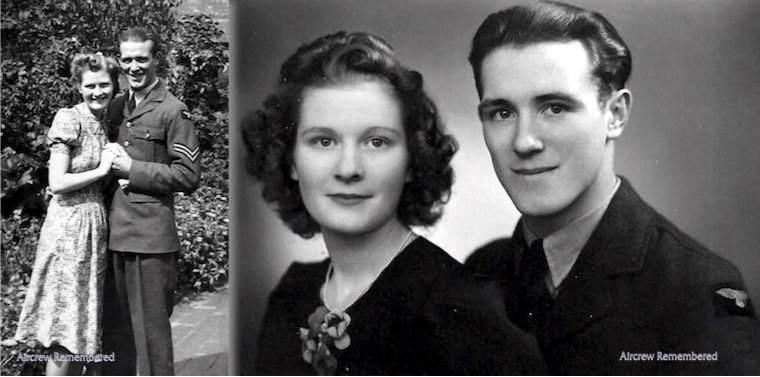
(The then Cpl. Ernest Emile Hursey prior to attaining his wings, with his wife probably taken around 1941 - courtesy Patricia Meads)
All but a couple of the Typhoons returned to RAF Hurn on the 22nd/23rd June to have the much-needed dust excluders fitted. During the day or so they were away, the base at B6 was constantly attacked by the Luftwaffe and by German artillery.
No details are available on the loss, but it is known that Typhoon MN814 spun into the ground near Ringwood (see map). We welcome any further information that others may have on this loss.
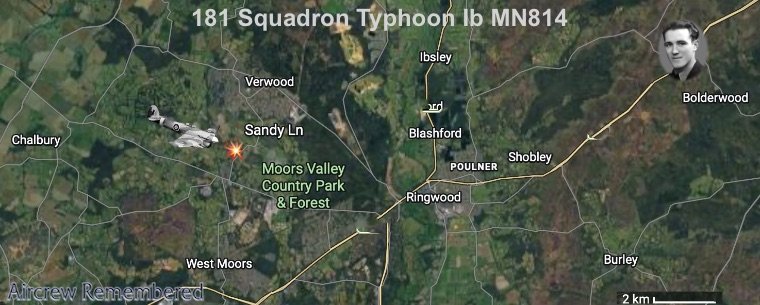 (Above: Map of the crash location)
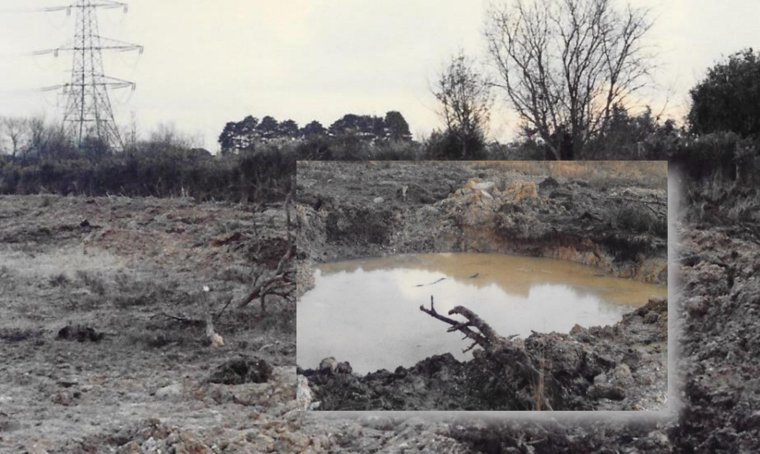 (Above and below: Crash site photographs (courtesy Brian Sharp)
 The above photographs, sent by Brian Sharp, show the actual crash site and the pieces left following the removal of the main parts. Brian lives in a house backing onto the site (between the electricity pylon and the row of trees). It is not currently known who carried out the recovery, what they recovered or where the recovered pieces are held. Can you assist with this?
In December 2014 an aviation researcher, Mr. Brian Sharp (who is building a model of this Typhoon), informed us that the actual co-ordinates of the loss were 50°51'41.00"N 1°53'19.53"W, which places it in the Sandy Lane area near Three Legged Cross. He also informs us that a recovery group excavated the area sometime in the 1970s. He is keen to identify the full squadron code for this Typhoon; if you are able to assist, please contact us.
 (Above: 181 aircrew in France, June 1944 (courtesy IWM))
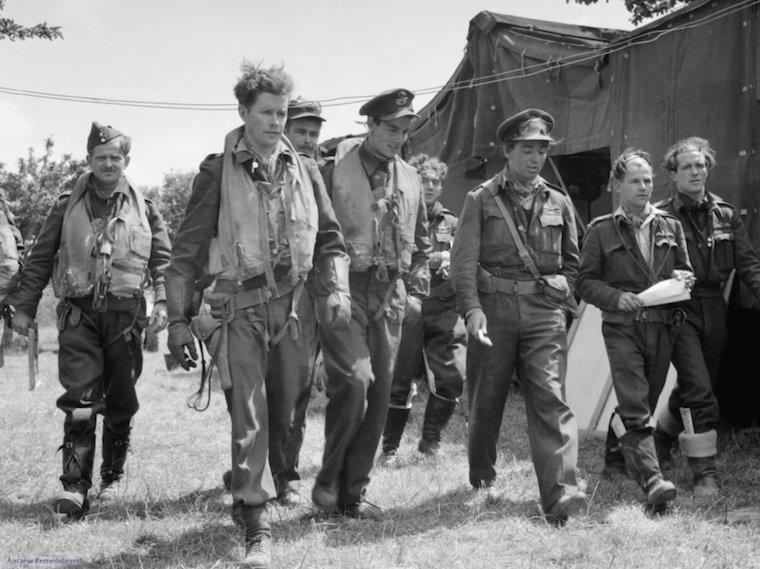 (Above: 181 aircrew in France, June 1944 (courtesy IWM). Second from the right has been identified as Flt Lt. James Kenneth Allison by his son, Glenn Allison.
Note: Flt Lt. Allison flew with 181 Squadron between the 6th February 1944 and the 6th July 1944. A note in his log book stated: "Jimmy Hursey dove straight in out of cloud doing an air test on 25-6-1944."
Tragically, the pilot had already lost almost his entire family before his own death. On the 27th July 1942, at about 06.00 hrs, a single Luftwaffe Dornier dropped two 250 kg bombs on the Royal Ordnance Factory at Rotherwas in Herefordshire.
One of the bombs went through the factory fence and hit the home of the factory's police chief, 48-year-old Chief Inspector Ernest James Hursey of the War Department Police, who was in charge of security at the factory. He was killed, along with his wife Bertha, aged 40, and F/O. Hursey's younger brother, Cpl. 1875001 Ronald Eric Hursey, aged 22, who was on leave from his Royal Engineers unit in Gibraltar.
Sadly, F/O. Hursey's wife, Vera Hursey (née Carter), aged 23, was also staying at the house with her mother, Florence Carter, aged 47; both were killed. The only survivor in the house was Ernest's youngest brother, 16-year-old Ken Hursey, who was at the rear of the police building.
In addition, some 17 people were killed at the factory, where the night shift was changing over to the day shift at the time. Some of the names that we have identified (in addition to the family already listed):
Ernest Henry Chesterman (Q.M.S., Home Guard), Age 58, of Sunnyside, Wellington.
Frederick James Dyke, Age 47, of 3 Henry Street, Ross-on-Wye.
William Garland MM, Age 45, of The Lodge, Vennwood, Bodenham.
Joseph Henry Giles, Age 47, of 14 Sydney Buildings, Poplar, London.
Edwin Gwilliam (Home Guard), Age 38, of Yew Tree Cottage, Christchurch, Coleford, Gloucestershire.
James John Shine, Age 33, of 5 Paynters Terrace, Merthyr Tydfil, Glamorgan.
Kathleen Blanche Wheeler, Age 31, of 72 Stonebow Road, Hereford.
Burial Details
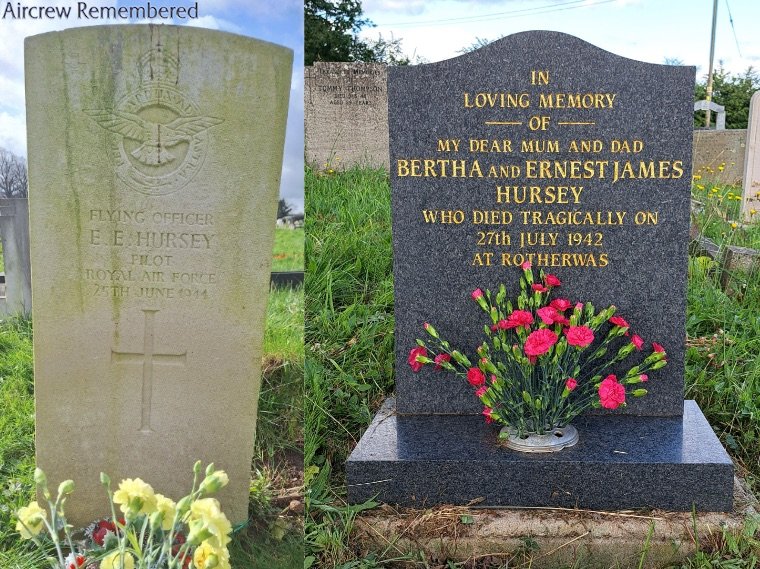 (Above: Grave of F/O. Ernest Emile Hursey and his parents' grave inscribed -"In loving memory of my dear mum and dad, Bertha and Ernest James Hursey, who died tragically on 27th July 1942 at Rotherwas.")
F/O. Ernest Emile Hursey. Hucknall Cemetery, Sec. D. Grave 524. Son of Ernest James Hursey (died 1942, age 48) and Bertha Hursey (died 1942, age 40). Husband of the late Vera Hursey (née Carter, killed with his parents on the 27th July 1942, age 23), of 14 Ladycroft Avenue, Hucknall, Nottinghamshire, England.
Researched following the webmaster's meeting with a relative of the pilot's family at his work. This page is dedicated to the relatives of the pilot and to the family of Vera Hursey (née Carter) and Florence Carter.
Sources and Acknowledgements
- Hereford Record Office
- Patricia Meads (photographs and further information),
- Linda Lagoe (grave photograph, September 2016),
- Tony Glover (age of pilot, December 2017).
- National Archives, Kew - AIR 27/1134 (181 Squadron Operations Record Book)
- Mr. Brian Sharp - crash site photographs and co-ordinates
- Glenn Allison - identification of his father and log book entry
- BBC News - "Man reflects on 1942 Rotherwas factory bomb tragedy", 27th July 2012
- Derrick Johnston - for drawing our attention to the BBC article
- Waterworks Museum, Hereford
- Imperial War Museum - photographs
- Commonwealth War Graves Commission - Civilian War Dead search exports (26th July to 1st September 1942; Hereford Municipal Borough; Ross and Whitchurch Rural District), and casualty records for Ernest Emile, Ernest James, Bertha, Vera and Ronald Eric Hursey, and Florence Carter
- John Edmonds, The History of Rotherwas Munitions Factory, Hereford (Logaston Press, 2004), as cited in published summaries
- Herefordshire Lore - photograph of the Royal Ordnance Factory, Rotherwas
- Herefordshire Lore - Age to Age Reminiscence Newsletter, Vol. 10, Issue 2, April 2002
- Bobbie Blackwell, Mrs T.J. Brown and David Lovelace - contributors to the newsletter
- US Library of Congress - Luftwaffe reconnaissance photograph
- Police Roll of Honour Trust - Ministry of Defence forces roll
- Nottinghamshire County Council Roll of Honour - Ernest Emile Hursey and Hucknall Cemetery
- Herefordshire History (Herefordshire Council) - Rotherwas photographic archive
- John Edmonds, The History of Rotherwas Munitions Factory, Hereford (Logaston Press, 2004), as cited in published summaries
- Waterworks Museum, Hereford
- Aircrew Remembered archive
SUPPLEMENT - Corrections and Further Information
A. Further information found

Rotherwas Royal Ordanance Factory
Ernest James Hursey. The CWGC records him as Chief Inspector, War Department Police, of Moorlands, Watery Lane, Lower Bullingham; son of William and Eliza Hursey of 21 Woodham Lane, New Haw, Addlestone, Surrey. He is also listed on the Police Roll of Honour (Ministry of Defence forces) as Ch/Insp Ernest James Hursey, died 27th July 1942, aged 48. Bertha, Vera and Florence Carter are all recorded as having died at Moorlands, and are commemorated by the CWGC in the Civilian War Dead roll under Ross and Whitchurch Rural District.
Cpl. Ronald Eric Hursey. Buried in Upper Bullinghope (St. Peter) Churchyard, Herefordshire, New Part, Row 2, Grave 7. His CWGC entry notes that his parents were killed in the same incident. Several of the factory victims were also buried at St Peter's, Bullinghope.
Total killed. Published accounts give between 16 and 24 killed in total; Wikipedia gives 22, which would agree with 17 at the factory plus the five at Moorlands. The CWGC records account for only 10 or 11 factory deaths and 5 at Moorlands (see Section C).
The raid itself. Local accounts state that the factory relied mainly on camouflage, and that its only defence, a Lewis gun position, was unmanned that morning because the gun was under repair. The same accounts describe the bomber as a Dornier Do 17 flying very low, with the second bomb bouncing off concrete and over the perimeter onto the police chief's house. A claim that the bomber was later shot down by Spitfires from RAF Tern Hill appears only in forum posts and has not been verified, so it is not recommended for publication without a better source.
Further reading. John Edmonds, The History of Rotherwas Munitions Factory, Hereford (Logaston Press, 2004). The Waterworks Museum, Hereford, holds a permanent exhibition on the Rotherwas factory, including the 1942 air raid. Herefordshire History (herefordshirehistory.org.uk) holds photographs of several victims, including Kathleen Blanche Wheeler and David William Jenkins.
B. Casualties of the raid - CWGC Civilian War Dead records
Extracted from CWGC searches of Civilian War Dead (26th July to 1st September 1942, Hereford Municipal Borough and Ross and Whitchurch Rural District), plus separate CWGC records where noted.
Killed at Moorlands, Watery Lane, Lower Bullingham (5)
- Ernest James Hursey, Age 48. Chief Inspector, War Department Police. Son of William and Eliza Hursey, of 21 Woodham Lane, New Haw, Addlestone, Surrey; husband of Bertha Hursey.
- Bertha Hursey, Age 40. Wife of Ernest James Hursey.
- Cpl. 1875001 Ronald Eric Hursey, Age 22. Royal Engineers. Son of Ernest James and Bertha Hursey. Buried Upper Bullinghope (St. Peter) Churchyard, New Part, Row 2, Grave 7. (Separate CWGC military record.)
- Vera Hursey (née Carter), Age 23. Of 14 Ladycroft Avenue, Hucknall, Nottinghamshire. Daughter of George W. and Florence Carter; wife of Sgt. Ernest Hursey, RAF.
- Florence Carter, Age 47. Wife of George W. Carter, of 14 Ladycroft Avenue, Hucknall, Nottinghamshire.
Survivor: Ken Hursey, aged 16.
Killed at the Royal Ordnance Factory, Lower Bullingham
Recorded by the CWGC as "Died at Royal Ordnance Factory, Lower Bullingham" (commemorated Ross and Whitchurch Rural District):
- Ernest Henry Chesterman, Age 58. Q.M.S., Home Guard. Son of the late Henry and Jane Chesterman, of Bridge House, Wye Bridge; husband of E. M. Chesterman, of Sunnyside, Wellington.
- Frederick James Dyke, Age 47. Husband of Mabel Ellen Dyke, of 3 Henry Street, Ross-on-Wye.
- William Garland MM, Age 45. Husband of Rose Garland, of The Lodge, Vennwood, Bodenham.
- Joseph Henry Giles, Age 47. Of 14 Sydney Buildings, Poplar, London. Son of the late Benjamin and Mary Ann Giles, of 35 Bath Street, Poplar; husband of Alice Elizabeth Giles.
- Edwin Gwilliam, Age 38. Home Guard. Husband of Marjorie Gwilliam, of Yew Tree Cottage, Christchurch, Coleford, Gloucestershire.
- James John Shine, Age 33. Of 5 Paynters Terrace, Merthyr Tydfil, Glamorgan. Son of Cornelius and Julia Shine; husband of Lillian Shine.
- Kathleen Blanche Wheeler, Age 31. Of 72 Stonebow Road, Hereford. Daughter of the late Albert Henry and Alice Wheeler.
Injured at the factory and died later (commemorated Hereford Municipal Borough):
- David William Jenkins, Age 50. Foreman. Husband of Blodwyn Phillis Jenkins, of 46 Belmont Avenue, Hereford. Injured 27th July 1942 at the Royal Ordnance Factory; died 28th July 1942 at the General Hospital.
- Beatrice Mary Saunders, Age 22. Daughter of William Henry and Lizzie Saunders, of Walkers House, Shelwick. Injured 27th July 1942 at the Royal Ordnance Factory; died 31st July 1942 at the General Hospital.
- Frederick George Bull, Age 41. Husband of Isobel Lona Bull, of 37 Locton Street, Bow, London. Injured 27th July 1942 at the Royal Ordnance Factory; died 26th October 1944 at the General Hospital.
Probable, not confirmed:
- Daniel James Reginald Davies, Age 36. Of Notts Cottage, Old Road, Bromyard; husband of Kathleen Davies. Died 27th July 1942 at the General Hospital, Hereford. His record does not name the factory, but the date, place and CWGC record sequence strongly suggest he was a victim of the raid.

Note: The full CWGC Civilian War Dead lists for Hereford Municipal Borough (3113255-3113261) and Ross and Whitchurch Rural District (3113262-3113277) have now been checked. Every record in both runs has been accounted for except 3113272, which is not returned by either search and may be a withdrawn or merged record. The other numbers belong to unrelated deaths: Frank William Brooks (Hereford, 1943); Frederick Smith Raper and William Constantine Walton (the factory explosion of 30th May 1944); Alan Dower Blumlein, Frank Blythen and Cecil Oswald Browne (the Halifax radar test crash at Welsh Bicknor, 7th June 1942); and the Revd. Frank Reginald Easton (Llangrove, 7th July 1942). The CWGC therefore commemorates 10 factory victims of the raid (11 if Davies is included) and 5 at Moorlands, a total of 15 or 16. The higher totals of 17-24 quoted elsewhere cannot be matched to CWGC records; any further victims, such as Winifred Aulsebrook (buried at St Peter's, Bullinghope), may not have been registered by the CWGC as civilian war dead or may relate to another incident at the factory.
C. Ken Hursey's account - BBC News, 27th July 2012
Summary of "Man reflects on 1942 Rotherwas factory bomb tragedy", BBC News (Hereford & Worcester), published on the 70th anniversary of the raid. Brought to our attention by Derrick Johnston, a reader of this page. Full article: www.bbc.co.uk/news/uk-england-hereford-worcester-19001211
 (Above: The Hursey family before the tragedy - courtesy Ken Hursey)
Ken Hursey, the only survivor at Moorlands, was 86 when he spoke to the BBC. He recalled that the morning of the 27th July 1942 was "a lovely sunny morning". When the sirens sounded at about 6 o'clock, "in Hereford nobody took any notice". He saw the bomb bays open and two bombs fall. One landed among a row of sheds and exploded; the other struck the end shed nearest the house, some 200 to 300 yards away, and bounced "out of the factory area along the ground into our house".
He survived only because the family had visitors staying and the front bedrooms were taken, so he was sleeping at the back of the house, which he called "fate". He did not know whether he had been knocked unconscious, but remembered that everything was "so quiet" until he heard someone running down the road shouting "is there anybody about?" He was gradually dug out of the debris with only "a couple of little scratches". The house was later demolished.
Ken, an apprentice electrician who had left school at 14, went to live with his uncle, Bob Hursey, and his wife. He later joined the Fleet Air Arm, and in 1949 the police. In 2012 he had been married to Margaret for 67 years, and they had three children and four grandchildren. Ken died in February 2015 and Margaret in March 2016.
He described his parents as "great", saying they had met in France while his father was serving in the Army during the First World War, and that his mother, Bertha, was French. Asked about the German pilot, he said: "I can't bear any animosity against them. They were only doing their job, the same as my brother who was in the RAF."
New information from the article. Bertha Hursey was French and met Ernest James Hursey in France during the First World War, which probably explains her son's middle name, Emile. The family had a further relative, Bob Hursey, Ken's uncle.
Discrepancies with the official records. The article describes the parents as "both in their late 50s"; the CWGC gives their ages as 48 and 40. It says Ernest junior was "killed in action" about a year after the raid; he was in fact killed almost two years later, on the 25th June 1944, in a flying accident during an air test in England. The article repeats Herefordshire Lore's figure of 17 killed at the factory, against the 10 or 11 commemorated by the CWGC (Section C).
SUPPLEMENT - Herefordshire Lore: "It was all work and bed"... experiences at the ROF, Rotherwas

Source: Herefordshire Lore, Age to Age Reminiscence Newsletter, Vol. 10, Issue 2, April 2002.
In April 2002 the Herefordshire Lore reminiscence newsletter published a feature on the Royal Ordnance Factory at Rotherwas, which it described as having "always been shrouded in secrecy". By May 1944 the factory employed 2,700 people, 2,000 of them women.
The raid of 27th July 1942
A summary of the factory's wartime incidents, contributed by Bobbie Blackwell, describes the raid. Two 250 kg bombs were dropped. The first hit a transit shed, killing 19. The second "strikes a girder, is deflected through the shed door, across the factory floor to hit the Police Superintendent's house killing all but one of its occupants". A heavy machine gun in the centre of the factory was unmanned, its crew having stood down because of the lack of Luftwaffe activity in the area.
The newsletter names the following dead:
- Factory: Fred Bull, 41, Bow, London; David William Jenkins, 50, Belmont Avenue, Hereford (printed as "David Williams"); Beatrice Saunders, 22, Shelwick; Ernest Chesterman, 58, Wellington; Fred Dyke, 47, Ross; William Garland, 45, Bodenham; Joseph Giles, 47, Poplar, London; Edwin Gwilliam, 38, Coleford; James Shine, 33, Merthyr; Kathleen Wheeler, 31, Stonebow Road, Hereford.
- Moorlands, Lower Bullingham: Bertha Hursey, 40; Ernest Hursey, 48; Florence Carter, 47; Vera Hursey, 23.
These names match the Commonwealth War Graves Commission records exactly. Cpl. Ronald Eric Hursey is not listed, as he was a serviceman rather than a civilian.
A victim's daughter remembers
Mrs T.J. Brown of Coleford, daughter of Edwin Gwilliam, wrote that "for many years I could not understand why my father seemed to be the only one killed". Research by her brother-in-law, Harry Fox, found "a large number killed and many died from their injuries. Everything had been kept secret because of the war."
Luftwaffe reconnaissance photograph
 (Above: Luftwaffe reconnaissance photograph of ROF Rotherwas, 4th December 1940)
The feature included a Luftwaffe reconnaissance photograph of the factory dated 4th December 1940, obtained from the US Library of Congress and sent in by David Lovelace, who added: "They were probably disappointed by the cloud cover." It shows the site had been identified by the Luftwaffe some 18 months before the raid.
Notes
- The newsletter dates the raid to "June 27 1942"; the correct date is the 27th July 1942.
- "David Williams" is David William Jenkins, foreman, of 46 Belmont Avenue, Hereford (CWGC).
- The newsletter's figure of 19 killed in the transit shed cannot be matched to CWGC records, which commemorate 10 factory victims.
- Ken Hursey's 2012 account (BBC News) also describes the second bomb bouncing along the ground into the house.


