





Operation: Armed reconnaissance
Date: 14th July 1944 (Friday)
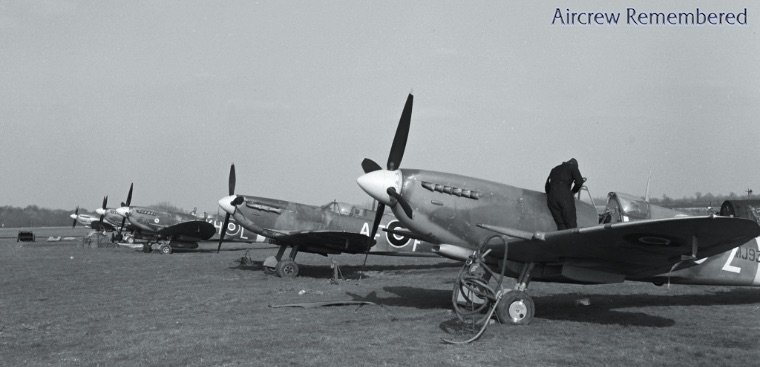
Unit: No. 403 (City of Calgary) Squadron, R.C.A.F. - motto: “Stalk and Strike”
Type: Spitfire LF Mk IX
Serial: MJ570
Base: RAF Bazenville (B.2), Normandy
Location: St. Lambert, Calvados, France, about four miles south-west of Thury-Harcourt
Pilot: F/O. Donald John Shapter, J/35505, RCAF Age 24 - Killed (1)
Reason for Loss
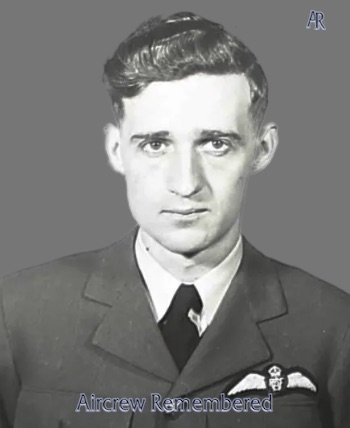
Shortly after noon on 14th July 1944, twelve Spitfires of No. 403 Squadron took off from Bazenville on an armed reconnaissance over the Falaise–Lisieux area, splitting into sections and spreading out to search for enemy movement. The four aircraft of Yellow Section, one of them flown by F/O Shapter, spotted a column of around thirty enemy vehicles - armoured cars, flak-gun vehicles, and trucks - moving through the small village of St. Lambert.
The Spitfires attacked, destroying the leading and trailing vehicles of the column, and were turning to begin a second pass when a half-track flak gun hidden beside a house in the village opened fire at point-blank range on Shapter's aircraft as it flew low overhead. He attempted to climb and find a place to put the Spitfire down, but it struck the top of a nearby hill and he was killed.
Villagers recovered his body from the wreckage, arranged a funeral, and buried him in the churchyard beside the local parish church. Local residents have tended his grave ever since, keeping it adorned with flowers to this day. This account was pieced together from eyewitness testimony and submitted to Aircrew Remembered by Jacques Grasset, who continues to look after the grave.
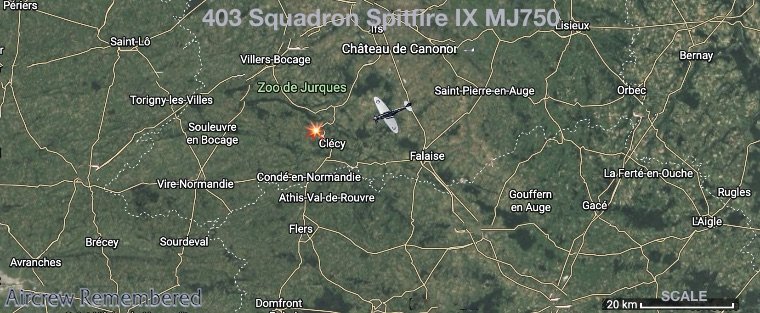 Over the course of the war, No. 403 Squadron built a formidable combat record. By May 1945 it had been credited with 123 enemy aircraft destroyed, a share in seven more, 10 probably destroyed, and 72 damaged (with a share in one further aircraft). Its pilots had also destroyed or damaged an impressive tally of ground targets, including some 30 tanks, 50 locomotives, and nearly 100 other vehicles.
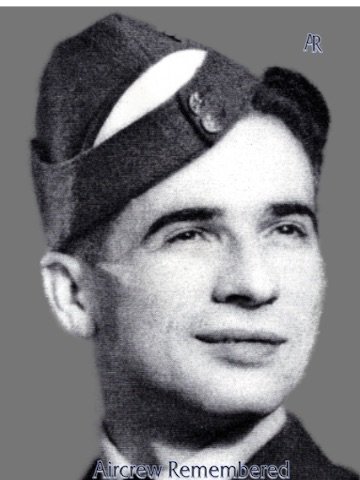
(1) F/O. Shapter's older brother had been killed two years earlier. W/O William J.A. “Aubrey” Shapter, R/78148, R.C.A.F., was flying as an observer with No. 207 Squadron aboard a Lancaster I, R5761 “EM-Y,” on a bombing operation to Essen on the night of 5th/6th August 1942. The aircraft was shot down by night-fighter ace Oblt. Kurt Loos of 1./NJG1 over Appeltern, the Netherlands, at 02:26 hrs. The pilot, Fl/Lt. Gerald Ings, and all seven of the crew were killed.
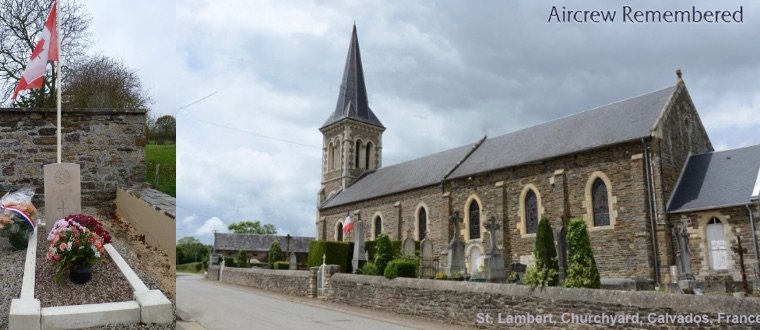 Burial Details
F/O. Donald John Shapter. St. Lambert Churchyard, Calvados, France. Born 19th October 1919. Educated to Junior and Senior Matriculation, attending Powassan Continuation School (1937–1938) before completing his Senior Matriculation at a University of Toronto school (1940–41). Before enlisting he worked as a student, taking summer jobs as a clerk in Powassan and North Bay, and as a camp guide.
Son of the Revd. Charles Percival Shapter (died 1971, aged 81, a United Church minister in Bracebridge, Ontario) and Margaret Mae Shapter (née Kerr, died 1973, aged 81). Husband of Elizabeth Jean Shapter (née Vining), of Toronto, Ontario, Canada, whom he married in Toronto on 21st September 1943. Father of Elizabeth Jean Shapter, born 27th June 1944 - just over two weeks before his death; he never saw his daughter, and she never saw her father.
Brother of Russel and Earl Shapter and of Mayme E. Shapter, among other siblings, and of W/O William J.A. “Aubrey” Shapter, killed in action on 6th August 1942 (see note 1, above).
His headstone bears the inscription: “In The Lord Is Their Reward And The Care Of Them Is With The Most High.”
 Training and Service
Shapter enlisted in the RCAF in Toronto on 27th June 1941. He completed his initial training at No. 1 Initial Training School, Toronto, between October and December 1941, passing with 77.4% in his ground examinations. His elementary flying training followed at No. 9 Elementary Flying Training School between December 1941 and February 1942, where he was assessed as an “average pilot” with an overall mark of 63%.
He went on to No. 6 Service Flying Training School at Dunnville between March and June 1942, where his progress was rated satisfactory, and he was awarded his pilot's flying badge on 19th June 1942. He was commissioned as a Pilot Officer on 9th September 1943.
His postings took him first to No. 126 (F) and No. 129 (F) Squadrons at Dartmouth, Nova Scotia, and later overseas to No. 61 Operational Training Unit and No. 1 Training and Engineering Unit, before he joined No. 403 Squadron, R.C.A.F. He held the final rank of Flying Officer, and was assessed medically fit for pilot duties (category A1B/A3B) throughout his service.
Supplement: Further Information
A number of additional details have come to light since the original loss report was compiled, and are recorded here for completeness.
Aircraft serial: Sources differ slightly on the serial of Shapter's Spitfire. Squadron records, the 127 Wing operational diary, and the CASPIR unit database all confirm the aircraft as MJ570, a Spitfire LF Mk IX on No. 403 Squadron's strength that month; an early version of this report cited “MJ750,” which appears to be a transcription error.
A family connection to the grave: Research into the St. Lambert crash site indicates that the grandfather of Jacques Grasset - the villager credited with the original eyewitness account - personally built Donald Shapter's coffin at the time of his burial in 1944, and lived in the house standing behind the churchyard. This appears to be the origin of the family's long connection to tending the grave.
“Missing” status and confirmation of death: Although villagers buried Shapter immediately after the crash, this was not known to Allied authorities at the time. RCAF records show he was officially listed as missing from 14th July 1944, and only formally presumed dead in a certificate issued in September 1945. It was not until 1946, after a Missing Research and Enquiry Unit investigated the area, that his grave at St. Lambert was located and confirmed to his family.
The village today: St. Lambert is a small commune in the Calvados department of Normandy, in the area known as Suisse Normande. Its population has remained modest since the war, numbering only a few hundred residents in recent censuses.
Sources and Acknowledgements
- RCAF Service Files
- Paradie-Dutil RCAF Archive
- Veterans Affairs Canada
- Aircrew Remembered Archives
- Jacques Grasset
- 127 Wing day-to-day diary (angels_eight archive)
- CASPIR Unit Display, 403 Squadron RCAF
- World War Two Cemeteries (ww2cemeteries.com) - St. Lambert Churchyard
- 403 Squadron Operations Record Book, RCAF Association


