





Operation: Training
Date: 2nd August 1945 (Thursday)
Time: 11:15
Unit: No. 309 Squadron (Polish)
Type: Mustang III
Serial: FX876
Code: WC-O
Base: RAF Andrews Field, Essex
Location: Oaksfield, Goulds Farm, Rayne, Essex
Pilot: W/O. Aleksander Pietrzak, 783147: Virtuti Militari, Krzyż Walecznych 2 Bars, Srebrny Krzyż Zasługi z Mieczami, Medal Lotniczy (x3), PAF. Age 30. Killed.
Aleksander Pietrzak - Polish fighter pilot – V1 ‘Ace’ – husband – father – the starting point for Aircrew Remembered. Additional details can be found in Sources and Acknowledgements section below.
We welcome any new information/photographs.
Reason for Loss
This pilot originally served with 302, 309 and 316 Polish Squadrons, carrying out escort duties and diver patrols against the incoming V1 flying bombs.
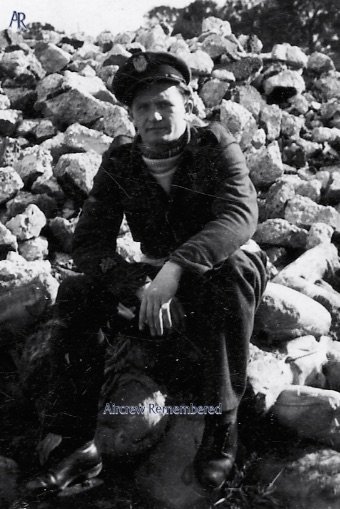
This is the brief account of a Polish fighter pilot who served with the Royal Air Force during the Second World War.
Prior to this he had served in the Polish Air Force, escaping via Romania to join the fight in France. We have no details of this period, although in 2010 we were contacted by a French family who had taken him in; they sent some remarkable photographs, which we have reproduced on following pages.
After the fall of France he escaped - again, we have no details of this - to England, where in January 1943 Sgt. Pietrzak began his retraining, flying Tiger Moths and Spitfires at 58 Operational Training Unit (OTU), Grangemouth, Scotland.
Following this he joined 302 Squadron. His war over England had begun.

Front row (Instructors): Fl/Sgt. Stefan Wojcik 783276, Fl/Sgt. Finney, P/O. Parker, P/O. Webster, P/O. Stanislaw Zajdel 783482 (Killed in flying accident, 19443), Fl/Sgt. Stanislaw Grondowski 782063 (killed in 1943).
Centre: Sgt. Alfred Krzysztof Wlodarski 781304 (Killed in flying accident, 1944), Sgt. Benner, Sgt. Gowers, Sgt. Taylor, Sgt. Luffman.
Rear row: Sgt. Józef Durys 782710 (died 2000), Sgt. Alek Pietrzak 783147 (Killed in flying accident, 1945), Fl/Sgt. Zbigniew Edward Urbańczyk. 781038 (died 1986)
Instruktorów Pilotażu - 58 O.T.U., Grangemouth .pdf
On 27th September 1943 he transferred to 316 Polish Squadron and flew on operations from February 1943 to March 1944, taking part in the defensive operations against the German V1 flying bombs. He joined 309 Squadron in February 1945.
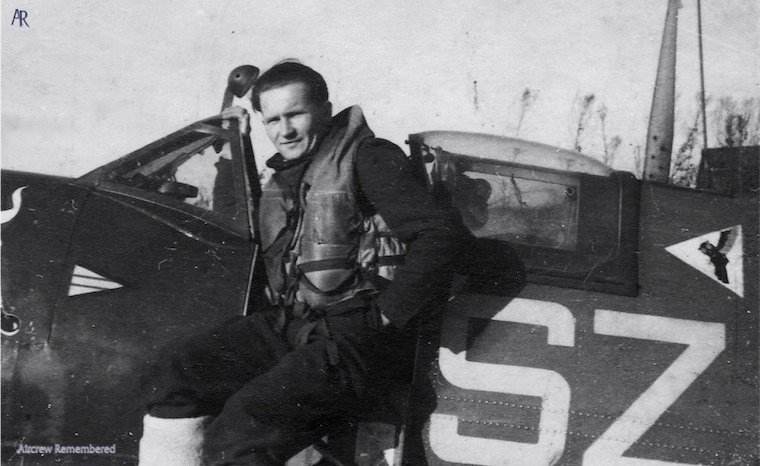 Aleksander Pietrzak's total flying time as pilot by day was 784 hours, of which 246 hours were in Mustang fighters. He became senior NCO pilot of the squadron stationed at Andrews Field and was highly thought of by his squadron commander. He had distinguished himself beyond the call of duty in the defence of this country during the V1 rocket attacks of 1944. He survived the air battles of the Second World War, only to tragically lose his life in a flying accident on 2nd August 1945 at Andrews Field.
 Whilst serving with 302 and 316 Squadrons, Aleksander Pietrzak carried out fighter escort duties, protecting Allied bomber sorties to Germany.
On two occasions Sgt. Pietrzak was involved in combat with defending Messerschmitt Bf109 / FW190 fighters:
11th September 1943 - Weather: cloudy with ground mist, wind S/SSW, visibility 1,000-1,500 yards. Cloud 5 to 8/10ths at 15,000 ft. Fourteen aircraft airborne at 16:00 hrs on Ramrod S.216 Part 1, escort cover to twenty-one Mitchell bombers bombing Rouen. Sgt. Pietrzak damaged a FW190 near Rouen at 17:10 hrs.
27th September 1943 - Weather fair, wind 10-15 mph, visibility 2,000 yards, cloud 4/10ths. Take-off at 09:35 hrs; twelve aircraft acting as top cover for the first fighter sweep, with seventy-two Marauder bombers, to St. Valery and area, Ramrod 250. Sgt. Pietrzak shot down a FW190 at 11:00 hrs, ten miles west of Le Tréport. Several aircraft landed at 11:35 hrs; others landed at various airfields due to shortage of fuel by 16:30 hrs.
14th October 1944 - Whilst with 316 Squadron, shot down a Bf109 ten miles north-west of Duisburg at 08:40 hrs.

18th October 1944 - 316 Squadron - shot down a Bf109F, shared with Karnkowski, ten miles north-east of Aalborg at 12:05 hrs.
18th October 1944 - 316 Squadron - shot down a Bf109F ten miles north-east of Aalborg at 12:05 hrs. (Note: his son, Stefan, corresponded with this pilot, Arno Rose, who managed to bale out of his aircraft and survive the war; sadly, he passed away in 2010.)
Left: Arno Rose, pictured in 2008.
23rd February 1945 - Whilst with 309 Squadron, damaged a Me262 in the Ruhr area at 15:52 hrs.
23rd March 1945 - 309 Squadron - damaged a Me262 ten miles south of Dummer Lake at 15:52 hrs.
Shortly after, Aleksander Pietrzak, now promoted to Warrant Officer, was transferred to No. 309 Polish Squadron, stationed at Andrews Field (Great Saling), Essex.
 No. 309 Squadron, 1945 - 1st August 1945
P-51 Mustang III, serial No. FX876, was sent to the workshop to undergo a routine minor inspection. The airframe was built by North American Aviation Inc.; its total flying time was 307 hours. All modifications affecting airworthiness, except No. 691, had been embodied. The engine was built by the Packard Motor Car Company, No. V324217; total running time was 664 hours. Both airframe and engine had been properly maintained and serviced, and both were certified fit for flight at 08:45 hours on 2nd August.
2nd August 1945
At 10:15 hours Mustang FX876 took off on its first flight since the inspection was completed. It should be noted that the aircraft was not 'test flown.'
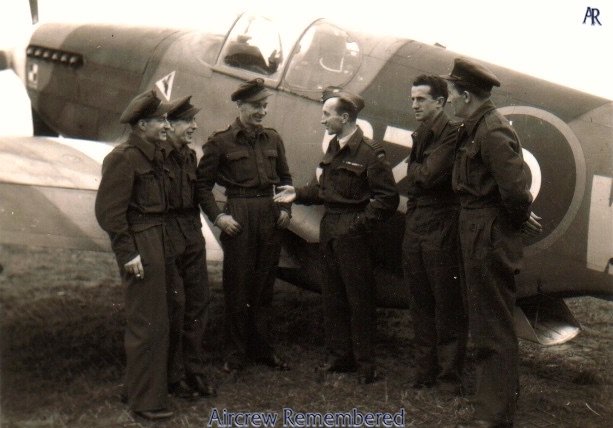
The pilot, W/O. Pietrzak, had been briefed to take part in a squadron formation exercise, to be followed by dive-bombing practice. FX876 was one of the first pair in the formation to leave the ground; the other member of this pair was the squadron commander.
Almost as soon as the two aircraft were airborne, W/O. Pietrzak overtook his leader and, a few seconds later, called him on the R/T (radio transmitter) to state that his rudder control had jammed and that he could not use starboard rudder, but could still apply port rudder. The squadron commander immediately ordered him to return and land, and W/O. Pietrzak thereupon turned away and disappeared.
Some four minutes later, after the rest of the squadron had formed up with the leader and W/O. Pietrzak's original place in the formation had been filled, FX876 reappeared, and W/O. Pietrzak requested permission to rejoin, stating that his aircraft was now serviceable.
This permission was granted. Various squadron formation manoeuvres were then carried out for a period of forty minutes, during which FX876 appeared to fly normally. Dive-bombing practice then began from a height of about 12,000 feet.
The squadron formed line astern, with W/O. Pietrzak as number seven. Each aircraft in turn pulled up into a stalled turn to the left and entered its dive, the instructions to each pilot being that recovery should be effected at 5,000 ft. FX876 entered its dive in exactly the same way as the aircraft ahead of it, but instead of pulling out at 5,000 ft, its dive was seen by the pilot of number eight aircraft, close behind, to become suddenly steeper until it reached an angle beyond the vertical. Number eight, realising that something was amiss, endeavoured to follow FX876 in order to keep it under observation.
The pilot of number eight stated that when FX876 started to dive beyond the vertical, he also noticed that it was side-slipping to the left, and he had great difficulty in following it. He stated that he then saw it carry out an aileron turn one and a half times round, and then pull out of its dive inverted at an altitude well under 100 feet. The pilot of number eight lost sight of it at this point, as his own airspeed was over 500 mph I.A.S. and his height was only around 3,000 ft; he therefore had his attention fully occupied in recovering normal flight, which he did by using his tail trim after unsuccessfully trying to ease back the stick. He then caught sight of FX876 again; it was still inverted and climbing. Although he himself was still travelling at very high speed, FX876 overtook him, nosed over into a dive, and continued to the ground.
It subsequently transpired that W/O. Pietrzak had fallen out of his aircraft whilst it was inverted and travelling at tremendous speed across Andrews Field aerodrome, at a height of only about 20 ft. He had undoubtedly been thrown from the cockpit under high negative 'G'.
The fact that no pieces of the cockpit hood were found away from the main wreckage suggested that the hood was open when the pilot was ejected. W/O. Pietrzak was killed instantly.
 Examination at the scene of the accident at Goulds Farm, Rayne, Essex, showed that the aircraft had struck the ground whilst diving vertically at very high speed. The force of the impact, and the fire that subsequently broke out, reduced the wreckage to such a condition that no technical evidence was obtainable from it, except that it was possible to state that there had been no structural failure of any major component in flight.
The engine had penetrated the ground to a depth of about 12 ft and had been smashed by the force of impact into three main portions. There were indications that it had been running at high speed when the aircraft hit the ground.
 Mustang FX876 in-flight - Alek at the controls, understood to be taken over the Rhineland. This photo was only recently discovered in Poland in 2007 by the webmaster.
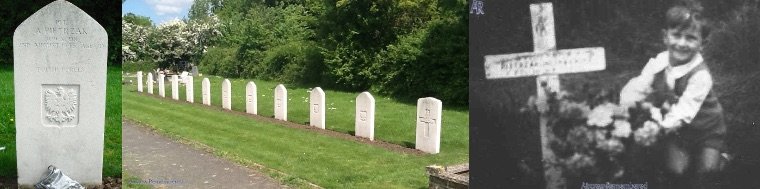 His son, Stefan, at his father's grave marker.``
Grave at Epping in 2014. (Note: a piece of his aircraft, left by the webmaster.)
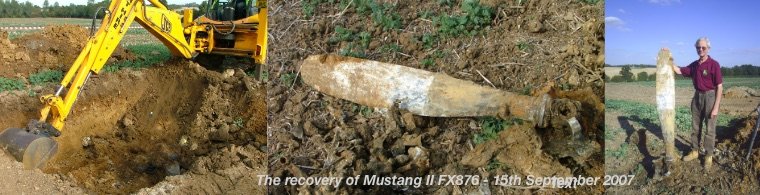
Above: Arcgaeligist recover some of the wreckage (courtesy Wings Museum)
Burial Details
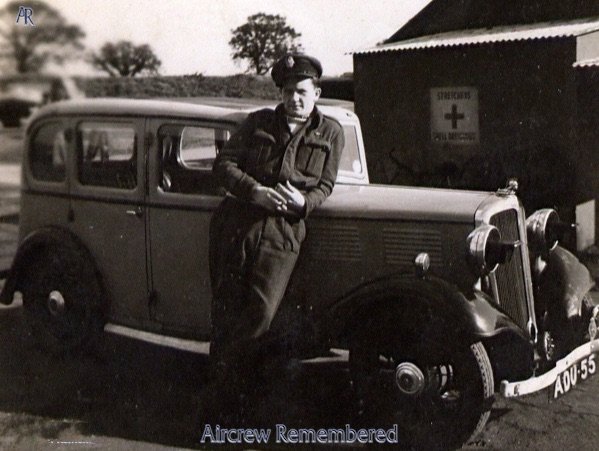
W/O. Aleksander Pietrzak, Virtuti Militari CV 2 Bars. Bury Lane Cemetery, Epping, Essex. Row Z, Grave 11. Born on 22nd January 1915 in Warsaw; educated at the Aleje Jerozolimskie in Warszawa. Son of Aleksander and Maria Pietrzak. Husband of 'Binky' Josephine Pietrzak (née Tuffield). Father of Stefan Pietrzak, of 62 Victoria Avenue, Hounslow, Middlesex, England. The funeral of Aleksander Pietrzak was held at 15:00 hrs on Tuesday, 7th August, at Epping Cemetery. The car provided by the RAF to take his young wife and her mother to the funeral was late; they arrived after the service had ended. One can only imagine the distress this caused, not only at the time, but for the rest of her days.
With many thanks to the Wings Museum for their valued assistance with this recovery; also to Agnes Modrzejewska for her research carried out on our behalf at the Kew Archives, and to Joe Fukuto of Canada for his work with the 'Aces of WW2' website and for his support.
Notes
RAF Andrews Field
Origins and construction
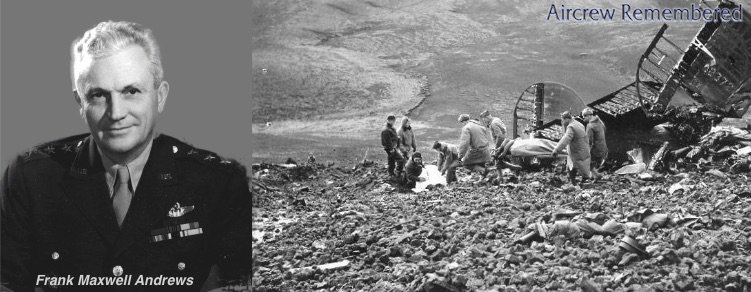
The airfield was built between 1942 and 1943, located about four miles east-northeast of Great Dunmow, Essex. It was built by the US Pioneer Corps and originally designated 'Great Saling' during construction. It was later renamed 'Andrews Field' in honour of USAAF General Frank Maxwell Andrews who was killed in an aircraft crash in Iceland in May 1943.
USAAF period
 The base was operated by the United States Army Air Forces from 1943-44, initially under the Eighth Air Force and then the Ninth Air Force. It was primarily home to the USAAF Ninth Air Force's 322nd Bombardment Group, which flew the Martin B-26 Marauder medium bomber. This unit used the base through much of the bombing campaign over occupied Europe until, with airfields becoming available on the continent in late summer 1944, the 322nd left Andrews Field for Beauvais/Tille on 25th September 1944.
RAF period
On 1st October 1944 the airfield was handed over to the RAF, under the control of No. 11 Group, ADGB. Within a week the headquarters of No. 150 (Polish) Wing and an advanced party of No. 19 Squadron moved in, and by mid-month Nos. 19, 65 and 122 Squadrons (No. 122 Wing) had joined the Polish Wing, made up of Nos. 129, 306 and 315 Squadrons - flying North American Mustangs. This was reportedly the largest gathering of Mustangs on any non-American airfield in the UK.
The main task of the Andrews Field Mustangs was escorting RAF Bomber Command's Lancasters and Halifaxes on daylight raids, while also continuing a home-defence role intercepting V1 flying bombs. Notably, at the end of February 1945, Gloster Meteor III jet fighters of 616 Squadron arrived, meaning the airfield briefly hosted Britain's first operational jet fighter type. After transfer to the Air Ministry, it was used briefly by RAF Fighter Command for Gloster Meteor jet fighter testing, before being finally closed in late 1945.
Wartime end and closure
The base's overall period of military use ran from July 1942 to November 1945, and it took part in the European theatre air offensive, the Normandy campaign and the Northern France campaign.
 Postwar
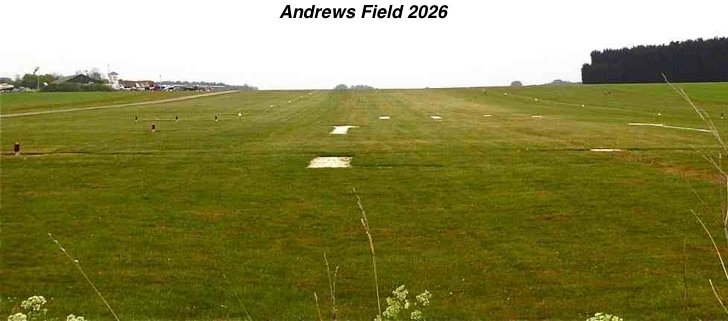
After closure, the site lay dormant for civil aviation purposes until 1972, when Clive Harvey and Robert Bucknell laid out a 3,000-foot grass strip along part of the original main runway, reviving the site as 'Andrewsfield.' A clubhouse and flying control tower were built in 1975 for the Andrewsfield Flying Club, and the airfield was licensed by the Civil Aviation Authority in 1976. For a time it also housed the Rebel Air Museum in a blister hangar near the clubhouse, before the museum relocated to Earls Colne airfield.
Today it operates as Andrewsfield Airport, a small general-aviation airfield. Physical Second World War-era remains are limited: aside from two T2 hangars, the firing-in butts and a few Nissen huts in the dispersed sites, little remains of the once-busy wartime airfield, though there are memorials, including one to the 322nd Bombardment Group and another to the 819th Engineer Battalion (US Army), in the village of Great Saling.
Polish Squadrons
No. 150 (Polish) Wing arrives
When the USAAF's 322nd Bombardment Group left for the continent in September 1944, the airfield was handed to the RAF, and by early October 1944 the headquarters of No. 150 (Polish) Wing and an advanced party of No. 19 Squadron moved in. The Polish Wing itself was made up of Nos. 129, 306 and 315 Squadrons, flying North American Mustangs. When the British No. 122 Wing (Nos. 19, 65 and 122 Squadrons) joined them later that month, the combined force was reportedly the largest gathering of Mustangs on any non-American airfield in the UK.
The Polish squadrons themselves
No. 315 (City of Dęblin) Squadron was formed in Great Britain in 1941, under an agreement between the Polish Government in Exile and the UK, and named after Dęblin, home of the main Polish Air Force Academy since 1927. It began on Hurricanes at RAF Acklington, then moved to RAF Northolt in July 1941, re-equipped with Spitfires, and flew offensive sweeps over occupied Europe, claiming two Bf109s destroyed plus several probables during its first operations in August 1941. By the time it reached Andrews Field in late 1944 it had converted to Mustangs. Over the whole war it amassed 86.33 confirmed victories, 18 probable and 26 damaged, before disbanding in January 1947.
No. 306 (Toruń) Squadron was formed on 29th August 1940 at RAF Church Fenton, inheriting the traditions and emblem of the pre-war Polish 'Toruń' Fighter Squadron. It claimed 68 confirmed kills, 16.5 probables and 26 damaged over the war, and its crews also brought down 59 V1 flying bombs - a role that fits neatly with Andrews Field's home-defence duties against V1s in late 1944 and early 1945. It disbanded in January 1947.
No. 129 Squadron was not a Polish-manned unit itself - it was a 'standard' RAF squadron - but it flew alongside the Polish squadrons as part of the wing at Andrews Field.
Later arrivals - No. 303 Squadron
By spring 1945, the Polish contingent had grown further: on 23rd April 1945, No. 303 Squadron flew its first operation from Andrews Field on Mustangs, escorting 150 Lancasters bombing Flensburg as part of Operation 'Ramrod' 1552. Around the same time, a Polish Air Force Film Unit crew visited in early April 1945 and filmed the squadron's new Mustang IVs, still awaiting their 'Kościuszko' badge and Polish Air Force insignia - a reference to 303's famous 'Kościuszko Squadron' heritage, the same unit that became legendary during the Battle of Britain. Other operations from this period saw squadrons such as No. 303 and No. 316 flying together with No. 122 Squadron RAF, landing at Helmond in the Netherlands to refuel before returning to Andrews Field.
Role from the airfield
While based at Andrews Field, the Polish Mustang squadrons had a dual role: escorting RAF Bomber Command's daylight raids by Lancasters and Halifaxes, while continuing a home-defence role intercepting V1 flying bombs. Their time there overlapped with the arrival of Britain's first jets, as Gloster Meteor III jets of 616 Squadron arrived at the end of February 1945.
Accidents
The B-26 Marauder's early reputation
The most significant accident-related theme at Andrews Field is tied to the aircraft type based there earlier in the war. The Martin B-26 Marauder was rushed into service and gained notoriety for poor handling, regular engine failures, a weak undercarriage and high stall speeds that led to a string of accidents and crew deaths, earning it grim nicknames such as 'Widow Maker,' 'Baltimore Whore' and 'Flying Prostitute.' Before the 322nd Bombardment Group arrived at Andrews Field, it had already suffered a series of accidents at its previous base, Rougham, which was part of the reason for its relocation in June 1943.
Once at Andrews Field, though, the picture improved considerably. After intensive low-level training that summer, the group's fortunes turned, and by the end of its operational tour the Marauder had gone from one of the most despised aircraft to one of the most respected: its low loss rate of just 0.3 per cent, or 13 losses in 4,000 sorties, reflected its sturdy airframe and its capability in experienced hands.
A specific documented incident
One recorded mid-air collision involving an Andrews Field aircraft: the B-26 'Patricia Ann' (of the 450th Bomb Squadron) collided with another B-26 over Beauville airfield. It suffered damage but was able to return safely to base.
Sources and Acknowledgements
- Wings Museum Near Balcombe, West Sussex
- Andrew Mielnik Memorial Archiwum
- RAF Grangemouth and 58 OTU
- National Archives, Kew
- Polish Memorial Committee
- Aircrew Remembered Person Archives
- Joe Fukuto of Canada and his work with the 'Aces Of WW2' Webs
- Polish Aviation Museum, Krakow
- Polish Memorial Exhibition. RAF Northolt.


