




Operation: Patrol
Date: 29th August 1944 (Tuesday)
Unit: No. 21 Squadron RNZAF
Aircraft Type: Vought F4U-1A Corsair
Serial NZ5255
Base: Piva Airfield, Bougainville, Solomon Islands
Location of Loss: Southwest of Bougainville, Solomon Islands
Pilot: Fl/Sgt. Ronald Lawrence Bayly NZ4210518 RNZAF Age: 20. Missing - believed killed
PILOT BACKGROUND
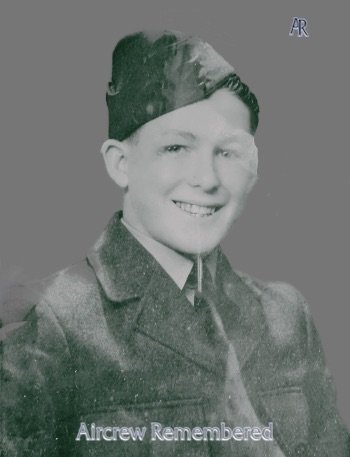
FlSgt. Ronald Lawrence Bayly
Born on 12th March 1924 in Te Awamutu, Waikato, New Zealand, the son of Cyril Thomas Bayly and Mary Hilda Bayly (née Russell). He was educated at Hamilton Technical High School, after which he worked as a draughting cadet with the Public Works Department (PWD). He served eight months with the Air Training Corps (ATC) before enlisting in the Royal New Zealand Air Force.
His service record:
- 6 Sep 1942 - RNZAF Seagrove, Aircrafthand (ATC)
- 7 Dec 1942 - Remustered as Aircrafthand (ADU)
- 1 Mar 1943 - New Plymouth
- 1 Apr 1943 - Remustered as Aircrew u/t & Initial Training Wing (ITW)
- 27 May 1943 - Remustered as Airman Pilot u/t
- 29 May 1943 - 1 EFTS (Elementary Flying Training School)
- 24 Jul 1943 - 2 SFTS (Service Flying Training School)
- 27 Sep 1943 - Pilot's Badge awarded (wef 27.9.43) & promoted to Sergeant
- 20 Nov 1943 - Sergeant confirmed
- 12 Dec 1943 - 2 OTU, P-40 Kittyhawk
- 2 Feb 1944 - 19 Squadron (P-40)
- 19 Feb 1944 - With Squadron to the Pacific
- 28 Apr 1944 - Ferried P-40 to New Zealand
- 23 May 1944 - 21 Squadron (P-40; Corsair on arrival Pacific)
- 19 Jun 1944 - With Squadron to Pacific, second South Pacific tour
- 29 Aug 1944 - Killed in action, age 20. 527 flying hours.
REASON FOR LOSS
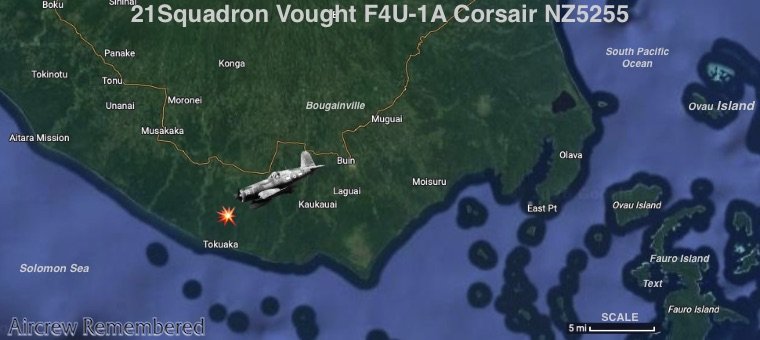
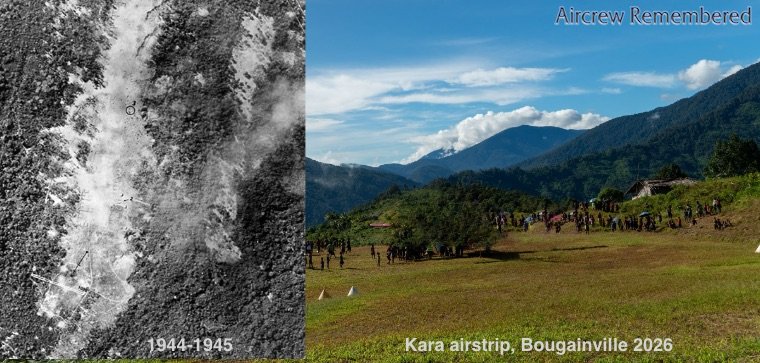
 On the 1944, Fl/SGT. Ronald Bayly was carrying out a patrol and ground strafing attack on Japanese positions in the area of Kara airstrip, southwest of Bougainville, Solomon Islands. Flying Vought F4U-1A Corsair NZ5255,8to flames. The time of the crash was recorded as 0900 hours. Anti-aircraft fire was not observed at the time, though its presence could not be ruled out.
Fl/Sgt Bayly was killed instantly. He was 20 years of age and had accumulated 527 flying hours at the time of his death. He was on his second South Pacific operational tour.
Some days after the crash, under Japanese supervision, a Catholic priest buried what was believed to be the pilot of NZ5255 close to the airstrip at Kara. However, after the conclusion of hostilities, the grave could not be located, and Fl/Sg Bayly is accordingly commemorated on the Bourail Memorial, Panel 6, at the Bourail New Zealand War Cemetery, New Caledonia.
KARA AIRSTRIP (BUIN AIRPORT / TORIPOIL)
WWII-era Japanese airfield in the Buin area, southwestern Bougainville. Also known as Toripoil Airfield.
Kara Airstrip (also known as Toripoil Airfield or Buin Airport) is a World War II-era airfield located in the Buin District, southwestern Bougainville Island, Papua New Guinea.
Kara was one of several airfields constructed and operated by Imperial Japanese forces in the Bougainville area. The southwestern tip of Bougainville - around Buin and Shortland - was a major hub of Japanese air and naval activity, serving as a staging point for operations in the Solomon Islands campaign. Allied forces frequently targeted these airfields during 1943-1944 as part of the broader effort to neutralize Rabaul and advance up the Solomons chain.
Today
The airstrip survives in some form and has been associated with local air access to the remote Buin area. The region is one of the more isolated parts of Bougainville, with limited road infrastructure, making small airstrips essential for transport.
Bougainville itself is a fascinating and complex place - it gained autonomy from Papua New Guinea following the 2019 independence referendum (where ~98% voted for independence), and negotiations toward formal independence are ongoing.
No. 21 SQUADRON RNZAF
No. 21 Squadron RNZAF was formed in May 1944 and deployed to Piva Airfield on Bougainville from July to September 1944, operating under the command of Squadron Leader L. R. Bush. The Squadron flew a demanding combination of air defence duties over Empress Augusta Bay and offensive fighter-bomber sweeps against Japanese-held areas of Bougainville and targets around the main Japanese base at Rabaul.
Ground strafing missions of the kind that claimedFl/Sg Bayly's life were among the most hazardous tasks assigned to Corsair pilots, requiring precise judgement of height and pull-out timing at low altitude over hostile terrain with no margin for mechanical failure or navigational error.
AIRCRAFT - VOUGHT F4U-1A CORSAIR
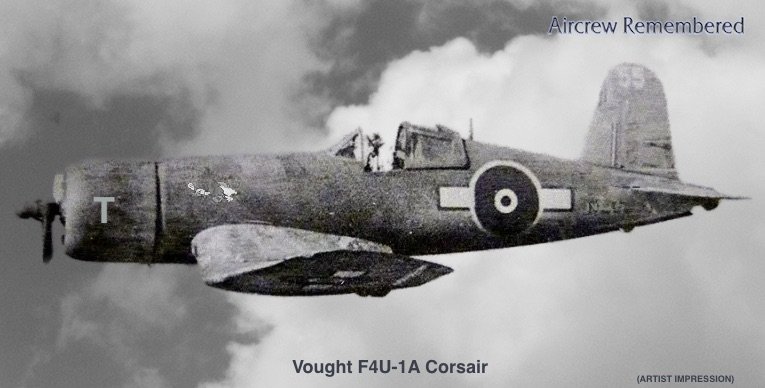
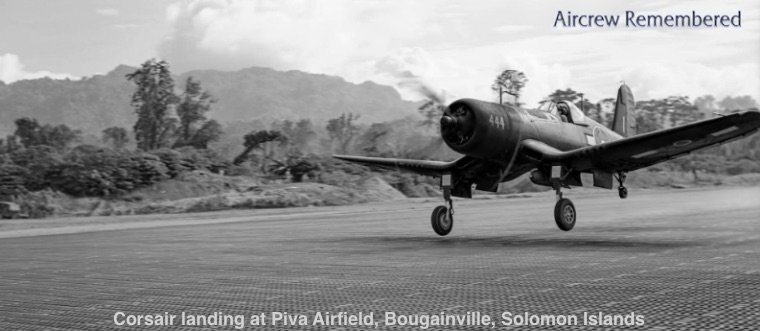
The Vought F4U Corsair was one of the finest carrier-borne and land-based fighter aircraft of the Second World War, powered by a Pratt and Whitney R-2800 Double Wasp radial engine producing 2,000 hp. Its distinctive inverted gull wing - designed to accommodate the large three-bladed propeller while keeping the undercarriage short enough for carrier deck operations - made it immediately recognisable in the Pacific theatre.
.With a maximum speed of 417 mph and a service ceiling of 37,000 ft, the Corsair was significantly faster and more powerful than the Japanese Zero fighters it frequently encountered. It was equally effective in the ground attack role, capable of carrying bombs and rockets in addition to its standard armament of six .50 calibre Browning machine guns, three mounted in each wing.
RNZAF squadrons operating in the South Pacific began transitioning from Curtiss P-40 Kittyhawks to Corsairs during 1944, and the type quickly proved its worth in both air combat and ground attack missions. It was on one such low-level strafing mission that Fl/Sg Bayly lost his life.
BOURAIL NEW ZEALAND WAR CEMETERY AND MEMORIAL
Location and Origins
Bourail New Zealand War Cemetery lies on the western coast of New Caledonia, approximately 1,600 kilometres north of New Zealand, about 9 kilometres south-east of the town of Bourail on the main road north and east of the Nera River. The land was donated to New Zealand authorities in 1943 by New Caledonian farmer Charles Goussard, and the cemetery was formally inaugurated on 7th October 1945.
New Caledonia served as a major Allied base in the South Pacific during the Second World War. The headquarters of the 3rd New Zealand Division was established at Bourail towards the end of 1942, with brigade headquarters and staging camps spread along the main arterial road on the western side of the island, where the principal defences were concentrated. Airfields were constructed to link the island with the battle zone and bases in Australia, New Zealand, Fiji, and other parts of the Pacific.
The Cemetery
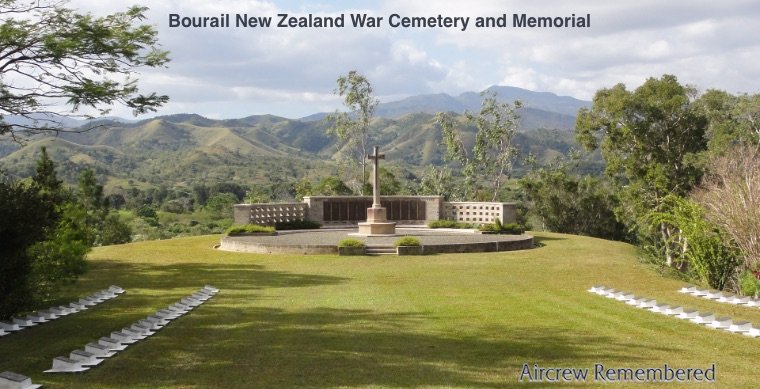
The cemetery was designed by C. P. Vize and constructed by New Zealand authorities. The remains of approximately 200 casualties were concentrated into it from 14 other islands across the South Pacific, including Guadalcanal, Vella Lavella, Mono, Bougainville, and other islands in the Solomon Islands. There are 246 Commonwealth burials of the Second World War in the cemetery, of which 4 are unidentified - 235 are New Zealanders, and 7 are from the United Kingdom.
The entrance on the south-western side leads through a terrace adjoining the Records building to a wide central avenue which curves between two double rows of graves to the Cross of Sacrifice, erected on a raised circular platform at the northern end.
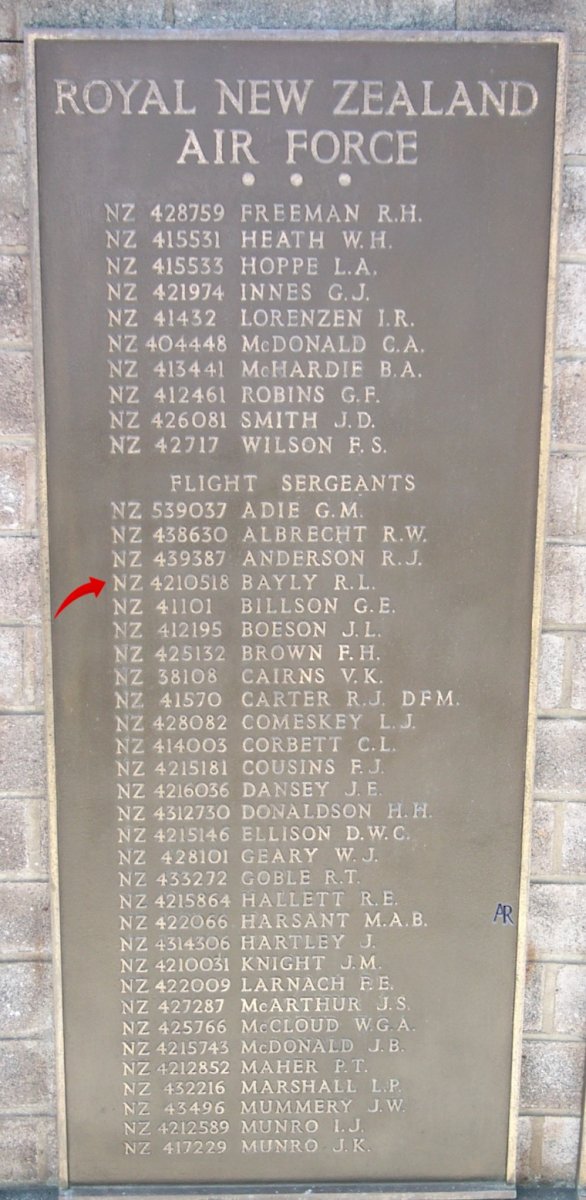
The Bourail Memorial
Standing immediately behind the Cross of Sacrifice is the Bourail Memorial, commemorating those members of the New Zealand Land and Air Forces and Merchant Navy, together with members of the Western Pacific Local Forces, who died during operations in the South Pacific area and have no known grave.
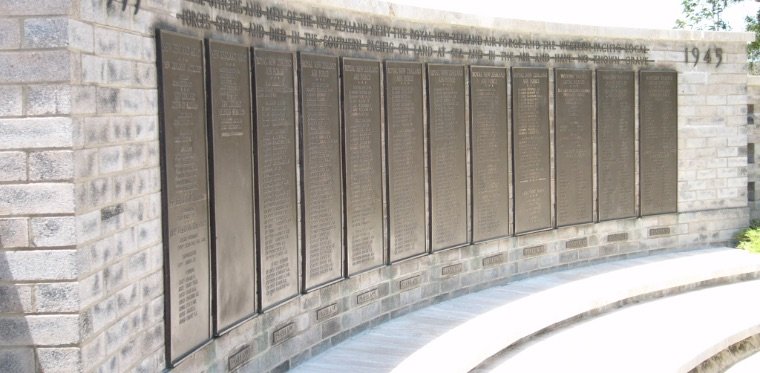
The Memorial consists of a curved screen wall with pierced wing walls of brick. Names are recorded on 12 bronze panels affixed to the main wall - the first nine bearing the names of New Zealanders, and the remaining three carrying the names of men of the Western Pacific Local Forces. Above the panels is the inscription:
1939 – 1945. These officers and men of the New Zealand Army, the Royal New Zealand Air Force and the Western Pacific Local Forces served and died in the Southern Pacific on land and at sea.
The Memorial commemorates over 200 members of the New Zealand Land and Air Forces and Merchant Navy, and 169 members of the Western Pacific Local Forces. Among those commemorated is Fl/Sg Ronald Lawrence Bayly RNZAF, whose name is recorded on Panel 6.
An ANZAC Day ceremony is held at the cemetery each year, attended by representatives of both New Zealand and New Caledonian communities.
BURIAL AND COMMEMORATION DETAILS
Name: Flight Sergeant Ronald Lawrence Bayly RNZAF
Service Number: NZ4210518
Commemoration: Bourail New Zealand War Cemetery, New Caledonia
Memorial: Bourail Memorial - Panel 6
Next of Kin: Son of Cyril Thomas Bayly (died 1976, age 76) and Mary Hilda Bayly (née Russell - died 1987m age 83) Home Town: Te Awamutu, Waikato, New Zealand
ACKNOWLEDGEMENTS
With sincere thanks to all those who contributed information towards this record. If anyone holds further details regarding Fl/Sg Bayly or No. 21 Squadron RNZAF, we would very much welcome hearing from you.
SOURCES
Medals Reunited New Zealand -/medalsreunitednz.co.nz
Family of Fl/Sgt. Bayly
Errol Martin - For your tomorrow, Vol 1-3
Commonwealth War Graves Commission - cwgc.org
Aviation Safety Network - asn.flightsafety.org
Wings Over New Zealand - rnzaf.proboards.com
Ross, J. - Royal New Zealand Air Force. Official History of New Zealand in the Second World War 1939–45. Battery Press, 1993
Wikipedia - No. 21 Squadron RNZAF
RAF Commands - rafcommands.com
AircrewRemembered - aircrewremembered.com
New Zealand War Graves Project - nzwargraves.org.nz
New Caledonia Tourism - newcaledonia.trave
Other sources, as shown below
Welcome to Medals Reunited New Zealand©
Established in 2014, Medals Reunited New Zealand© is a voluntary service of former career military men who are dedicated to returning FOUND, PRE-OWNED and anonymously DONATED medals to families or a near descendant. Our FREE service is self-funded and 100% not-for-profit. It is also FREE from any administrative, postal or insurance charges.
We will attempt to trace the family or near descendant of any NAMED medal entrusted to us while the search is undertaken.
If you are a family member or descendant, you are welcome to advertise your lost/missing or stolen medals on this website FREE of charge. Un-named medals are generally untraceable and so cannot be listed, unless accompanied by at least one medal known to be named.
Please note: unlike World War 1 medals, World War 2 campaign stars & war service medals issued to NZ and UK personnel were UN-NAMED.
MEDALS ~ FOUND Medals (and Ephemera) that MRNZ is holding. May be claimed by any proven descendant on proof of identity.
MEDALS ~ LOST Medals descendant families are looking for who have registered their contact details with MRNZ.
MEDAL SEARCHES … Tracing descendant kin to return the medals that we hold keeps MRNZ fully engaged. Regrettably we are unable to undertake requests to search for family medals, but here you will find helpful hints to assist you initiate your own search.
MEDAL PROTOCOL … The Do's and Don'ts of when, where, what, why, and how to wear medals in New Zealand.
MEDAL TECH … The terminology and technical aspects associated with orders, decorations, medals and ribbons.
REUNITED MEDAL POSTS … Watch for NEW stories of successfully reunited medals posted on our website and Facebook page.
Please enjoy the website. Suggestions for correction or improvement are always welcome.
Ian D Martyn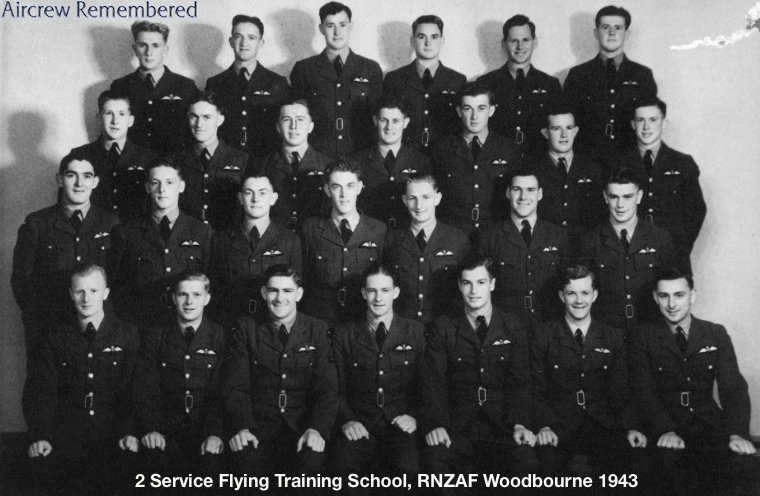
Rear row: Frank Thomas Symon 427341, Kenneth William John Busch NZ4215729 , Robert Anderson Barnett 4215722, J.McR Calder, Jack Douglas Dungey NZ4215237, Kenneth William Wrightt. NZ4213959
Third Row; Jack Muir Knight NZ4210031, Keith Leonard Armstrong NZ4215111, Leon Bremner Piper NZ4215704, Henry Earl Wilson 421848, G. George, R.P George, Ronald Lawrence Bayly 4210518.
Second Row; C.C c, N.J. Liggins, R.H Wheeler, P. teel, Gordon Douglas Lewis McDonald 416510, Wilfred George Newfield field NZ4211844, Colin Edward Palmer Z4213787
.
Front; T. Cheetham, H.P Crump, D.L Barr, Victor Jack Mortensen NZ4212586, R.S Mabin, P.W.G Millton, William Douglas Smith NZ4210850 (Courtesy Air Museum of New Zealand - this copy sent by Caroline Lockyer) (Courtesey Air Muzium, New Zealand)
"Of the 30 members of this course, Dungey didn't quite make it, so remustered to navigator and was unfortunately killed 4/12/44 with 8 squadron in a PV-1. Peter Steel was shipped overseas to serve with the RAF, and survived the war. J K Williams became temporary wastage and was carried over to 42B Course, subsequently ending up with 20 Sqdn. Kingston was killed in a Harvard accident during tis course 22/10/43. Cheetham, Liggins, Mabin, Millton, Mortensen were all retained to be trained as flying instructors at Tauranga, although Mortensen later also got onto fighters, but was killed with 23 Sqdn at Los Negros on 28/3/45. All the rest bar Piper were posted direct to various fighter squadrons, although several others did not survive the war, including G D L McDonald (car accident 22/1/44), W D Smith (lost 14 Sqdn 11/6/44), K L Armstrong (lost 19 Sqdn 24/4/44), R L Bayly (lost 19 Sqdn 29/8/44), and J M Knight (lost 19 Sqdn 28/8/44). So to 14 Sqdn went Barnett, Crump, George G, George P R, G D L McDonald, W D Smith; to 16 went Barr, Newfield; to 17 went Olson and Wheeler, to 19 went Armstrong, Bayly, Calder, Knight, Palmer, Symon, Wright, and to 20 went Busch and Wilson. Seems like a fairly typical bunch to graduate from a wartime course."
(courtesy Wings over New Zealand)
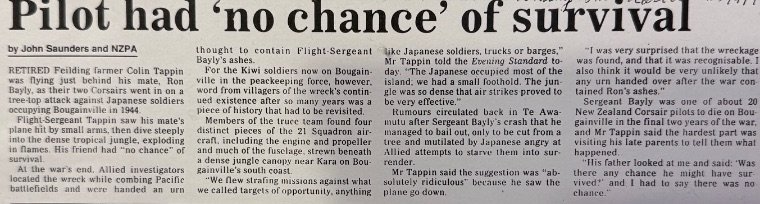
Pilot had 'no chance' of survival
Evening Standard 25th April 2009
by John Saunders and NZPA
Retired feilding farmer Colin Tappin was flying just behind his mate, Ron Bayly, as their two Corsairs went in on a tree-top attack against Japanese soldiers occupying Bougainville in 1944.
Flight-Sergeant Tappin saw his mate's plane hit by small arms, then dive steeply into the dense tropical jungle, exploding in flames. His friend had "no chance" of survival.
At the war's end, Allied investigators located the wreck while combing Pacific battlefields and were handed an urn thought to contain Flight-Sergeant Bayly's ashes.
For the Kiwi soldiers now on Bougainville in the peacekeeping force, however, word from villagers of the wreck's continued existence after so many years was a piece of history that had to be revisited.
Members of the truce team found four distinct pieces of the 21 Squadron aircraft, including the engine and propeller and much of the fuselage, strewn beneath a dense jungle canopy near Kara on Bougainville's south coast.
"We flew strafing missions against what we called targets of opportunity, anything like Japanese soldiers, trucks or barges," Mr Tappin told the Evening Standard today. "The Japanese occupied most of the island; we had a small foothold. The jungle was so dense that air strikes proved to be very effective."
Rumours circulated back in Te Awamutu after Sergeant Bayly's crash that he managed to bail out, only to be cut from a tree and mutilated by Japanese angry at Allied attempts to starve them into surrender.
Mr Tappin said the suggestion was "absolutely ridiculous" because he saw the plane go down.
"I was very surprised that the wreckage was found, and that it was recognisable. I also think it would be very unlikely that any urn handed over after the war contained Ron's ashes."
Sergeant Bayly was one of about 20 New Zealand Corsair pilots to die on Bougainville in the final two years of the war, and Mr Tappin said the hardest part was visiting his late parents to tell them what happened.
"His father looked at me and said: 'Was there any chance he might have survived?' and I had to say there was no chance."
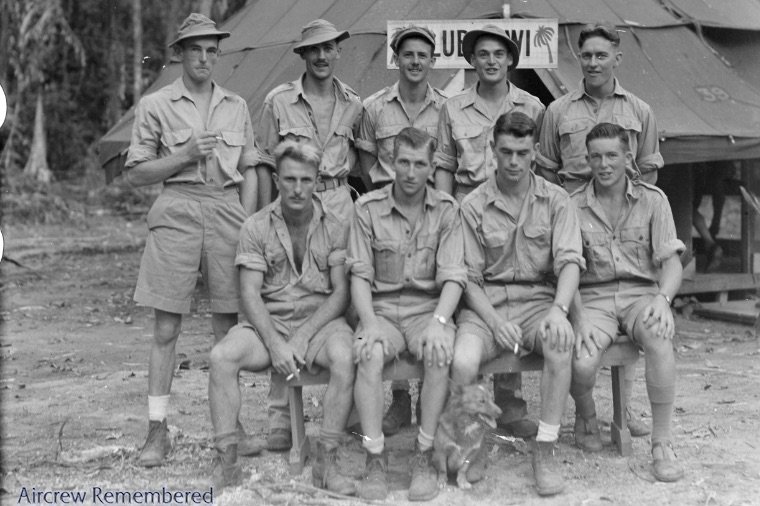
19 Squadron personnel in front of the 'Club Kiwi' tent, during their first tour. Torokina, Bougainville.
L-R: Rear; C.F Tappin (mentioned in article above), R.L Smith, K.W Wright, JMcR. Calder, K.L Armstrong.
Front; F.T Symon, J.M Knight, C.E Palmer, R.L Bayly. (Courtesey Air Muzium, New Zealand)


