




Operation: Training
Date: 14 October 1941 (Tuesday)
Unit: No. 1 Coast Artillery Co-operation Unit, No. 70 Group, Coastal Command
Type: Bristol Blenheim IV
Serial: T.1951
Code: —
Base: RAF Detling, Kent
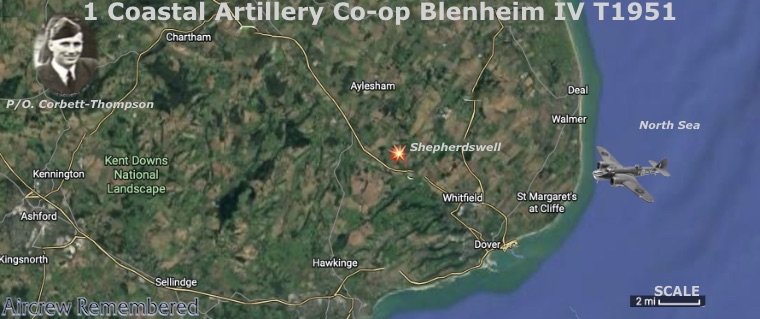
Location: Shepherdswell, Kent
Crew
Pilot: P/O. Bruce Francis Patrick Corbett-Thompson, Aus/404560, RAAF, Age 29 — Killed
Observer: Sgt. Frederick Whyatt Treeby, 1250021, RAFVR, Age 24 — Killed
Wireless Operator/Air Gunner: Sgt. Norman Thomas Wosencroft, 1073096, RAFVR, Age 31 — Killed
Wireless Operator/Air Gunner: Sgt. Sidney Yates, 987761, RAFVR, Age 20 — Killed
Reason for Loss
Weather conditions were described as ‘fine’. Taking off at 09:20 hours, the aircraft was carrying out a low dive-bombing attack on a defined troop-concentration training area in south-east Kent, on the orders of Squadron Leader D. C. Yorke.
While in a left-hand turn during the low dive-bombing run, the aircraft struck tree tops. It then went apparently out of control, turned upside down (inverted), and crashed into a small wood approximately 200 yards further on, at 09:45 hours — just twenty-five minutes after take-off.
The aircraft struck the ground and trees while inverted, with full engine power still applied. Investigators confirmed there was no engine failure. No attempt was made to leave the aircraft by parachute, consistent with how quickly and at how low an altitude the sequence unfolded.
 Findings of the Court of Inquiry
The primary cause was recorded as “an error of judgment on the part of the pilot,” specifically a misjudgement of the turn and height during the dive-bombing attack, which caused the aircraft to clip the tree tops. The aircraft, engine, and maintenance records (Form 700 and the relevant log books) were all found to be in good order; nothing mechanical contributed to the accident.
The Air Officer Commanding’s remarks added a further gloss to the Court’s finding. He attributed the accident to “excess of enthusiasm on the part of the pilot,” and noted specifically that carrying a crew of four had no bearing on the outcome, and that the pilot had sufficient experience to have been assigned this type of attack — in effect endorsing the decision to send him on the sortie while still agreeing that the immediate fault lay with the pilot’s handling of the aircraft.
 No secondary cause was identified, and the accident was not referred to the Accidents Investigation Branch.
In short: an experienced but perhaps overly aggressive pilot flew too low and turned too tightly during a simulated dive-bombing attack, clipped the tree tops, lost control, flipped inverted, and crashed into woodland seconds later — a split-second misjudgement that left no time for any of the crew to bail out.
Burial Details
P/O. Bruce Francis Patrick Corbett-Thompson is buried in Hawkinge Cemetery, Plot O, Row 2, Grave 49. He was born on 26 June 1912 in London, England, the son of Francis Stuart Corbett-Thompson and Eileen Claire Marie Corbett-Thompson (died 1954), and husband of Anna Ruth Edith Corbett-Thompson (née Hayward; married 31 May 1935, died 1968, aged 66), of Teneriffe, Queensland, Australia.
Sgt. Frederick Whyatt Treeby is buried in Portishead (St. Peter) Churchyard, Grave 296. He was the son of James Albert Treeby (died 1949, aged 75) and Kathleen Louise Treeby (died 1947, aged 55), and husband of Betty Doreen Treeby, of Portishead, Bristol, England.
Sgt. Norman Thomas Wosencroft is buried in Liverpool (Allerton) Cemetery, Section 1C, Church of England, Grave 92. He was born on 5 August 1910 in Garstang, Lancashire, the son of Thomas William Wosencroft (died 1939, aged 60) and Ethel Elsie Weatherhead (died 1943, aged 63).
Sgt. Sidney Yates is buried in Radcliffe Cemetery, Plot C, Square 8, Grave 1348. He was the son of Fred and Alice Yates, of Radcliffe, Greater Manchester, England.
Service Record — P/O. Corbett-Thompson
- 27 June 1940: Enlisted, Australian Military Forces, Private (QX13459), Lines of Communication Signals, Kelvin Grove, Queensland Signals Section.
- 23 September 1940: Discharged, Australian Military Forces (QX13459).
- 11 October 1940: Enlisted, Royal Australian Air Force, service number 404560, Brisbane.
- 11 October 1940: Commissioned Pilot Officer, RAAF (404560).
- 14 October 1941: Killed in flying accident while serving with No. 1 Coast Artillery Co-operation Unit, RAF (Coastal Artillery and Supporting Elements), Pilot Officer, RAAF (404560).Notes
Notes
(1) No. 1 Coast Artillery Co-operation Unit — Origins
The unit began life on 14 December 1936 as No. 1 Coast Artillery Co-operation Flight, formed from No. 1 Flight of the Coast Defence Development Unit, based at RAF Gosport. It came under No. 17 Group on 1 January 1937, and was upgraded from a Flight to a full Unit — becoming No. 1 Coast Artillery Co-operation Unit — on 1 June 1937.
As the name suggests, its role was co-operation with coast artillery: flying target-towing and spotting/observation sorties so that coastal gun batteries could practise and calibrate their fire, much as earlier RFC/RAF units had done for army artillery using the ‘clock code’ spotting system.
Wartime moves: 15 September 1939, moved to RAF Thorney Island, with a detachment at Detling. 18 May 1940, reduced in establishment and consolidated entirely at Detling. June 1941, transferred from No. 17 Group to No. 71 Group, Army Co-operation Command. 18 August 1941, moved to Bodorgan, Anglesey, retaining a small operational detachment at Detling. 1 January 1942, transferred to No. 35 Wing.
The unit was disbanded on 11 October 1943. One source dates its overall existence as 1937–41 and 1942–43, suggesting a possible break or reformation in the record that is not fully detailed in the sources available.
(2) Bristol Blenheim IV — Origins and Design
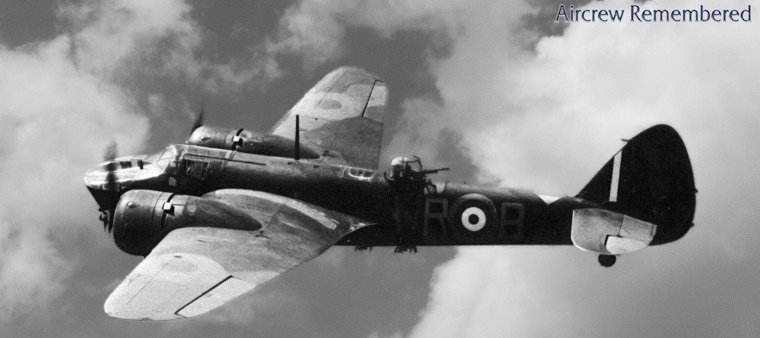
The Blenheim IV was the definitive development of the original Blenheim I, itself derived from a civil airliner design (the Type 142) built in response to a challenge from newspaper proprietor Lord Rothermere to produce the fastest airliner in Europe. The Mk. IV was the long-nosed development known as the Type 149, while in Canada Fairchild built the same design under licence as the Bolingbroke. The Bristol 149 Blenheim IV first flew on 24 September 1937.
The Mk I’s short nose had been unpopular, especially with navigators cramped below the pilot, and its range needed improving for long over-water patrols. The solution was an even longer nose, with the top of the navigator/bomb-aimer’s compartment lowered and the pilot’s windscreen moved back; the starboard roof of the nose was scooped out further still, giving the aircraft its distinctive asymmetrical appearance from the front. A 94-gallon fuel tank was also added in the outer wing, extending range by around 500 miles, though this made the aircraft too heavy to land safely when fully loaded.
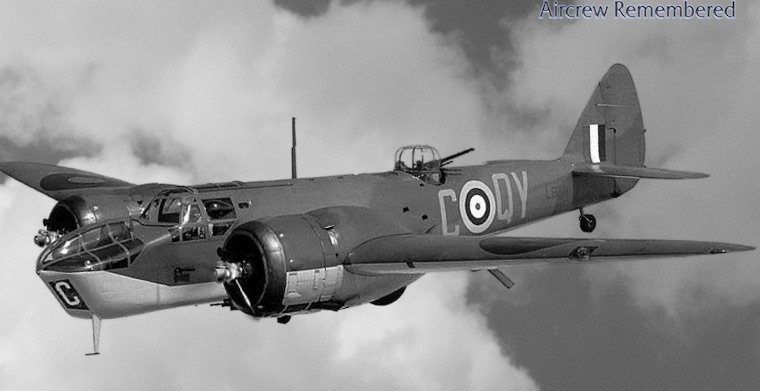 Specifications (Mk IV, Mercury XV engines): crew of three (pilot, navigator/bomb-aimer, wireless operator/gunner) — though T.1951 carried an additional gunner, making four in all; two Bristol Mercury XV air-cooled radial engines of approximately 905–920 hp each; wingspan 56 ft 4 in; length 42 ft 7 in; maximum speed approximately 266 mph; cruising speed approximately 198 mph; service ceiling approximately 27,260 ft; range approximately 1,460 miles; maximum take-off weight 14,400 lb.
Early Mk IVs were poorly armed, with only a single forward-firing .303 in Browning machine gun in the port wing and a single .303 in Vickers gun in the dorsal turret. Combat experience quickly showed this to be inadequate, and the turret was upgraded to two guns, a free-mounted Vickers ‘K’ gun was added in the nose, and rear-firing ventral turrets aimed via periscope by the navigator were fitted underneath.
Deliveries to RAF squadrons began on 10 March 1937 for the Mk I, with the Mk IV entering production in 1938. During the desperate daylight raids of May 1940 against German bridgeheads in France and the Low Countries, Blenheim IVs — alongside Fairey Battles — suffered the highest proportional losses ever recorded by the RAF in operations of comparable size. On 11 March 1940 a Blenheim IV became the first RAF aircraft to sink a U-boat, scoring direct hits on U-31 in the Schillig Roads, and on 4 July 1941 Wing Commander H. I. Edwards won the Victoria Cross flying a Blenheim IV during a daylight raid on Bremen.
Beyond its bomber role, the Mk IV was widely used by Coastal Command for anti-shipping and reconnaissance work, and — as in this case — as a bombing and gunnery trainer once it had become obsolescent as a front-line type; this was exactly the role T.1951 was performing with No. 1 Coast Artillery Co-operation Unit when it crashed on 14 October 1941.
UK production of the type totalled 3,296 aircraft (Bristol, Avro, and Rootes Securities combined), with a further 676 Bolingbrokes built in Canada and 10 in Finland, giving a grand total of 3,982 aircraft. The Mercury XV engines recorded in the Court of Inquiry papers (A.M. Nos. 160283 and 160343) match exactly the Mk IV’s standard powerplant, confirming T.1951 was a typical example of the type, by then relegated to training duties with a coast artillery co-operation unit rather than front-line bombing.
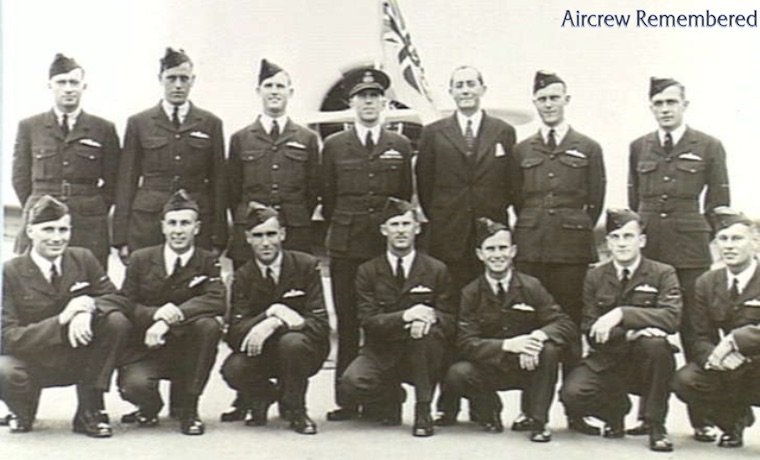
Above: Canada. Australian airmen who recently received their ‘Wings’ at a Canadian Flying Training School. Sir Clive Baillieu, prominent Australian, who is Director of the British Purchasing Commission, Washington, pinned the ‘Wings’ on their tunics.
Left to right, front row: Leading Aircraftman B. D. P. Corbett-Thompson, Brisbane; 402537 Pilot Officer [P/O] Clive Henry Phillips, Mosman, NSW (lost on operations over the Netherlands on 6 August 1942); K. D. Bassott, Karoala, Koma; 404617 P/O George Leslie Lachlan Hay, Chippendale, City of Sydney (lost on operations over Turkey on 24 October 1943); D. G. Andrews, Chelmer, Brisbane; D. H. Hannah, Tamworth.
Rear row: F. H. Mitchell, Redfern, Sydney; S. I. Hansen, Toolburra; E. H. Brown, Upper Undulla Terra; Squadron Leader J. C. Gordon, M.C.; Sir Clive Baillieu; W. G. Lewis, Bardon W. 4, Brisbane; 404550 Flight Sergeant Robert Neville Lonergan (lost on operations over Germany on 10 March 1942), Eumundi.
Sources and Acknowledgements
- National Archives of Australia
- Paul McGuiness, Australian Archives
- Aircrew Remembered Archives
- Wikipedia
- Imperial War Museum
- National Archives, Kew


