




Operation: Formation training
Date: 19th November 1943 (Friday)
Unit: No. 57 Op57erational Training Unit. (OTU)
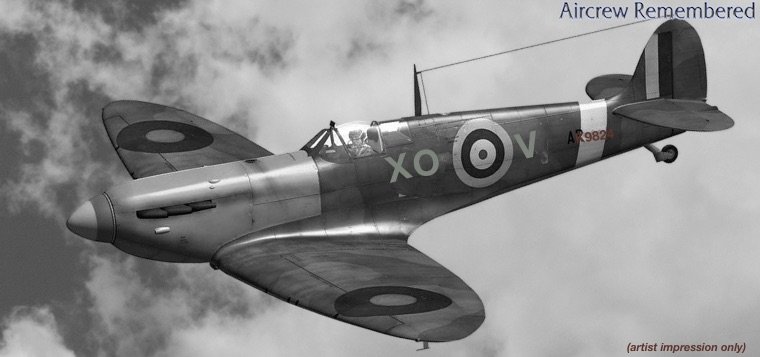
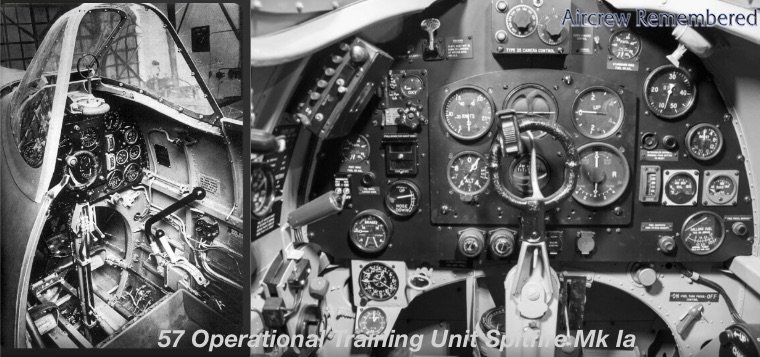
Type: Spitfire Ia
Serial: K9824
Code: XC-V
Base: RAF Eshott, Northumberland
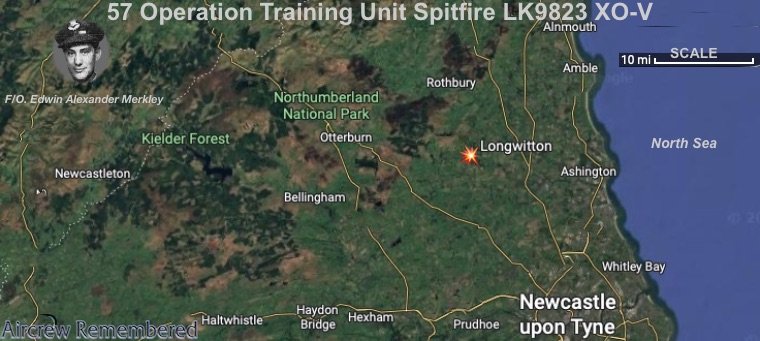
Location: Longwitton Hill, Northumberland
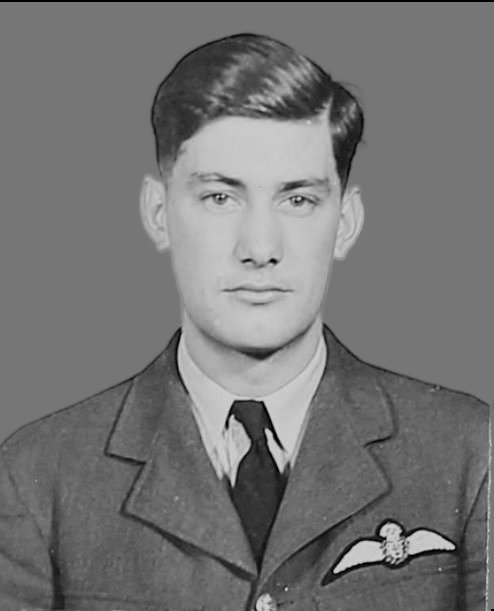
Pilot: F/O. Edwin Alexander Merkley J/28385 (R/93370) RCAF Age 25. Killed
REASON FOR LOSS:
Circumstances
P/O Merkley was briefed to fly as No. 2 in a section of three aircraft. The formation was led by W/O Olsen, with Sgt. Barklan flying as No. 3. Their orders were to carry out exercises 7 and 13b (Merkley) and exercises 7 and 10a2b2 (Barklan), comprising:
Formation flying for 1 hour - vic, line astern and echelon, including mild tail chase
P/O Merkley to dog fight with W/O Olsen upon conclusion of formation exercise
Sgt. Barklan to carry out spinning and aerobatics for 30 minutes
The exercise was carried out in clear sky at a height of approximately 5,000 to 6,000 feet. The flight was authorised at 08:00 hours and the formation took off at 08:40 hours. The weather was reported as suitable for the exercise.
 Cause of the Accide
While executing a mild tail chase, No. 3 (Sgt. Barklan) lost position during the exercise and used a dangerous method of regaining it, which resulted in him striking P/O Merkley's aircraft (No. 2) at an angle of approximately 45 degrees. Both aircraft went into the ground, and both pilots were killed.
Finding - Responsibility
The official investigation found that P/O Merkley kept in good position throughout the entire exercise and was in no way to blame for No. 3 crashing into him. No technical failure in engine, airframe or ancillary equipment was found on either aircraft. Following the accident, further orders were issued on the procedure to be used in gaining and regaining formation.
Tribute from Commanding Officer
The following is extracted from a letter written by Group Captain Archibald P. Hope, Commanding No. 57 O.T.U., to Mrs. Merkley, dated 29 November 1943:
P/O Merkley was doing very well on his training here, as was to be expected of a pilot with his experience. All his instructors spoke most highly of his enthusiasm and keenness in the air, and on the ground. His death is a regrettable misfortune which is deeply felt by all who knew him.
Funeral and Burial
Date of Funeral: 23 November 1943, at 11:00 a.m.
Location: Royal Air Force Cemetery, Harrogate, Yorkshire, England
Officiant: R.C.A.F. Chaplain at Harrogate
Grave Reference: Section C, Row E, Grave 1 (E.1, Section C)
Full service honours were accorded. A firing party was present together with representatives of his fellow pupils and the instructors of No. 57 O.T.U. The coffin was covered with the Union Jack and the Last Post was sounded. Wreaths were sent from the officers of the unit, from the Warrant Officers and Senior N.C.O.'s, and from the Airmen and airwomen.
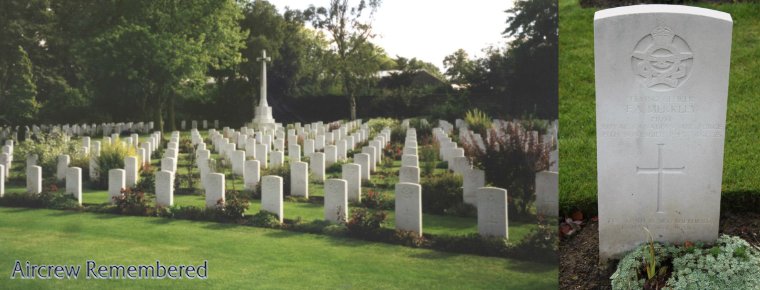
His grave is maintained by the Commonwealth War Graves Commission (formerly the Imperial War Graves Commission) at Harrogate (Stonefall) Cemetery, Yorkshire.
 Burial Details
F/O. Edwin Alexander Merkley. Stonefall Cemetery and Crematorium. Sec. C. Row E. Grave 1.Born on the 07th May 1018 ib Davidson, Saskatchewan, Canada. Enlisted on the 01st December 1942. Son of Ashton Hamond Merkley (died 1957, age 71) and Mary Elizabeth Merkley (née Wiggins - died 1971, age 84) of int-Vital, Manitoba, Canada. Epitaph: 'The Lord Is My Shepherd; I Shall Not Want'.
Sgt. John Wentworth "Jack" Barklam. Born in 1922. Margaret Churchyard Extension. Grave 1182. Son of Francis George and Gladys Barklam, of Prestwich.
 57 OTU Origins and Background
Formed at RAF Hawarden, North Wales, from No. 7 OTU on 1 November 1940, within No. 10 Group, to train fighter pilots for Fighter Command using Spitfires and Miles Masters. The move to RAF Eshott in Northumberland came in November 1942 because the unit's training syllabus requirements had outgrown the capacity of the busy Hawarden airfield, particularly given the number of aircraft being flight-tested after production at the nearby Vickers factory.
The Airfield
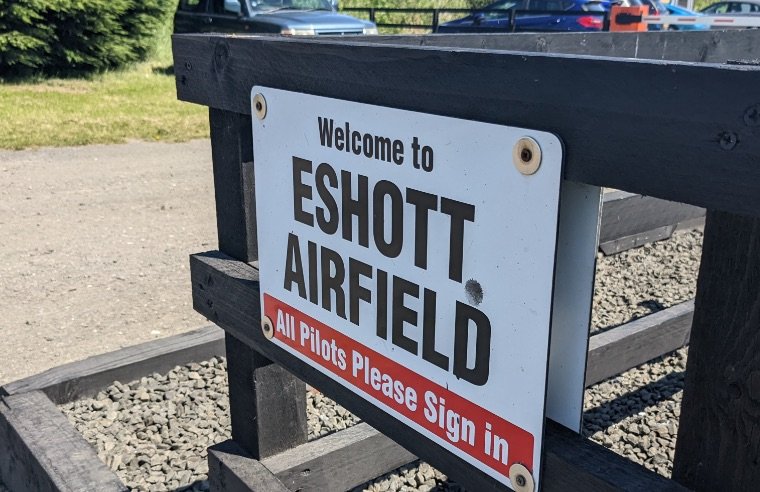
RAF Eshott near Felton opened in November 1942 and was unusual in that the main east/west runway was exceedingly large for a fighter station, at over 1,800 yards, and on several occasions it was used as a diversionary airfield for bombers who were unable to land at their parent station. The airfield lies about 20 miles north of between Morpeth and Alnwick, and was also known as Bockenfield Aerodrome.
The advance party - consisting of 1 WAAF Officer and 38 Airwomen - arrived on 3rd November 1942 and were billeted at dispersed sites around the airfield and at Eshott Hall, which had been requisitioned. The move was completed by 11th November with all aircraft arriving safely. At its peak, some 2,000 personnel were stationed at the base.
 What the Training Involved
The training at an OTU was in effect a postgraduate course, as all aircrew taking part were already qualified to wear their appropriate badges. Airmen trained together, being taught to work on the actual type they were to fly on an operational squadron. The average course consisted of formation flying, battle formation training, low level flying, gunnery training, practice interception exercises, dogfighting, and each student was expected to complete at least one long range cross-country exercise. SquarespaceNortheastatwar
As P/O Merkley's own accident documents show, exercises were numbered and carefully structured - formation flying in vic, line astern and echelon, mild tail chases, dog fighting, spinning and aerobatics - precisely the kind of intensive programme being run at Eshott throughout 1943.
Aircraft on Strength
In December 1943 - the very month after Merkley's death - the operational strength of RAF Eshott was: 77 Supermarine Spitfires, 9 Miles Master Mk. 1, 1 Miles Master Mk. 2, 10 Miles Master Mk. 3, 6 Miles Martinets, 1 Airspeed Oxford, 1 Dominie, 2 Magisters, and 1 Tiger Moth.
One particularly notable aircraft that passed through Eshott was Spitfire P7350 - the 14th Spitfire off the construction line, and the only Spitfire still flying today that saw active service in the Battle of Britain. It was dramatically shot down by a Bf 109 in 1940, but was returned to flight and used to train student pilots at 57 OTU RAF Eshott. It now flies with the RAF's Battle of Britain Memorial Flight.
 The Accident Record
Training at Eshott was dangerous work. The first fatal accident occurred on 3rd February 1943 when young French pilot Sgt H.R.E. Moureaux was killed when his Spitfire flew into high ground near Rothbury whilst carrying out aerobatics. The crash had been witnessed by a shepherd but it was a number of days before the wreckage was found when dense fog descended on the area. Northeastatwar
In November 1943 - the same month Merkley was killed - there were 12 accidents and 4 fatalities, one of the worst months of the entire war for the unit. Over the full period of the station's wartime use, a total of 271 accidents were recorded with 32 fatalities.
Command Structure and Closure
From Eshott the unit passed to the control of No. 9 Group on 20 April 1943. A further transfer of control to No. 12 Group occurred on 15 September 1944, and the unit finally disbanded on 6 June 1945. Training on Spitfires was carried out at Eshott until the unit was transferred north to RAF Boulmer in August 1944. The airfield was then put on care and maintenance until it was sold off in 1948. Asisbiz + 2
Today the site still operates as a small private airfield for microlights and light aircraft, and some of the original wartime buildings survive. It is one of the more tangible remaining links to the enormous training effort that produced the RAF's fighter pilots of the Second World War - and the airfield where Edwin Merkley flew his last sortie on the morning of 19 November 1943.
Sources and acknowledgement
- Flight Commander's Report - Sgd. E.L. Westly, Capt. R.N.A.F.
- Accident Investigation Report - No. 57 O.T.U.
- Accident Investigation Report - No. 57 O.T.U.
- Casualties Officer, Ottawa, 29 November 1943
- Air Mail notification to Mr A.H. Merkley - Squadron Leader W.R. Gunn, RCAF.
- Veterans Affairs Canada, Canadian Virtual War Memorial record
- Paradie RCAF Archives
- Commonwealth War Graves Commission
- Imperial War Museum
- CASPIR - Canadian Aircraft Serials Personnel Information Resource
- Wikipedea


