




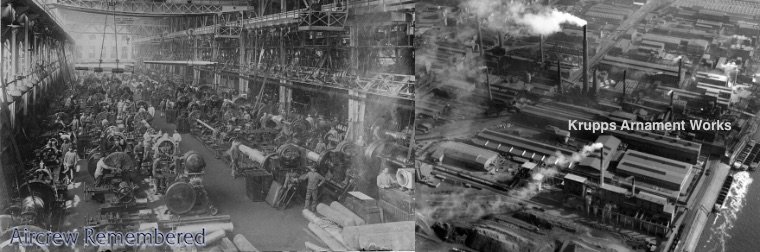
Operation: Essen - Krupp Works
Date: 27/28 May 1943 (Thursday/Friday)
Unit: No. 428 (Ghost) Squadron, RCAF, No. 6 Group
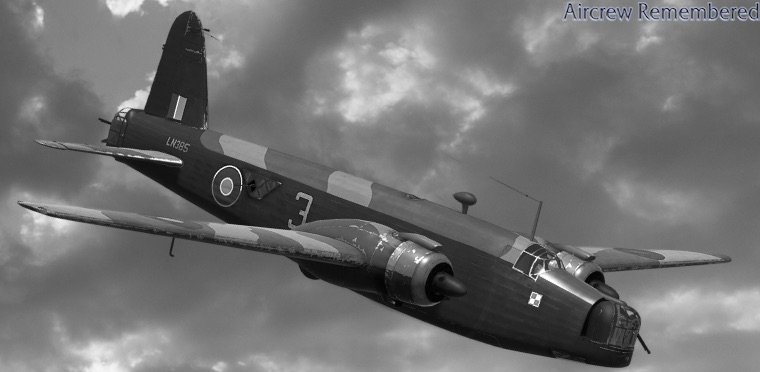
Type: Vickers Wellington X
Serial: HZ485
Code: NA-G
Base: RAF Dalton, North Yorkshire
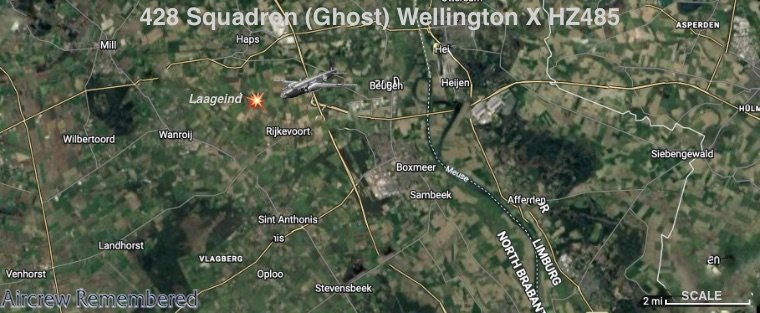
Location: Laageind, Netherlands
Pilot: W/O1. Denison Hilton Thompson, R/72344, RCAF, Age 25
Nav: F/O. Alexander Farquhar Beaton, J/13842, RCAF, Age 24
Air/Bmr: Fl/Sgt. Gordon Gerald Hart, R/111333, RCAF, Age 22
W/Op/Air/Gnr: Sgt. Kenneth Graham Chilver, 1076367, RAFVR, Age 24
Air/Gnr: Fl/Sgt. Gerald Churchill Patrick O'Hara, R/110283, RCAF, Age 23
Reason for Loss
Overview
This raid was part of the Battle of the Ruhr (5 March - 31 July 1943), the sustained RAF campaign against German heavy industry in the Ruhr valley, of which the Krupp armaments works in Essen was one of the primary targets throughout.
The raid itself
A force of 518 aircraft attacked - 274 Lancasters, 151 Halifaxes, 81 Wellingtons, and 12 Mosquitos - with 23 aircraft lost, a loss rate of roughly 4.4%. This made it one of the larger raids on Essen during the battle, though smaller than the massive 705-aircraft raid that would hit the city again on 25/26 July.
Conditions on the night
Squadron records from No. 100 Squadron (one of the units involved) describe the conditions:
There was considerable uncertainty about cloud cover over the Ruhr, so sky-marking (parachute flares/markers above the cloud) was used rather than ground-marking, since crews could not see ground detail through the thin but persistent cloud layers.
Flak was moderate to intense, and German night fighters were active - eight were spotted by No. 100 Squadron crews, though no combats were reported in their case.
Fires were seen burning well through the cloud in photographs, and the sky-marking results were judged good.
 Aftermath and significance
One source notes that the Krupp works suffered severe damage in this raid, and that Gustav Krupp suffered the stroke that ended his active involvement in the firm the following morning - though this precise causal link should be treated with some caution, as it comes from a single secondary source rather than a rigorously sourced account.
Contemporary German sources reflect the pressure Bomber Command was putting on German leadership that week: Milch remarked around this time that the English were "giving sensational publicity to their successes in the air," adding that although they exaggerated, "unfortunately much of what they claim is true," specifically citing the RAF's attack on Dortmund as impressive. The day after the Essen raid, he wrote that German air supremacy had been lost due to enormous RAF and British industrial effort combined with "unfortunate circumstances and negligence" on the German side.
This raid sat in a very intense stretch of May 1943 operations: Dortmund was hit by 826 bombers on 23/24 May, Dusseldorf by 729 on 25/26 May, this Essen raid followed on 27/28 May, and Wuppertal-Barmen was hit by 719 bombers just two nights later on 29/30 May - the raid that produced the devastating firestorm destroying 90% of that district. Over the full Battle of the Ruhr, Essen alone was attacked with more than 3,000 sorties and the loss of 138 aircraft, leaving "large areas of devastation" in both the Krupp works and the town itself.
According to Dutch local history sources, HZ485 was shot down by a night fighter and crashed around 01:30 on the morning of 28 May, at Laageind near Rijkevoort, in the municipality of Beugen en Rijkevoort, North Brabant. Local eyewitness accounts recorded decades later describe the aircraft skimming low over a farmhouse where a local resident, Fons Schaminee, lived, passing behind Jan Linsen's farm, clipping the top of a wooden electricity pole, then flattening out just over the Laag Werveld road before crashing into the lower-lying meadow at the edge of the marsh - the aircraft apparently burying itself partway into the marsh up to its wings. Shortly afterward, German troops cordoned off the Laag Werveld area on both sides; just before that happened, two brothers named Broekman reportedly managed to take the leather flying jackets of two of the crew.
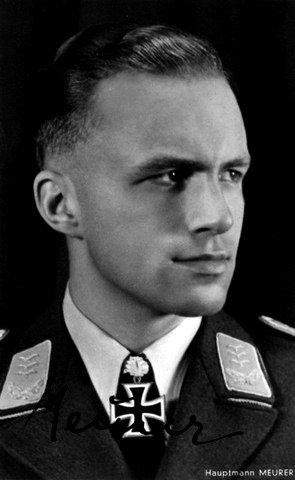
Taking off at 23:12 hrs, with an estimated time of return of 04:25 hrs, the aircraft was shot down by night fighter pilot Oberleutnant Manfred Meurer of 3./NJG 1, flying a Bf 110 G-4 from Venlo airfield. (Shown left)
All five died on 28 May 1943, and all are commemorated with no known grave on the Runnymede Memorial, Surrey - consistent with the local account of the aircraft going down into marshland, which likely made recovery of the crew impossible or incomplete at the time.
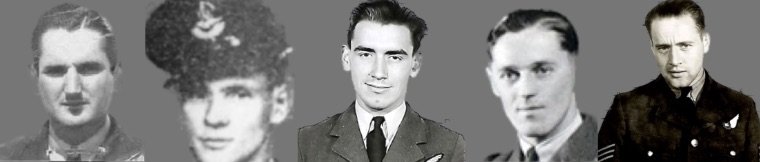
Above L-R: W/O1. Thompson, F/O. Beaton, Fl/Sgt. Hart, Sgt. Chilver and Fl/Sgt. O'Hara
Burial Details
W/O1. Denison Hilton Thompson. Runnymede Memorial, Panel 179. Son of Herman Hilton and Elsie Thompson, of Toronto, Ontario, Canada. Born on 13th April 1918 in Toronto, Ontario, Canada.
F/O. Alexander Farquhar Beaton. Runnymede Memorial, Panel 172. Son of Norman and Mary Beaton, of Brandon, Manitoba, Canada. Born on 24th August 1918 in Mantario, Saskatchewan, Canada.
Fl/Sgt. Gordon Gerald Hart. Runnymede Memorial, Panel 182. Son of George Frederick and Helen Margaret Hart (nee Kerwin), of Ottawa, Ontario, Canada. Born on 20th July 1919 in Ontario, Canada. (Note: his service records show three different birth years.)
Sgt. Kenneth Graham Chilver. Runnymede Memorial, Panel 145. Son of Benjamin and Lily Chilver. Husband of Gwennie Chilver, of Middlesbrough, Yorkshire.
Fl/Sgt. Gerald Churchill Patrick O'Hara. Runnymede Memorial, Panel 185. Son of Gerald Churchill O'Hara (died 1970, age 82) and Ann O'Hara, of Vancouver, British Columbia, Canada. Born on 11th November 1918 in Vancouver, Canada. A truck driver prior to service. (Note: as with Fl/Sgt. Hart, his service records show three different birth years.) Tragically, his brother, Fl/Sgt. Morgan O'Hara, R128741, was also listed as missing on 8th September 1943, as air gunner on Halifax LK648 to Hanover, with all crew.
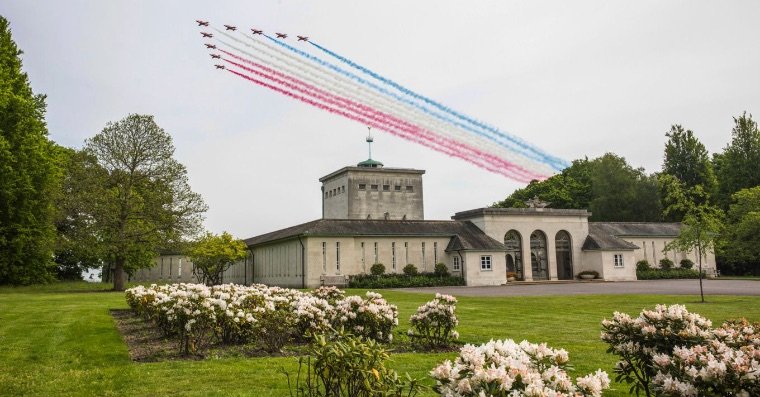
Runnymede Memorial
The Memorial (formally the Air Forces Memorial) sits on Cooper's Hill at Englefield Green, near Egham, Surrey, overlooking the Thames between Windsor and Egham on the A308. It is a Commonwealth War Graves Commission site commemorating over 20,000 airmen and airwomen of the Commonwealth air forces who died in the Second World War operating from bases in the United Kingdom and North and Western Europe and who have no known grave - it is specifically for the missing, not burials. It covers Bomber, Fighter, Coastal, Transport, Flying Training and Maintenance Commands.
It was designed by Sir Edward Maufe, with sculpture by Vernon Hill and engraved glass and ceiling work by John Hutton, built around a tower evoking a wartime airfield control tower. Queen Elizabeth II unveiled it on 17 October 1953, her first official visit to a CWGC site as monarch.
It is open to visitors daily: weekdays 9am-6pm (or dusk if earlier), weekends and holidays 10am-6pm (or dusk if earlier).
Sources and Acknowledgements
- Kracker Luftwaffe Archives
- National Archives, Kew
- International Bomber Command Centre
- Paradie-Dutil RCAF Archives


