




OBITUARY
Flight Lieutenant Idris Trevarthen Garrett
Brazilian-born Spitfire Pilot - 154 and 232 Squadrons
My Dad’s War - 1940-1946
Article researched and compiled by his son, David Garrett © - January 2026
My paternal grandfather was a Welsh engineer who emigrated to Brazil in about 1907. He worked as an engineer for a steamboat company based in Porto Alegre - his name (and mine, since I was named after him!) was David Trevarthen Garrett.
In 1914 he came back to Wales on home leave, and in September he married Mary Eleanor (“Nellie”) Roberts, who returned with him to Porto Alegre. Their first child, my father, was born in Pelotas in May 1916 and was christened Idris Trevarthen Garrett.

 Idris’s early schooling was in Porto Alegre, but at the age of about 11 he was taken to the UK to continue his education at Epworth College, a boarding school in North Wales. He was there for six long years, and by the time he returned to Brazil in 1933 the family had moved to Niteroi, across the bay from Rio de Janeiro. They lived in a house on the Rua General Pereira da Silva, near Icarai beach.
Being Brazilian-born, Idris did his national service with the Brazilian military. Then, in October 1935, he began his working career with a printing company, Cia. Lithographica Ferreira Pinto, a subsidiary of Souza Cruz (itself a subsidiary of British American Tobacco).


Life was good in pre-war Brazil, far from the dark clouds that were gathering over Europe. But eventually the inevitable war came, and Britain called on its citizens and volunteers from all over the world. In early September 1940 Idris boarded a Royal Mail liner, the “Highland Brigade”, bound for Europe and England. The voyage was not without its perils - a sister ship, the “Highland Patriot”, was torpedoed and sunk by a U-boat on 1st October, off the coast of Ireland.
But a week before that, on 24th September, the “Highland Brigade” had docked safely at Liverpool. Idris wasted no time in applying to join the RAF; his application was successful, and he was taken into the service just two days later! As a Volunteer Reservist, he was immediately posted to No. 6 ITW (Initial Training Wing) at Aberystwyth, to be initiated into the structures and disciplines of the Royal Air Force.


It just so happened that the Arts faculty of University College London had been evacuated to Aberystwyth after the outbreak of war. One of the young undergraduates was 19-year-old Edwina Hole-Baker, just starting her second year, and one morning in early October she was introduced to Idris in a crowded café near the pier...
In the course of two short weeks Idris had arrived in bomb-damaged Liverpool, enlisted in the Royal Air Force, and met the girl he was destined to marry. It must have seemed that he was aboard a runaway train!
The Initial Training Wing provided trainees with knowledge of RAF structures and operational policies, basic military skills, square-bashing and physical fitness, plus some psychological preparation for war. There were also inoculations and medical appraisals (in which Idris was somewhat economical with the truth, but this would not come out until later).


Having successfully completed his initial training, he was accepted for flying training, and in April 1941 he was posted to 15 EFTS (Elementary Flying Training School) at Carlisle. The very first entry in his logbook is dated 23rd April 1941: a 45-minute air experience flight in a Miles Magister, an RAF basic military trainer. Ten days later, on 3rd May (his 25th birthday), Idris flew solo for the first time.
By the end of May, with 58 hours in his logbook, it was time to move on, and he was posted to 8 SFTS (Service Flying Training School) at Montrose, in Scotland. The training there was on the Miles Master, the RAF’s advanced trainer for Spitfire and Hurricane pilots - his service career would indeed be on the fighters he had been hoping for!

June, July and August were filled with concentrated training on the Master, and on 17th August 1941, with 110 hours in his logbook, Idris had his first solo in a Hurricane. He completed his SFTS training in early September, with his proficiency signed off as “Above the Average”, and he was promoted to Pilot Officer and awarded his RAF Wings - a proud milestone. Idris grew a neat trademark RAF moustache in celebration. He kept it all his life, and this is the last photo ever taken of him clean-shaven.
So now it was time to train specifically for warfare. In late September he was posted to 57 OTU (Operational Training Unit) at Hawarden, on the outskirts of Chester. Most of the training was on Spitfires, and by early November the six-week course was complete. Idris had 184 hours in his logbook, 43 of them on Spitfires, and he was deemed ready for a squadron.
In October he and Edwina became engaged, and they excitedly began to make plans for a wedding in early 1942.
154 was a new squadron, formed at Fowlmere (a satellite of Duxford) on 17th November 1941. By the end of the month its full strength of 28 pilots had arrived, comprising the Squadron Leader, two Flight Lieutenants, seven officers and 18 NCOs. The first days must have been like the first day of a school term, as sleeping quarters and the orderly room were sorted out and people got to know each other. Then the weather clamped down, nothing was possible for the first few days of December, and flying only started on 4th December.
It immediately became apparent that squadron flying would be very different from training, and that a moment’s carelessness or bad luck could have serious, possibly fatal, consequences. On 5th December a heavy landing caused an undercarriage collapse - Sgt Scott was unhurt, but the Spitfire was beyond repair on site. Three days later Idris went one better: he had a total lapse of concentration and forgot to lower the undercarriage at all! He too was unhurt, and this one was repairable on site, but the dressing-down from the Squadron Leader must have been severe.
The very next day Idris’s flight commander suffered an undercarriage lock-down failure on landing, and another Spitfire had to be sent away for repair. And on 12th December there was a bad accident with the squadron Magister, in which the pilot was very seriously injured and the passenger, Sgt Groves, was killed.
Four accidents in the first week of flying - it was a sobering introduction to squadron life, and a reminder of the hazards of flying these beautiful aircraft. But, constantly interrupted by fog, snow, ice and bad weather, the pilots began to put in some hours and some constructive time together in the air. By the end of February 1942 the squadron was declared operational, and it was handed over to Squadron Leader Donald “Gus” Carlson, a Battle of Britain veteran from New Zealand, who would command it in action for the next twelve months. The British Empire was well represented, with a good sprinkling of pilots from Canada, Australia, Rhodesia and (especially) New Zealand, as well as the lone Brazilian.
February 1942 was arguably the lowest point of the war for Britain. Japan had attacked Pearl Harbor two months earlier and was rampant across the Pacific, forcing the surrender of Singapore on the 15th. A German battleship squadron had sailed up the Channel in broad daylight on the 12th, and the U-boat campaign in the North Atlantic had begun to sink terrible amounts of shipping. In North Africa, Rommel’s Afrika Korps was preparing to capture Tobruk in June and drive the Allies out of Libya.

It was against this dark background that 154 Squadron, now proudly operational, entered the war in earnest. It was re-equipped with Spitfire Vbs, replacing its IIs. Although welcome, this was not actually a massive improvement; in truth the Vb was already quite dated by early 1942, especially when compared with the ferocious Focke-Wulf 190s across the Channel.
In March, 154 had its first posting, to Coltishall in Norfolk. Over the next three months it would be rotated through Fowlmere, Coltishall and Churchstanton (in Somerset), with elements of final squadron training, especially gun and cannon firing, mixed in with the occasional sweep or convoy patrol. Dangers were always there - P/O Thomas Welch failed to return from a shipping reconnaissance mission to the Dutch coast on 4th May, and Sgt John Oliver unaccountably crashed on Dartmoor a few days later. Oliver was buried in Exeter Cemetery, a long way from his home in Blenheim, New Zealand.


In London, on 17th March 1942, Idris and Edwina were married. The photo shows him looking very smart (and a trifle nervous) in his best uniform, and Edwina looking beautiful and very young in her bridal dress. She was barely 21. In the year and a half since they had first met in Aberystwyth they had been able to see very little of each other, but now they had made an enormous commitment. And, two years into a worldwide conflict with no end in sight, and with Idris now seriously involved in the war, they must have been secretly apprehensive about what the future might hold for their marriage.
As it happened, the Fates showed their hand very quickly, for in early June the squadron was posted to Hornchurch, in the cauldron of Fighter Command’s front line. Its time at Hornchurch promised to be both busy and dangerous, and a general comment on RAF strategy is perhaps appropriate here.
Following the Battle of Britain, Fighter Command’s policy from 1941 onwards had been to “lean towards France” and deliberately seek to engage the Luftwaffe in combat across the Channel. This was achieved through operations known generically as Circuses, with various derivatives (Ramrods, Rodeos, Roadsteads and Rhubarbs), all deliberately attempting to provoke fighter-on-fighter confrontations and wear down the German fighter force. Squadrons of RAF Spitfires would escort a few medium bombers or fighter-bombers to a target (a Circus), attack ground targets (a Ramrod), or simply fly a fighter sweep looking for trouble (a Rodeo or Rhubarb).
But the losses were dreadful. The pilots of the short-range Spitfires were always fighting with one eye on the fuel gauge, and the enemy radar could always see them coming and position fighters accordingly. Then the introduction of the superb Fw190 in August 1941 placed the Spitfire V at a serious disadvantage. RAF losses were so great that in October Churchill’s War Cabinet ordered cross-Channel fighter operations to be drastically scaled down, and at the end of 1941 Sholto Douglas, Air Officer Commanding-in-Chief (“AOC-in-C”) of Fighter Command, ordered them to cease altogether, reluctantly calling it a “disagreeable necessity” because of the losses. Fighter Command had lost nearly 400 Spitfires and pilots in the second half of 1941, while inflicting minimal strategic damage on the other side of the Channel.
It would be natural to assume that this chapter was now closed. But, incredibly, in March 1942 Churchill authorised Sholto Douglas to resume cross-Channel operations, and the heavy losses started piling up again. John Starkey, in his excellent “The RAF’s Cross-Channel Offensive”, wrote that the resumption of Fighter Command’s actions over France in 1942 must surely rank as insanity. By the end of that year a further 492 Spitfires and their pilots had been added to the grim scoreboard.
Following the March resumption, the losses, eclipsing even those of 1941, mounted so quickly that on 13th June Sholto Douglas once again called a halt to fighter operations over France. But Trafford Leigh-Mallory, commanding 11 Group, effectively ignored the order, and the operations continued, at great cost, for another ten weeks.
These ten weeks coincided very closely with 154’s time at Hornchurch.
The posting began on 7th June, with 154 as one of the four squadrons (64, 81, 122 and 154) making up the Hornchurch Wing. Of these, 64 was a highly experienced and battle-hardened unit, having been in action during the Dunkirk evacuation and the Battle of Britain, and continuously operational ever since. The other two, like 154, had been formed from scratch in 1941 and were relatively inexperienced.

The skies over France were deadly in that summer of 1942 - the new Luftwaffe fighter, the Fw190, was more than a match for the Spitfire V in the air, while ultra-low ground attacks always carried the risk of being hit by defensive ground fire. It did not take long for the squadron’s first casualty to be recorded: on 21st June Idris’s Flight Commander, F/Lt Graham Hugill, was shot down during a fighter sweep over Dunkirk and Calais. Fortunately, he was later reported to be a POW.
F/Lt Alan (always known as “Shag”) Eckford was moved across from 64 Squadron to take his place as Flight Commander. Eckford had joined the RAF before the war; he had accumulated several aerial victories during the Battle of Britain and was awarded the DFC in December 1940. He would become a good friend to Idris and an experienced guiding light in the air for the next year.

The Wing Leader at Hornchurch, taking over from the much-respected Harry Broadhurst, was the legendary Brendan (“Paddy”) Finucane, by now a national hero. He was promoted Wing Commander (Flying) on 20th June 1942 (the youngest “Wingco” ever) and arrived at Hornchurch the next day to take up his post. Many considered that, at just 21 years of age, the Irishman was too young to command a wing, but his score of 32 aerial victories put him at the very top of Fighter Command’s list of aces (and very much in the public eye), and his record as a Squadron Leader, together with his DSO and DFC with two bars, spoke for itself.
Finucane immediately impressed his style of command on the wing, leading it on a concentrated mix of feint and actual sweeps, Ramrods and Rodeos, plus a big Circus to Hazebrouck, all in the last week of June. The first week of July then brought variable weather; there was no operational flying, and the squadrons were able to draw breath.
On 9th July, 64 Squadron was released from front-line duties so that it could, under the leadership of Squadron Leader Duncan Smith (father of Iain Duncan Smith, who became leader of the Conservative Party in 2001), re-equip with the Spitfire Mark IX - the first RAF squadron to receive this much-needed and very potent upgrade. By now it was generally accepted that the Spitfire V, though still a very capable fighter which would go on to serve with distinction in many theatres of the war, was largely outclassed by the Fw190. The Mark IX would redress the balance.

There was an unusual side effect of this upgrading of 64 Squadron’s Spitfires. For some months the British motor industry had been asking whether its enormous contribution of over £100,000 to the national Spitfire Fund could be recognised by naming a whole squadron under its banner. The Air Ministry and the RAF had agreed, and 154 Squadron had been chosen as recipient of this honour and title. So, as 64 Squadron was temporarily withdrawn to take up its Mark IXs, eleven of its Mark Vs were moved across the airfield at Hornchurch to be taken on charge by 154. These Spitfires, together with ten of 154’s existing aircraft, were named after the major motor industry contributors (“Rootes”, “Nuffield”, “Lord Austin” and so on); all twenty-one were badged with a newly designed squadron badge, and 154 officially became the Motor Industry Fighter Squadron.
The withdrawal of 64 Squadron on 9th July coincided with a marked increase in operational intensity for the three remaining squadrons, with Rodeos and sweeps to Dunkirk, Abbeville and Boulogne on the 8th, 12th and 13th respectively, followed by a Roadstead to Ostend on the 14th. (It is worth remembering that Sholto Douglas, AOC-in-C Fighter Command, had a month earlier ordered an immediate end to these types of cross-Channel operation.)
On 15th July, a dull and cloudy day, a Ramrod was ordered against a hutted army camp at Etaples, near Le Touquet. It was a big operation - the Hornchurch Wing put up 30 aircraft, and the North Weald Wing flew cover 4,000-5,000 feet above. Gus Carlson had flu and was unable to fly, so Paddy Finucane led 154 Squadron at the head of the attacking formation.
His luck ran out as they crossed the French coast at nought feet, when a burst from a lone machine gun in the dunes punctured the radiator of his Spitfire. He immediately turned sharply back over the Channel, trailing a long plume of coolant, accompanied by his wingman Alan (“Butch”) Aikman, both knowing that the rapidly overheating engine would not hold out for long. Ten miles out to sea Finucane carried out the inevitable ditching, but hopes of survival were dashed as he and the aircraft sank immediately. Aikman circled above the spot, transmitting Mayday calls, but there was nothing more he could do.
It had been laid down at the briefing that, if the leader was hit, the operation would continue, so in the meantime the three squadrons attacked the target at very low level, just a couple of miles inland from the coast. There were heavy flak defences - 154 lost F/Sgt Alfred Bray and 122 lost F/Sgt Dennis James, both killed, and three of 81’s aircraft were damaged.
The squadrons, the RAF and the nation mourned the loss of one of their young heroes, and three thousand people attended the Requiem Mass in Finucane’s honour at Westminster Cathedral two weeks later. It is not recorded what memorial services were held for Sergeants Bray and James.
Petrus Hugo took over as Hornchurch Wing Leader. Always known as “Dutch” Hugo, he was a 24-year-old South African who had joined the RAF before the war. A superb leader, he had ten victories to his credit and a bar to his DFC by the time he came to Hornchurch.


There was a brief lull on the Channel front in the latter part of July, but all this changed on the 30th, when the Kenley, Debden and Hornchurch Wings combined to escort Hurri-bombers on a big Ramrod to St Omer. The Luftwaffe responded in force, with ferocious aerial battles all the way back to and across the Channel. 154 were pleased to record their first victory, Squadron Leader Gus Carlson and his wingman Frank Flote destroying a Fw190, but this victory was overshadowed by appalling RAF losses, with no fewer than 14 aircraft failing to return. The Hornchurch Wing lost eight: Sgt Dawson and P/O Hurt from 154, four from 122 (including Squadron Leader Prevot), and two from 340. Another three from the Kenley and Debden Wings, and three of the Hurri-bombers, added up to another disastrous day for Fighter Command.
Incredibly, Trafford Leigh-Mallory ordered a repeat on the very next day, when Circus 201, comprising twelve Boston light bombers and massive fighter support, attacked the hornets’ nest of Abbeville-Drucat airfield, the hub of the Luftwaffe’s fighter operations on the Western Front. Twelve Spitfires failed to return (including three from the American “Eagle Wing”) - thankfully the Hornchurch Wing was not involved this time.
154 Squadron moved to the satellite field of Fairlop at the beginning of August. No losses were suffered in ten more days of routine sweeps, Rodeos and convoy patrols, and then on the 10th the squadron was released to Ipswich for a brief period of rest and recuperation. The sun shone, and the squadron returned to Fairlop on the 15th, much refreshed.
19th August was the day of the ill-fated Operation Jubilee, the amphibious landings at Dieppe. The wing flew four sorties during a long, strenuous day, the first taking off in darkness at 04:35. Surprisingly, 154 saw very little aerial action during the day, their only engagement coming when they came across an unfortunate Dornier 217 bomber in the wrong place at the wrong time. Idris and eight other pilots all fired at it, and they were each credited with a one-ninth share of its destruction.
Other squadrons encountered much more hostility. The Luftwaffe aggressively defended its airspace, and by the end of the day the RAF had lost a devastating 106 aircraft to fighters and flak.
The costly cross-Channel fighter operations, which had supposedly been terminated in June, were finally wound down by the end of August, but the skies over the Channel were still dangerous. On an air-sea rescue patrol on the 27th a Fw190 carried out a very successful attack, which resulted in F/O Alex Turnbull having to crash-land at Eastleigh and Sgt John Hall, seriously wounded, having to bail out over the Channel. Fortunately he was picked up by an Air Sea Rescue launch.
Then on 28th August there is a telling entry in Idris’s logbook: “rear cover to Fortresses”. The USAAF had started bomber operations, and daylight attacks on Europe would henceforth be carried out by large aircraft carrying bombs, not small fighters with machine guns.
On 1st September, 154 and 81 Squadrons were posted to Wellingore, in Lincolnshire. For ten days the pilots were put through an intensive course of navigation training, with lectures and exercises coupled with lengthy cross-country flights. From mid-month onwards various personnel were rotated on leave, and there was no operational flying for the rest of the month. October passed slowly - the Spitfires were ferried away, and the squadron busied itself packing up for a posting overseas.

Pilots were instructed in the servicing and re-arming of aircraft, and also in the art of revolver firing! Clearly something big was afoot, but the details were being kept strictly under wraps.

Eventually, in late October, they were taken to Glasgow, from where the pilots of eleven fighter squadrons embarked on 31st October for an unknown destination, total secrecy still being scrupulously maintained. When the next day dawned, they could see that they were part of an enormous convoy stretching to the horizon in all directions, well protected by a strong force of aircraft carriers and escort vessels. The convoy was the Eastern Task Force for Operation Torch, the invasion of North Africa. The planners were very lucky in that the main U-boat force was operating in the South Atlantic at the time, and so the convoy was virtually unmolested.
Operation Torch would be the biggest landing of the war so far, under the command of General Dwight D. Eisenhower, later to command D-Day. Landings were to take place simultaneously at the vital strategic ports of Casablanca, Oran and Algiers. The overall aim was to secure each beachhead rapidly and then push eastward as fast as possible, with the capture of Tunis as the ultimate objective. The likely level of resistance was difficult to gauge - Morocco and Algeria were French colonies, technically under the control of Vichy France, which was collaborating with Germany.

Late at night on 5th November the ships passed through the Strait of Gibraltar. The main landing convoys continued eastwards, but the merchant ships carrying the precious pilots peeled off under cover of darkness and docked at Gibraltar in the early hours of the 6th. The pilots were taken to accommodation on the Rock, where they caught up on sleep and then spent the day relaxing.
On the 7th they were briefed on the operation and their part in it. The British squadrons would fly from Gibraltar to the most easterly landings, at Algiers, and would provide air cover together with Fleet Air Arm aircraft launched from the four carriers. The eleven squadrons would operate as three main wings - 154 would be one of three squadrons in 322 Wing, under Dutch Hugo as Wing Commander, a familiar figure from their days at Hornchurch. 81 Squadron under Razz Berry was also in this wing, so there were familiar faces around.
The pilots selected their aircraft, readied them for the long flight, prepared their maps and studied the notes from their briefings. There would be no ground or administrative staff at their destinations; they would be very much on their own on a strange continent, and each pilot could take only the bare minimum of personal kit and clothing that could be crammed into the corners of his Spitfire. This might have to last him for a long time...
At Algiers, the landings began in the early hours of 8th November. On the beaches they met limited resistance, although there was some serious fighting at the docks. The airfield at Maison Blanche, some 10 miles outside the town, was secure by early morning, and the first three squadrons from Gibraltar arrived in the early afternoon. The next day they managed to find some fuel, and shot down several of the Ju88 bombers that were now, predictably, attacking the invasion force in the town and harbour.
The unsung heroes of Operation Torch were the Servicing Commandos. These were elite teams of RAF ground crew technicians who had answered notices posted at fighter aerodromes in early 1942 asking for “volunteers... to service aircraft under hazardous conditions”. Their job, operating just behind the front line, was to keep aircraft flying in support of advancing troops until the squadrons’ regular ground personnel arrived. Operation Torch was the first time they had been used in combat, and they were invaluable at places like Algiers and Djidjelli.
The photo shows the scene at Maison Blanche on the afternoon of D-Day, 8th November. The Servicing Commandos had landed on “Charlie” beach with the assault forces in the early hours and immediately marched eight miles to the airfield. They have dumped their kitbags and are working on the Spitfires of 322 Wing, which have just arrived from Gibraltar.

On 9th November, 154 was the fourth squadron into Africa from Gibraltar. They escorted two B-17 Flying Fortresses carrying General Mark Clark (Eisenhower’s deputy) and his staff on the long flight to Algiers. Idris’s logbook gives the flight time as 3 hours 40 minutes, and it probably felt every minute of that, listening for any unwelcome change in the engine note while flying over a featureless Mediterranean Sea. Every pilot would have had one eye on the fuel gauge - even with drop tanks, 480 miles was really stretching it for a Spitfire V, and in fact one of the pilots, Frank Flote, ran out of fuel and crash-landed just two miles short of the airfield. A flight commander from 111 Squadron suffered the same fate the very next day; the margin was very tight.

On 11th November the British forces began their advance eastward, going ashore at Bougie, about 140 miles along the coast from Algiers. The landing, although successful, stirred up heavy opposition from the German and Italian air forces, with torpedo and bombing attacks on the shipping in the harbour. Attempts were also made to land at Djidjelli, a further 50 miles along the coast. On the 12th, 154 was ordered up from Algiers to the tiny airstrip at Djidjelli, a flight of just over an hour, but on arrival found no troops and consequently no fuel. The previous day’s landing attempt had proved impossible because of heavy surf, but the news had somehow failed to reach Algiers.
Totally on their own, the pilots managed to siphon the remaining fuel from the tanks of some of the Spitfires, and so were able to put up six aircraft against a lone Ju88, though without result. An evening patrol in defence of Bougie fared much better, however, with 154 pilots downing three bombers; 43 Squadron Hurricanes, up from Algiers, shot down a further four.
The Luftwaffe attacked Djidjelli and nearby Bougie in force the next day, but thankfully a convoy of fuel tankers had arrived from Bougie at first light, and so the squadron was ready to meet the challenge. No fewer than six bombers were shot down, including an early-morning Ju88 confirmed to Idris and two other pilots. It was a foretaste of six months of intensive aerial combat...
The squadron was based at Djidjelli for the next six weeks. Conditions were extremely primitive - the little grass strip was barely adequate for fighters, and in December the abnormally heavy winter rains turned it into a muddy nightmare. The squadron’s ground crews and support echelons, being ferried by boat from Gibraltar, did not arrive until 1st December, so for the first fortnight all base functions, both technical and domestic, were carried out by the Servicing Commandos.
The pilots lived in slit trenches and tents, cold, tired and wet through, with the airstrip under constant bomber attack. Then, from 18th December onwards, the field was so waterlogged that it was completely unusable for the rest of the month; the Spitfires were trapped there, and all flying was suspended. Djidjelli was not a pleasant place to be.
This was not good for Idris. He had been economical with the truth during his RAF assessment medical in 1940, and had not disclosed that, as a young man in Rio, he had undergone an operation to remove part of his intestine. In normal times this would not have mattered, but the miserable rough living, on top of the usual strains of operational flying, was beginning to take its toll, and there were signs that trouble might be in the pipeline...
The abnormally wet winter had badly affected the Allies’ planned “race to Tunis”, and a stalemate developed during December. The Axis powers made good use of the slowdown to ship enormous quantities of troops and weapons into Tunisia, using the short supply lines from Sicily and mainland Italy. At the peak, some fifty Ju52 transports were landing at Bizerta daily, together with squadrons of the latest Messerschmitt 109G and Fw190 fighters.

Early in January 154 was moved further east to Bone. This was an important supply port for the Allies, and the town and airfield were a constant target for enemy bombers. The airfield had been severely damaged, and just a fortnight after arriving 154 were moved again, to a new field called Tingley just outside the town, which they shared with 81 Squadron (recently re-equipped with Spitfire IXs) and 232 Squadron.
Bone was a real hotspot. German forces in North Africa were now being squeezed into Tunisia from both west and east, and the airfield at Tingley was less than 50 miles from the border, in the very front line. The Allies were landing troops and materiel along the coast, and the Germans were flying troops and materiel into Bizerta and Tunis, so the fight for air superiority above the border was unrelenting. Idris’s logbook for January and February is full of convoy patrols, scrambles, bomber escorts and sweeps.

By March the Allies had built a major network of landing grounds around the town of Souk-el-Khemis, about 30 miles inside Tunisia. There were six of these, all named after London railway stations, and in mid-March the three Tingley squadrons were moved there, 154 and 232 going to Victoria and 81 (with their much-envied Spitfire IXs) going to Paddington.
The 100-mile transfer was a nightmare for the ground echelons - it rained hard all the way, some vehicles got completely bogged down and had to be recovered the next day, and the campsites were waterlogged. It was much easier for the pilots, who made the 45-minute flight the next morning. The airstrips, like Tingley, had runways and dispersals of pierced steel planking (“PSP”), negating the effects of the mud as long as the pilot didn’t put a wheel over the edge...

Gus Carlson was promoted to Wing Sweep Leader at this time, with Anthony Wenman moving across from 242 Squadron to take over command of 154. Shag Eckford replaced Wenman as Squadron Leader of 242. Idris was sad to see him go, but it was a well-deserved promotion.
The squadrons busied themselves settling into their new homes. These were less primitive than Djidjelli or Bone, but the off-duty scene was much the same. The pilots still lived in tents a couple of miles from the airstrips, and domestic life - eating, washing and leisure time - all took place outdoors. Some basic huts had been built at the dispersal areas (a considerable improvement), but aircraft maintenance and preparation still all took place in the open. Slit trenches were an essential safe haven, for the Souk-el-Khemis airfields were within range of Axis fighters, and strafing attacks, which could come at any time, now supplemented the regular bombing.

Eventually the winter rains relented, to be replaced by dust and wind.
Idris’s logbook reflects the bitter aerial battles of April, as the Axis forces were driven back towards Tunis. 154 suffered losses, but those of 232, their sister squadron at Victoria, were truly appalling, with no fewer than six pilots shot down in the week to 19th April.
Two of those were Flight Lieutenants, so urgent replacements were needed. The call went out to 154, where Idris received a rapid promotion to Flight Lieutenant and was moved across the airfield to 232. It must have been difficult for him to leave his brothers in arms of eighteen months in 154, and, given the events of the previous week, the post of Flight Lieutenant in 232 carried disturbing prospects! No wonder the entry in the 232 Squadron Operations Record Book for 22nd April reads: “The new B Flight Commander arrived today - F/Lt Garrett of 154. We wish him luck”.
Just three days later, Idris was shot down himself.

232 were on an early-morning sweep in the Medjez-el-Bab/Tebourba area, right over the front line. Two Me109s were seen below, and the squadron dived on them, but it was a trap, as twelve more came diving on the Spitfires out of the sun. In the hectic dogfight that followed, Idris became separated from the squadron and his aircraft was badly hit. He turned for home, but the engine was finished and he was losing height, so he prepared for a crash-landing.
This was successful - the aircraft did not turn over, and Idris rapidly left the scene, which was about four miles north-east of Medjez-el-Bab, a strategic crossroads on the Medjerda river. Realising that he must be in No Man’s Land, very close to the enemy lines, he trudged cautiously westwards for three hours, making for the river, at one stage evading a German patrol by hiding in long grass.
On reaching the river, he followed it upstream and was suddenly challenged by a British sentry in a ruined building on the other side. After Idris had explained the situation, the sentry told him not to touch the small (booby-trapped) boat moored nearby but to wade across, which Idris gratefully did. He was soon provided with a jeep, and by late afternoon he was back at Victoria with his squadron.
Another 232 pilot, Sgt Bannister, had been shot down and killed in the same action, and two more pilots were shot down the very next day, one of them F/Lt Bland, who most likely died while attempting a forced landing like Idris’s. That made ten pilots shot down in one terrible fortnight. Four of them had died, and four were on their way to Germany as prisoners of war. Just two had found their way back to the airfield at Victoria, and one of those did not fly again for over a month.
Idris returned to operations immediately, in his new position as Flight Lieutenant. He had been exceptionally lucky.
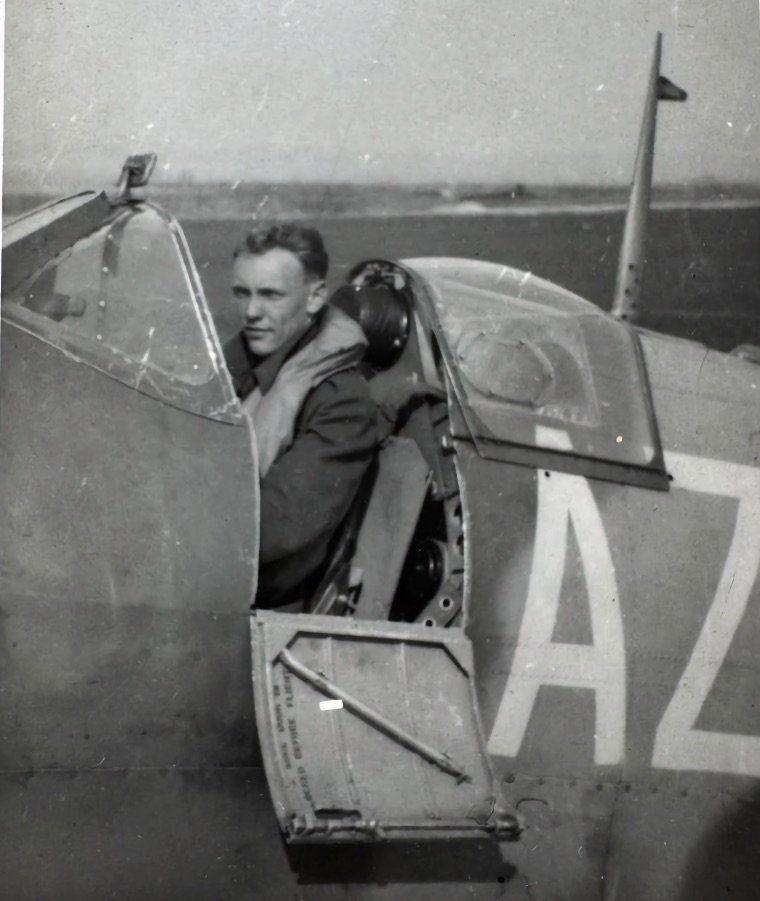
In early May, the Air Ministry produced a detailed account of Idris’s adventures on 25th April and took several photos of him with his new Spitfire. One of these (below) has become the iconic Garrett family photo of his RAF service.

Idris led the squadron several times in the first ten days of May, as the Luftwaffe put up its desperate final resistance. But the Allies were now in command both in the air and on the ground, and the end was inevitable. Tunis and Bizerta fell on 7th May, and the last troops on Cap Bon surrendered a week later. On the 13th the squadron said goodbye to Victoria airfield and moved to an airfield at Protville, a few miles north of Tunis. They were then released from operations and set up camp on the beautiful golden beaches at La Marsa, on the outskirts of Tunis. The whole squadron spent some blissful days sunbathing, swimming and relaxing, interrupted only by their participation in the big victory flypast over Tunis on 20th May.
On June 5th the squadron set off on their reposting to Malta, a routine 90-minute crossing carried out at low level to escape the attention of Sicilian radar. But the transit turned out to be far from routine for one of their number when P/O Ken Cam’s Spitfire developed engine failure half way across. He miraculously survived a horrendous crash-landing on the tiny volcanic island of Linosa – the Italians transferred him by submarine to Taranto and handed him over to the Germans, who transported him all the way to prisoner-of-war camp at Stalag Luft 3, where he spent the rest of the war. His account of his war, published as “Make it Do”, makes fascinating (and distressing) reading!
(Above: Edward Kenneth Cam, 134752, always known as Ken.
(courtesy of his son, Peter Cam)
Idris, as his flight commander, spent some time trying to ascertain the outcome, but there were no signs of life, and the crash was so destructive that it appeared unlikely that Cam would have survived. Idris eventually set off for Malta, arriving 20 minutes after the rest of the squadron.
He had troubles of his own, for he was still in pain internally, but fortunately a proper medical examination was now possible.
The medics did their tests and immediately rushed him into hospital. He had made his last ever flight in a Spitfire.
In early June the squadron said goodbye to Africa, and the pilots flew their aircraft to Malta, where Idris at last had access to proper medical care for his ever-worsening insides.
He took his aircraft up for a brief cannon test on 7th June, but this was to be his last ever flight in a Spitfire.
The medics did their tests and rushed him into hospital. After a period of rest and recuperation he began a long and circuitous repatriation from Malta to England, via Tripoli, Cairo, Tripoli again and Gibraltar, finally arriving at RAF Lyneham. This journey, spread over a month in various lumbering transport aircraft, must have seemed interminable, but eventually he reached England at the end of July.
The RAF Medical Board then gave him a thorough going-over, the upshot of which was that he was offered the choice of a desk job at the Air Ministry or training as a flying instructor.
He naturally chose the latter. Cleared by the Medical Board in October to fly non-operationally at heights up to 5,000 feet, he secured a posting to No. 10 Flying Instructors School at Woodley, near Reading, and reported there in January 1944. At the end of an intensive three-month course flying Tiger Moths, Magisters and Masters, he was signed off as qualified to teach on these elementary types.
Rather disappointingly, his assessments on completion were given as Average (as an elementary-level pilot) and Below Average (as a flying instructor). It would seem that the skills needed to fly and instruct at the elementary level were not the same as those needed to fly a high-powered Spitfire in combat! But more of that later...
In May he was posted to No. 4 EFTS at Brough, near Hull, as a fully qualified instructor.
He would now introduce RAF trainees to the thrill of flying - their first air experience, their first solo, their first qualification. It was exactly the same process that he himself had gone through at Carlisle just three eventful years earlier. Edwina was able to come up from London from time to time, and it must have been good to catch up on some of the togetherness that had so far been missing from their marriage. It must also have been wonderful to know that, accidents apart, Idris was going to survive the war, and that their dream of a life together back in Brazil would become a reality.

The DH82a, always known as the Tiger Moth, was the RAF’s primary basic trainer throughout the Second World War. First flown in 1931, it was a direct throwback to the fighter aircraft of the First World War: a fixed-undercarriage biplane with a maximum speed of just over 100 mph, incredibly manoeuvrable and fully aerobatic. Idris taught exclusively on this aircraft for sixteen months, putting in some 600 hours of tuition and falling in love with the little gem in the process.
He was good with his hands, and took it upon himself to make an accurate scale model, working not from plans but from the real thing!
Painstakingly measuring every aspect of the Tiger Moths around him, he scaled everything down at a ratio of 1:70, and with soft wood, string, glue, wire and paint he fashioned a beautiful replica of the aircraft that was now his life. The model is finished in the colours and number (72) of one of the many aircraft in his logbook, and it was clearly a labour of love - a little gem with a five-inch wingspan.


Once he had adjusted from Spitfires to Tiger Moths, Idris would have been ideally suited to instructing. He was by nature always patient, gently spoken and calm, and his students would have reaped the rewards. After the end of the war the RAF still needed to train its peacetime intake, and needed instructors to do so. Idris’s skills had been noted, and in September 1945 he was posted back to No. 10 FIS at Woodley - but this time he would be the one teaching the would-be instructors. His final assessment on leaving 4 EFTS Brough read Above the Average (as pilot) and Above the Average (as instructor), and ratings at this level were not freely given. He was a natural instructor.
At Woodley it was much easier to see Edwina, now pregnant with their first child, and the logbook shows a welcome five-day gap for the first post-war Christmas, which would have been spent in Muswell Hill, where Edwina lived with her grandmother. Then it was back for just one more month of tutoring at Woodley.
He made his last flight as an RAF officer on 5th February 1946, giving one last lesson in a Tiger Moth, and the RAF released him from service on 12th February. (With impeccable timing, I was born five days later.)

And so the battered logbook finally closed. It showed a grand total of 1,380 hours in the service of the RAF, spread over nearly five years, and Idris neatly analysed them all on a separate sheet tucked into the back of the book. He had accumulated 391 hours on Spitfires and 814 hours on Tiger Moths (which he would fondly refer to as “Tigerschmitts”), plus a smattering on other types.
Some 202 of the Spitfire hours were operational. Idris did not record any kind of balancing “score” for these hours, and his total confirmed results amounted to a one-ninth share of a Dornier 217 and a one-third share of a Ju88. He was one of the many brave volunteers who learnt to fly front-line fighters, who were there when needed, and who flew into danger in all conditions, accepting that fate or bad luck could have the final say at any time. He of course acknowledged that his Spitfire was there to be used as a lethal weapon, and was happy to do the job, but he was at heart a gentle man. His recollections were always of its grace and beauty, and of the excitement of simply being allowed to fly a beautiful machine of such speed and power.
After my birth in February 1946, Dad was swiftly flown back to Brazil, where Souza Cruz had held his job open for nearly six years and were naturally quite anxious to have him back! Their loyalty was handsomely rewarded, for he stayed with them for the whole of his working life.

Mum and I followed by sea, arriving at the end of July. They made a wonderful family life for me and my sister, growing up in São Paulo and Rio, and they enjoyed a loving forty-year marriage until his death in 1982, which came far too early.

His joy in his Spitfires and his Tiger Moths lives on in the Garrett family, long after his passing...
David Garrett - January 2026
Supplement: Additional Research
The following information came to light while this page was being prepared. It is offered as a supplement to David’s account rather than as part of it. Each item gives its source, and where published sources disagree with each other, or with the account above, this is stated so that readers can judge for themselves.
Spitfires flown by Idris identified in the records
Three individual Spitfires have so far been linked to Idris in published records:
|
Serial |
Mark |
Date |
Occasion |
|
BM120 |
Spitfire V |
19th August 1942 |
154 Squadron - Operation Jubilee (Dieppe), the day of the shared Dornier 217 |
|
ES262 |
Spitfire |
10th April 1943 |
154 Squadron - two patrols over the Beja area (15:35-16:30 and 17:40-18:50) |
|
ER603 |
Spitfire Vb |
25th April 1943 |
232 Squadron - shot down by a Me109 and crash-landed near the German lines |
ER603 was built at the Castle Bromwich Aircraft Factory and, according to its production record, went to 38 Maintenance Unit on 10th October 1942 and is recorded at Gibraltar on 6th November 1942 - the same day the Torch pilots docked there - before going on to North-West Africa and 232 Squadron.
His fellow 232 Squadron pilots
Sgt Kenneth Edward Bannister (service number 1333493), who was killed in the same action on 25th April 1943, was flying Spitfire EE860. F/Lt Brian Bland (service number 101014), from Norwich, was killed the following afternoon flying Spitfire ER913. According to the squadron record summarised on allspitfirepilots.org, his section was on patrol between 10,000 and 12,000 feet from 14:20 to 15:50 when it turned to engage some Me109s and, for a short time, had its back to the sun. The section was bounced; both F/Lt Bland’s aircraft and that of Sgt Lewsey were seriously damaged. Sgt Lewsey made a forced landing, and it is believed that F/Lt Bland was killed attempting to do the same. His body was taken to the mortuary at Medjez-el-Bab.
Earlier that month, on 11th April 1943, another 232 Squadron Flight Lieutenant, the Danish-born Colin Frank Sorensen of the RCAF, had been shot down by a Bf109 over Tunis in Spitfire ER723 and taken prisoner.
The “Highland Patriot”
The sister ship mentioned at the start of the story was torpedoed at 06:47 on 1st October 1940 by U-38 (Kapitänleutnant Heinrich Liebe), about 500 miles west of Bishop Rock. She was hit by two torpedoes and, after being abandoned, by a third which set her on fire and sank her. She had been on the South American run, sailing from Buenos Aires to Glasgow - very much the route Idris had just travelled. Three of the 172 people aboard were lost; the master, 135 crew and 33 passengers were rescued by the sloop HMS Wellington and landed at Greenock.
No. 154 (Motor Industries) Squadron
The squadron reformed at Fowlmere on 17th November 1941, having originally existed only briefly in 1918 without ever receiving aircraft. Its Spitfires carried the code letters HT. The squadron badge, approved in May 1942, shows the “derestriction” road sign in front of three arrows: the arrows represent the unit’s fighting qualities, and the road sign the Motor Industry Fighter Fund that paid for its aircraft. The motto is “His modis ad victoriam” - “By these means to victory”.
Between 7th May and 7th June 1942, while at Churchstanton, the squadron temporarily formed part of the Exeter (Czechoslovak) Wing. Churchstanton airfield lay on the Blackdown Hills in Somerset, about six miles south of Taunton; it was renamed RAF Culmhead on 22nd December 1943 to avoid confusion with RAF Church Fenton, and parts of it are now a Scheduled Monument.
Standard reference sources record 154 Squadron at Tingley from 17th January to 16th March 1943 and 232 Squadron there from 12th January to 16th March 1943, which agrees with the account above. After Idris left, 154 Squadron went on to serve in Sicily from July 1943 and in Italy from September 1943, rested in Palestine, then operated from Corsica over southern France in 1944. It was disbanded at Naples on 1st November 1944, re-formed at Biggin Hill on 16th November 1944 as a Mustang bomber-escort squadron, and was finally disbanded on 31st March 1945.
Paddy Finucane’s last operation - a note on the records
The 154 Squadron Operations Record Book entry for 15th July 1942, as published by the Battle of Britain London Monument, opens by describing a fine, bright day, with pilots called to the briefing room at 11:30 and told by Wing Commander Finucane that the hutted camp at Etaples was to be attacked and that he would lead 154. This differs from the “dull and cloudy day” in the account above, and readers may wish to compare it with other records. Finucane was flying Spitfire BM308 when its radiator was hit by ground fire.
Figures for the Requiem Mass at Westminster Cathedral also vary: a contemporary news report (Auckland Star, 30th July 1942) gave the attendance as more than 2,500, while later accounts generally give over 3,000. The Mass was followed by a nationwide appeal which funded the “Finucane Ward” at the Royal Hospital, Richmond.
Further reading
John Starkey’s book, quoted above, is “The RAF’s Cross-Channel Offensive: Circuses, Ramrods, Rhubarbs and Rodeos 1941-1942”, published by Pen & Sword (Air World imprint) in January 2023 (ISBN 9781399088923).
Sources and Acknowledgements
Primary sources
- - Flying logbook of F/Lt Idris Trevarthen Garrett RAFVR, 1941-1946, with his own summary sheet of hours (Garrett family collection).
- - Operations Record Books of No. 154 Squadron and No. 232 Squadron RAF (The National Archives, Kew, series AIR 27).
- - Air Ministry account of F/Lt Garrett’s experiences on 25th April 1943, and accompanying official photographs, May 1943.
- - RAF certificate of service and release, February 1946 (Garrett family collection).
- - Family papers, letters and photographs of the Garrett and Hole-Baker families.
- Published and online sources
- - John Starkey, The RAF’s Cross-Channel Offensive: Circuses, Ramrods, Rhubarbs and Rodeos 1941-1942 (Pen & Sword, 2023).
- - allspitfirepilots.org - pilot entries for Idris Trevarthen Garrett, Kenneth Edward Bannister, Brian Bland, Colin Frank Sorensen and Brendan Finucane; aircraft entry for Spitfire ER603.
- - uboat.net - entries for the Highland Patriot and for U-38’s patrol of September-October 1940.
- - Battle of Britain London Monument (bbm.org.uk) - “The Airmen’s Stories: F/O B E F Finucane”, including the 154 Squadron ORB entry for 15th July 1942.
- - Papers Past, National Library of New Zealand - Auckland Star, 30th July 1942, “Mass for Ace Airman”.
- - Historic England, National Heritage List entry 1020492 (RAF Culmhead), and the Airfields of Britain Conservation Trust entry for Culmhead (Churchstanton).
- - Heraldry of the World - No. 154 Squadron badge and motto (after B.R. Holliss and R. Symons, Knights of the Sky).
- - Wikipedia - “No. 154 Squadron RAF” and “RAF Tingley” (squadron dates citing C.G. Jefford, RAF Squadrons, Airlife, 1988).
- armedconflicts.com - No. 154 Squadron RAF (Motor Industries) history summary, after J.J. Halley, The Squadrons of the Royal Air Force & Commonwealth 1918-1988 (Air-Britain, 1988).
- Peter Cam
Acknowledgements
With thanks to John Engelsted and the contributors to allspitfirepilots.org for their research on 154 and 232 Squadron pilots and aircraft; to the Battle of Britain London Monument for publishing the 154 Squadron record of 15th July 1942; and to Aircrew Remembered for preserving the stories of those who served.
Photographs: Garrett family collection unless otherwise stated. [David - please add credits here for any images from other sources, e.g. Imperial War Museum, before publication.]
If you have additional information or photographs to add to this page, please get in touch. We seek to commemorate all and would be pleased to receive your contributions.


