




Operation: Circus 210
Date: 28th August 1942 (Friday)
Unit: No. 401 Squadron (motto: Mors celerrima hostibus - 'Very swift death for the enemy')
Type: Spitfire IXb
Serial: BS180 (1)
Code: YO-Y
Base: RAF Biggin Hill, Kent
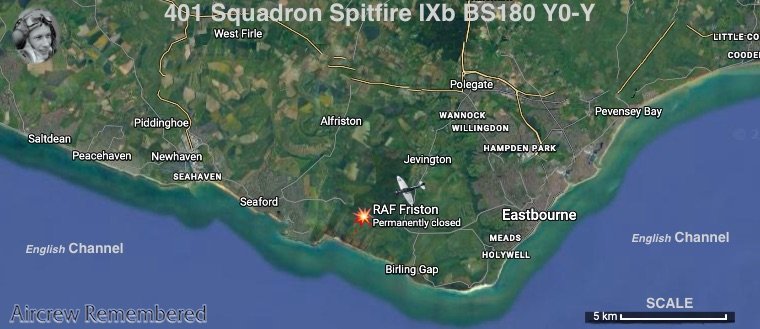
Location: RAF Friston, East Sussex
Pilot: Fl/Sgt. Andrew Lloyd Sinclair, J/17656, RCAF, Age 23 - Safe
Reason for Loss
Previous combat reports (National Archives: AIR 50/136).
7th July 1944. Spitfire IXb. Time up: 11:22 hrs. Down: 13:35 hrs.
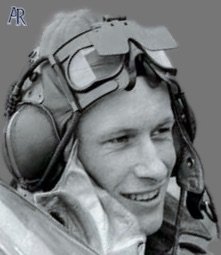
"I was flying Blue 4 when we ran into 4 109's. I chased 3 of them into the area of Lisieux, where I was able to single one out. I fired about 3 - 1 second bursts at about 250 yards. The Me109 didn't seem to be hit and the chase went down to almost the deck, where he pulled up and tried to half roll. This was at about 500 ft. He then flew right into a group of trees, where he burst into flames. I claim 1 Me109 destroyed."
"Returning from the Lisieux area, 3 FW190's made an attack on me. I broke around trying to get onto the tail of one of them, the other two having disappeared. I finally ended up with a head-on attack. I gave him a 1 second burst. He flew on straight and level for a short distance, burst into flames and crashed. The height where this took place was about 2,000 ft. Cine camera was used for both combats. I claim a FW190 destroyed."
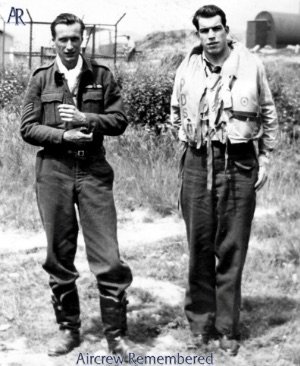
Left: Fl/Sgt. Andrew Lloyd Sinclair (left) with William Kennedy Ferguson (killed on the 15th January 1943 - see here for brief details).
28th August 1942. Spitfire IXb BS180. Time up: not stated.
"I was flying Blue 2 in 401 Squadron on Circus 210, escorting 12 Fortresses to bomb Meaulte. When over Amiens at 26,000 ft I saw 2 FW190's coming in to attack my section from above and from the NW. I broke away from my section and turned to meet them head on. I picked on one FW and fired head on with cannon and machine gun from 250 yards to point blank range. I saw strikes along the fuselage as he broke away and pieces of his A/C were flying off between the cockpit and tail. As he swerved away black smoke was pouring out. This was the last I saw of the E/A as I was then attacked by another E/A. I claim this FW190 as damaged."
He returned with his engine damaged by enemy fire. Unable to make it back to base, he made a wheels-up landing at RAF Friston, with category B damage to Spitfire BS180.
Later, in January 1945, as Fl/Lt. Sinclair he was awarded the DFC. He also served with 185 Squadron in Malta.
During this Circus the squadron lost another pilot: Spitfire IXb BR628, flown by 23-year-old Fl/Lt. James Whitham DFC, J/15281, RCAF, who was killed over Amiens.
 2nd October 1944. Spitfire IXb. Time up: 11:34 hrs. Down: 13:30 hrs.
"I was flying Blue 1 in a section of 4 when we made contact with 8 long-nosed 190's south of Nijmegen, flying west. After one second bursts I saw strikes on one, but was unable to see what happened to it as it half rolled down into cloud at 6,000 ft while I attended to other aircraft. G.G.S. and cine camera used. I claim 1 FW190 as damaged."
(1) Spitfire IX BS180 was later lost over the English Channel on the 23rd September 1943. The pilot, Fl/Sgt. Wiktor Kempka, 793627, PAF, of 303 (Polish) Squadron, was rescued.
BS180 history: FF 17-7-42. 33 MU 19-7-42. 72 Sqn 24-7-42. 401 Sqn 27-7-42 'YO-Y'. e/f, belly landed Friston, AC 28-8-42, Fl/Sgt. A.L. Sinclair (RCAF) safe. GAL RiW 2-9-42. 9 MU 20-2-43. 340 Sqn 16-3-43. 341 Sqn 26-3-43. AST mods 18-4-43. 303 Sqn 31-7-43. Damaged by FW190s near Le Treport and abandoned over the Channel, CE 23-9-43, Fl/Sgt. W. Kempka (PAF) rescued.
(AC - repair is beyond the unit's capacity but can be carried out on site by another unit or a contractor. FF - first flight. GAL - General Aircraft Limited. MU - Maintenance Unit. RiW - repaired in works.)
Burial Details
None - the pilot survived the war (see details below).
Sq/Ldr. Andrew Lloyd Sinclair DFC. Born on the 4th March 1919 in Paris, Ontario, Canada. He enlisted in the RCAF on the 11th November 1940. He trained at No. 3 ITS (graduated 28th May 1941), No. 4 EFTS (graduated 15th July 1941) and No. 9 SFTS, where he got his wings as a Sergeant on the 25th September 1941. He was then sent to the UK.
He served with 401 Squadron in 1942 and was posted to Malta in 1943, serving there with 185 Squadron. He was commissioned on the 27th April 1943, returned to the UK, and rejoined 401 Squadron as a Flying Officer for the summer and autumn of 1944.
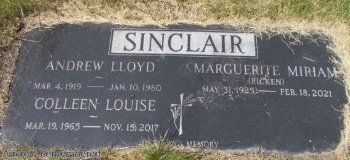
 He survived the war and remained in the RCAF with service number 26337, flying the Sabre jet. Retired from the RCAF on the 4th March 1960. He was the husband of Marguerite Miriam Sinclair (née Ricken, born 31st May 1925, died 18th February 2021, age 95).
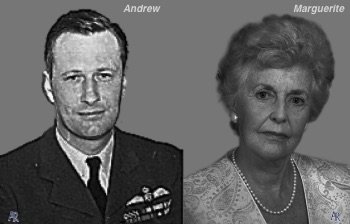
Family and postwar life. Sinclair enlisted at Hamilton, Ontario. Marguerite's obituary (Winnipeg Free Press, 23rd and 27th February 2021) records that as the wife of an RCAF officer she lived in Germany, Alabama, Quebec, Ontario and Manitoba, consistent with service with No. 1 Air Division in Europe and a staff posting in the United States. She attended the reunions of the Sabre Pilots Association of the Air Division Squadrons (SPAADS) and volunteered for over ten years at the Western Canadian Aviation Museum. The couple had six children; their daughter Colleen died in 2017. (Names of living family members have been left out of this supplement.)
Andrew passed away on the 10th January 1980, age 60. Both rest in Assumption Roman Catholic Cemetery, Winnipeg, Manitoba, Canada, in the Garden of Gethsemane.
Others mentioned in this report
Fl/Lt. James Whitham DFC. St. Pierre Cemetery, Amiens. Plot 1. Row B. Grave 12. Son of Charles and Lilian Whitham and husband of Margaret Craig Whitham, of Ottawa, Ontario, Canada.
Fl/Sgt. Wiktor Kempka, 793627, KW x 3. Survived the war. Born on the 8th April 1915 in Jaworzno, Poland.
On the 23rd September 1943 he took off in BS180 at 14:45 hrs on Ramrod 240, part of the 303 and 302 Squadron escort for 72 Marauders bombing Beauvais-Tillé airfield. He was attacked by four FW190s, his engine was damaged and he baled out over the Channel. After sending several Mayday calls he was picked up by a Walrus and its two-Spitfire escort, returning at 17:40 hrs. On the 21st May 1944, flying Spitfire Vb BM565 on Ramrod 905, he was shot down over northern France and became a prisoner of wa
Passed away on the 5th April 2006 in Dukinfield, England.
Supplement
Me 262 crash site: the Dutch loss register (SGLO T4472) places the 5th October 1944 Me 262 at Overasselt-Nederasselt and dates it 6th October, while other sources describe a boggy field north-east of Nijmegen on the 5th. The date of 5th October is supported by the squadron, the DFC recommendation and Luftwaffe sources.
Additional information
Distinguished Flying Cross. Award effective 18th January 1945, London Gazette 26th January 1945, AFRO 471/45 dated 16th March 1945. The recommendation (National Archives AIR 2/9045) is dated 14th November 1944, by which time he had flown 278 sorties (313 operational hours). It notes that on his first tour, in the Middle East, he destroyed one enemy aircraft and damaged another; that in Normandy he destroyed two enemy aircraft on one operation shortly after rejoining the squadron; that his ground attacks destroyed or damaged some 50 enemy vehicles; and that he later led sections through heavy flak to dive-bomb rail targets in north-west Germany and Holland. The award was presented on the 1st December 1948.
Claims. 28th August 1942, one FW190 damaged; 10th June 1943 (Malta, 185 Squadron), half share of an MC202 destroyed; 7th July 1944, one Me109 destroyed (it struck the ground without being hit) and one FW190 destroyed; 2nd October 1944, one FW190 damaged; 5th October 1944, one fifth share of an Me 262 destroyed.
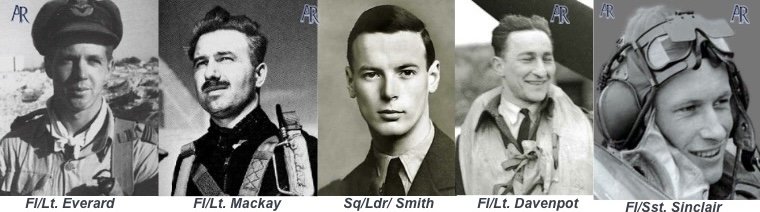
 The first Me 262 shot down by the RAF or RCAF, 5th October 1944. While patrolling over the Nijmegen bridge, Sinclair shared in the destruction of an Me 262 with Sq/Ldr. Roderick Smith, Fl/Lt. Hedley "Snooks" Everard, Fl/Lt. Robert "Tex" Davenport and Fl/Lt. John MacKay of 401 Squadron. His DFC recommendation records it as the first jet aircraft shot down by the RAF or RCAF. The aircraft was Me 262 A-2a Werknummer 170093, coded 9K+BL, of 3./KG 51. Its pilot, Hauptmann Hans-Christoph Buttmann, aged 24, baled out at about 300 metres but his parachute failed to open and he was killed. Photographs of the crater and wreckage are held by the Australian War Memorial (C278031 and C278063), and Rod Smith described the action in a Veterans Affairs Canada "Heroes Remember" interview.
 Fl/Lt. James Whitham DFC. His DFC was awarded on the 18th September 1942, three weeks after his death. He is commemorated on page 124 of Canada's Second World War Book of Remembrance.
Further abbreviations used in the BS180 history. e/f - engine failure. CE - Category E, written off. AST - Air Service Training Ltd.
Memorials
- Fl/Lt. James Whitham DFC is commemorated in St George's Royal Air Force Chapel of Remembrance, Biggin Hill, where his name appears on the panels around the altar, as well as in the Book of Remembrance in Ottawa.
- William Kennedy Ferguson: in 1994 the people of Saint-Martin-des-Entrées renamed their main street "Rue William-Kennedy-Ferguson" in his honour.
- Sq/Ldr. Andrew Lloyd Sinclair DFC: no memorial other than his grave was found.
Sources and Acknowledgements
- Paradie-Dutil RCAF Archive
- National Archives, Kew (AIR 50/136; AIR 2/9045)
- The Carillon Passages / Winnipeg Free Press (obituary of Marguerite Miriam Sinclair)
- Aircrew Remembered Archives
- Australian War Memorial (photographs C278031 and C278063)
- Studiegroep Luchtoorlog loss register (T4472)
- Kracker Luftwafa Archivw
- Find A Grave
- Flying For Your Life (The Canadian Fighter Pilot abd Air Gunner Museum)
- Spitfire Production List


