




Operation: Berlin, Germany
Date: 12th/13th August 1941 (Tuesday/Wednesday)
Unit No: 142 Squadron (motto: 'Determination'), 1 Group, Bomber Command
Type: Wellington II
Serial: W5433
Code: QT:?
Base: RAF Binbrook, Lincolnshire.
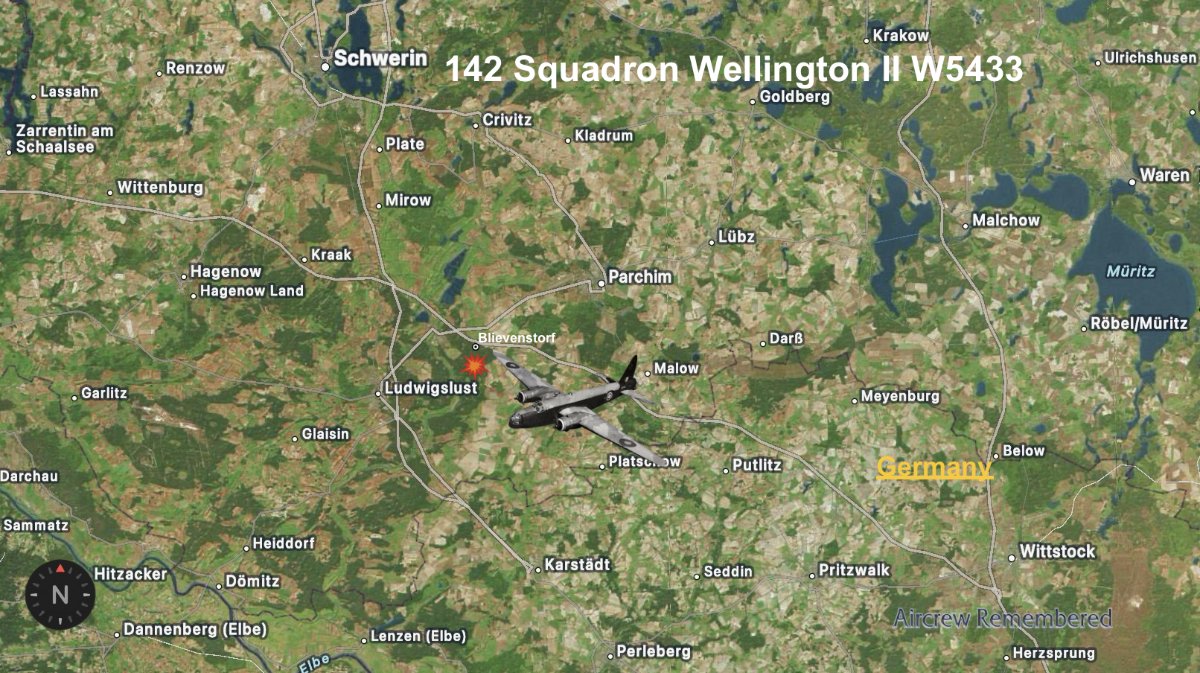
Location: Blievenstorf, some 80 miles (130 km) NW of Berlin
Pilot: Flt Lt. Alexander Douglas Gosman DFC, 40107 RAF Age 26. PoW No. 3713 *(1)
2nd Pilot: Plt Off. John Raymond Gibbon 61312 RAFVR Age 22. PoW No. 3732 * (2)
Obs: Fg Off. Robert McDougal Durham DFC, 45231 RAF Age? PoW No. 3722 * (3)
WOp/Air Gnr: Sgt. Leslie Frith 617340 RAFVR Age 21. PoW No. 146 ** (4)
Air Gnr (Front): Sgt. Kenneth Stanley Holman 751800 RAFVR Age 24. PoW No.145 ** (5)
Air Gnr (Rear): Sgt. James ‘Jim’ Jackson 401518 RNZAF Age 20. PoW No. 148 ** (6)
* Stalag Luft 3, Sagan-Silesia, Germany, now Żagań in Poland
** Stalag Luft 6, Heydekrug, Memelland now Šilutė in Lithuania
REASON FOR LOSS:
W5433 took-off from RAF Binbrook at 20:46 hrs on the night of the 12th/13th August 1941 and joined a force of seventy (70) aircraft on an operation to bomb Berlin with the German Air Ministry in Alexander Platz as the aiming point. Only thirty-two (32) aircraft reached the aiming point of which nine (9) where lost.
W5433 was last heard on the w/t reporting that the port engine had failed and the aircraft was being abandoned.
W5433 was claimed by Flak from 3. Flak Div. and Flakgruppe Süd. The aircraft crashed near Blievenstorf at 01:06 hrs. (Note: The victory was confirmed by OKL on the 29th February 1942) (Ref 1, p26).
(1) The Distinguished Flying Cross (DFC) was awarded to Flt Lt. Gosman whilst with 142 Sqn effective 11th August 1941 (London Gazette 19th December 1941).
After he was captured on the 13th August he was transferred to Dulag Luft, Oberursel arriving there on the 15th August. After the statutory interrogation and solitary confinement on the 9th September he was transferred to Oflag XC in Lübeck, Northern Germany arriving there the next day.
In October that year he was transferred to Oflag VIB, which was SW of the village of Dössel (now part of Warburg) in NW Germany. On the 7th September 1942 he was transferred Oflag XXIB located at Szubin located a few miles SW of Bydgoszcz in Poland arriving there the next day.
On the night of the 27th January 1945, with Soviet troops only 16 mls (26 km) away, orders were received to evacuate the PoWs to Spremberg which is to the west of Sagan-Silesia. The PoW’s were informed of the evacuation, which was on foot, at about 22:00 hrs the same night and were given 30 mins to pack and prepare everything for the march. The weather conditions were very difficult, with freezing temperatures, and it was snowing accompanied by strong winds. There was 6 inches (15 cm) of snow and 2000 PoWs were assigned to clear the road ahead of the main groups.
After a 34 miles (55 km), the PoWs arrived in Bad Muskau where they rested for 30 hours. The PoWs were then marched the remaining 16 miles (26 km) to Spremberg where they were housed in empty garages, storerooms. During next days, PoWs were divided up according to Compounds, and they were led to railway sidings and loaded into tightly packed carriages.
On the 4th February 1945 he was amongst the PoWs transferred to Stalag 3A at Luckenwalde in Brandenburg, Prussia. On the 22nd April 1945 as the Russians approached the camp the guards fled leaving the prisoners to be liberated by the Red Army.
Stalag 3A was turned over to the Americans on the 6th May at which time the Senior American Officers (SAO) took over the running of the camp until all the PoWs were evacuated.
Flt Lt. Gosman DFC was interviewed on the 12th May 1945
Alexander Douglas Gosman was born on the 10th June 1915 in Bromley, Kent. He enlisted in the RAF on the 12th July 1937. Alexander passed away on the 5th April 1998 in Hastings, West Sussex.
(2) After being captured near Berlin Plt Off. Gibbon’s PoW story matches that of Flt Lt. Gosman DFC until he was amongst the Stalag Luft 3 PoWs who arrived at Spremberg where they were housed in empty garages, storerooms.
On the 2nd February he was amongst the North, East and remaining West compound PoWs were sent to Marlag und Milag Nord at Westertimke in Lower Saxony.
- Marlag is an acronym for Marinelager (Navy PoW camp), Milag is short for Marine-Interniertenlager (Marine internment camp), and Nord is German for ‘north’.
On the 2nd April 1945 the Commandant announced that he had received orders to leave the camp with most of his guards, leaving only a small detachment behind to hand over the camp to Allied forces, who were already in Bremen.
However, that afternoon a detachment of over a hundred SS-Feldgendarmerie entered the camp, mustered over 3,000 men and marched them out, heading east. The next day, at around at 10:00 hrs the column was strafed by RAF aircraft, and two PoWs were killed.
- It is not known if Plt Off. Gibbon was amongst the PoWs who were mustered, remained at the camp or escaped from the marching column because the records are not complete.
Over the next few days the column was attacked from the air several times. Finally the Senior British Naval Officer (SBNO), who was later killed in a strafing attack by RAF aircraft, offered the Germans the PoW’s parole, in return for being allowed to rest during the day and march at night. The Germans agreed.
On the 9th April 1945 the guards at Marlag-Milag moved out and were replaced by older men, presumably local Volkssturm. Meanwhile, the column slowly headed east, finally crossing the River Elbe, north of Hamburg, on the 18th April.
On the 27th April the camps were liberated by elements of the British Guards Armoured Division. The next day, the 28th April, the column finally arrived at Lübeck on the Baltic coast. They were liberated by the British 11th Armoured Division on the 1st May 1945.
John Raymond Gibbon was born on the 24th June 1919 in Montreal, Canada. Prior to enlisting in the RAFVR during 1939 he was employed as a clerk with a Haulage Contracting and Motor Engineering company in Cornwall. No further biographical information found.
(3) The Distinguished Flying Cross (DFC) was awarded to acting Fg Off. Durham whilst with 142 Sqn effective 11th August 1941 (London Gazette 19th December 1941).
Fg Off. Durham was the Squadron Bombing Leader.
A ‘General Questionnaire for British/American Ex-PoWs’ has not been found for Fg Off. Durham although it is known that at one point in time he was held at Stalag Luft 3, Sagan-Silesia in Germany.
(4) Sgt. Frith was that day and transferred to Dulag Luft, Oberursel. After the statutory interrogation and solitary confinement on the 20th August 1941 he was transferred to Stalag 3E at Doberlug-Kirchhain in Lower Lusatia, Brandenburg arriving there the next day.
- This was a camp to house British Army PoWs but in July 1941 it was used to take the overflow of RAF NCO PoWs lost in Bomber Command summer offensive.
In May 1942 he was transferred to the newly opened Stalag Luft 3 at Sagan-Silesia, in Germany and remained there until June 1943 when he was transferred to Stalag Luft 6 at Heydekrug in Memelland
In early 1944 the Russian Army were advancing into the Baltic States from the North and the East preparation for evacuating the camp was being made. PoWs from Stalag Luft 6, the camp closest to the Russian advance, were in the "northern route" of the force-marches, and were transported to Stalag 20A by train in July 1944, and from there took part in the forced-march
He arrived at Stalag 357 at Thorn (Toruń) in Poland on the 17th July 1944. On the 1st September 1944 the PoWs were force-marched from Thorn (Toruń) in Poland to the site of the former Stalag 11D, with construction being carried out by the Italian PoWs from Stalag 11B. The camp was commonly known as Stalag 357, Fallingbostal but officially the designation was Stalag 357, Oerbke.
From the date of his interview it appears that he was not amongst the PoWs who were force-marched from the camp on the 7th April 1945. The camp was liberated on the 16th April 1945 by British troops from B Squadron 11th Hussars and the Reconnaissance Troop of the 8th Hussars. They were met at the main gate of Stalag 357 by a guard of Airborne troops, impeccably attired and led by RSM Lord.
The now Warrant Officer (WO) Firth was interviewed on the 26th April 1945.
Leslie Firth was born on the 14th February 1920 in Bradford, West Yorkshire. Prior to enlisting in the RAF on the 10th August 1938 he was an Machine Tool Engineer. No further biographical information found.
(5) After being captured Sgt. Holmon’s PoW story matches that of Sgt. Firth (Serial 4 above) until he arrived at Stalag 357, Fallingbostal. From the date of his interview it appears that he was amongst the PoWs who were force-marched from the camp.
In early April 1945 the PoWs were informed by the Commandant Oberst (Col) Hermann Ostmann that the about 10/12,000 Allied PoWs were being evacuated from the camp in the face of the Allied advance. On the 7th April 1945 Sgt. Holmon was amongst the men who were marched from the camp in columns of 2,000 in the general direction of Lauenburg on the Elbe River. After about ten (10) days they arrived at the village of Ludersburg, north of Luneburg on the west side of the Elbe river where they stayed overnight. Early the next morning, on the 19th April at about 10:00 hrs the column crossed the Elbe via a pontoon bridge and passed through the small town of Lauenburg before crossing the frontier into Mecklenburg. The column then turned east along a raised road to the village of Horst where they were afforded a short rest before arriving at Gresse, some 15 km NE of Lauenburg. Here they were issued with Red Cross parcels.
At around 10:30 hrs whilst the column was on a narrow country road amidst open fields they heard aircraft flying nearby which turned out to be a flight of seven (7) or eight (8) RAF Typhoons which dived in line-astern and strafed the column with rockets and dropped anti-personnel bombs all except the last aircraft which wheeled away at the last moment perhaps realising that they had mistaken the columns as retreating German troops. It was reported that upwards of sixty (60) allied PoW’s were killed and many were wounded.
- It was established that a total of forty-two (42) named Allied PoWs died either on the 19th April or in the following days. In addition there was one (1) unnamed American killed who was has yet to be identified;
- Six (6) German guards were also killed and a number were wounded. None have been identified;
- A total of forty-five (45) named and one unnamed wounded were admitted to the Boizenberg-on-Elbe Cottage Hospital. Twenty-seven (27) were seriously injured, seven (7) of whom succumbed to their injuries in the following days.
The then Warrant Officer (WO) Deans confronted Oberst (Col) Ostmann and bluntly gave him a choice, to be captured by the Russians or the British. Oberst Ostman provided WO. Deans with a pass and a German guard, and they headed west to contact the advancing British troops. On the 1st May WO. Deans and his guard were sheltering in a house east of Lauenberg when they heard over the radio the news of the death of Adolf Hitler. The next morning the house was overrun by troops of the British 6th Airborne. WO. Deans was taken to the commander of VIII Corps where he explained the situation. He was provided with a captured Mercedes car and drove back to Gresse. Two (2) days later the PoW column marched back across to the British lines.
- A number of so far unidentified Allied PoWs were killed in escape attempts but a large number of the men finished the march.
The now Warrant Officer (WO) Holman was interviewed on the 5th May 1945
Kenneth Stanley Holman was born on the 13th August 1916 in Wembley, Middlesex. Prior to enlisting in the RAF he was employed in the Furnishing industry on the 8th June 1939. Kenneth passed away in January 1995 in Stamford, Lincolnshire.
(6) After he was captured Sgt. Jackson he followed Sgt. Frith and Sgt. Holmon to Dulag Luft, Oberursel, Stalag 3E at Doberlug-Kirchhain and Stalag Luft 3 at Sagan-Silesia.
In November 1942 he was transferred to Stalag Luft 1 at Barth-Vogelsang. In November 1943, until the end of the war Stalag Luft 1 became a camp for commissioned officers of the Allied Air Forces and the SNCOs were transferred to Stalag Luft 6 at Heydekrug in East Prussia.
In early 1944 the Russian Army were advancing into the Baltic States from the North and the East preparation for evacuating the camp was being made. PoWs from Stalag Luft 6, the camp closest to the Russian advance, were in the "northern route" of the force-marches, and were transported to Stalag 20A by train in July 1944, and from there took part in the forced-march. He was amongst the PoWs who stopped at Stalag Luft 4 at Groß-Tychow in Pomerania.
In late January 1945 the PoWs could see the distant flash of artillery fire from the east. On the 28th January the evacuation was ordered, and a train loaded with mostly sick and wounded were transported to Stalag Luft 1 at Barth, Germany. On the 2nd February another train load was transported to Stalag 13D at Nürnberg, Germany. Over a period of 3 days from the 6th February some 6,000 prisoners were ordered to leave the camp on foot with little notice. The PoWs in groups of 250 to 300 were marched, heading west, covering long daily distances on starvation rations.
On the 28th March the column arrived at Ebbsdorf where a large number of the men were jammed into railway box cars and sealed in for some 33 hours until the train arrived at Stalag 11B, near Fallingbostel on the 30th March. Many camps on the eastern edge of Germany were combined into one large camp here. The treatment was a repetition of that at previous camps, with the exception of food, of which there was virtually none. There were no beds or bedding in the buildings.
On the 6th April after only being in this camp for a week, Lagers A and B from Stalag Luft 4 were forced on their final march, this time heading east, doubling back on the route they took to arrive. This last march only lasted approximately three weeks but was just as harsh as the previous march except for the treatment by the Germans, which was somewhat better. There was still little or no food available, and the pace was much slower, advancing 4 to 5 miles a day.
On the morning of the 2nd May 1945 the main column was resting in a ditch next to the River Elbe near Lauenburg, Germany, when British troops arrived and liberated the camp. The now liberated PoWs were given virtually nothing and told to march west. The march from beginning to end, spanned 86 days over an estimated 600 miles. Seven PoWs were declared to have died during the march by the Casualty Branch of the Adjutant General’s Office.
The now Warrant Officer (WO) Jackson was interviewed on the 11th May 1945.
James ‘Jim’ Jackson was born on the 25th October 1920 in North Auckland, New Zealand. He was employed as a clerk prior to enlisting in the RNZAF on the 4th April 1940. James passed away on the 25th November 2010 in Northland, New Zealand.
BURIAL DETAILS:
None – all the crew survived
Researched by Aircrew Remembered and dedicated to the crew and their families (29th Oct 2026).
Other sources listed below:
References:
1. Nachtjagd Combat Archive (13 July 1941 - 29 May 1942) The Early Years Part 2 - Theo Boiten.


