




Operation: Scramble
Date: 25th June 1944 (Sunday)
Unit: No. 421 Squadron, RCAF
Type: Spitfire IX
Serial: MJ870
Code: AU-G
Base: A.L.G. B.2, Bazenville, France
Location: Over airfield
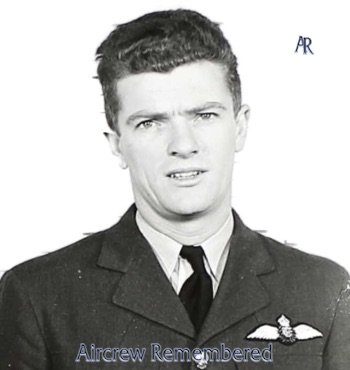
Pilot: Fl/Lt. Charles Donald Grant, J/5807, RCAF, Age 24 - Killed
Reason for Loss
Early Life
Grant grew up on his family's farm in Hillier, Prince Edward County, Ontario, attending Cold Creek School from 1925 to 1932 and Wellington Consolidated School from 1932 to 1937, where he completed his Junior Matriculation apart from three subjects. He worked as a farm labourer for Canadian Canners before returning to work the family farm alongside his mother. His father, Charles Wood Grant, had died in 1937.
Before joining the RCAF, Grant served briefly in the non-permanent militia, attesting with the 2nd Battalion, Hastings and Prince Edward Regiment, at Wellington, Ontario, on 16th July 1940. He gave his occupation as “Farmer” and named his mother, Mary Grant, as next of kin.
Grant applied to the RCAF on 5th June 1940, requesting flying duties as a pilot or observer. In his own hand, he noted that if he were called up that summer, “I can get a man to work it until fall,” so that the family farm would be covered in his absence. He listed his sports as hockey, baseball and tennis, played moderately, and gave as references the manager of the Canadian Canners farm and the principal of Wellington Consolidated School.
He formally attested into the RCAF at Toronto, Ontario, on 24th October 1940. His attestation paper records his birthplace, his father, Charles Wood Grant (by then deceased), his mother, Mary Agnes Grant (née Campbell), and his religion as Anglican.
 Pilot Training
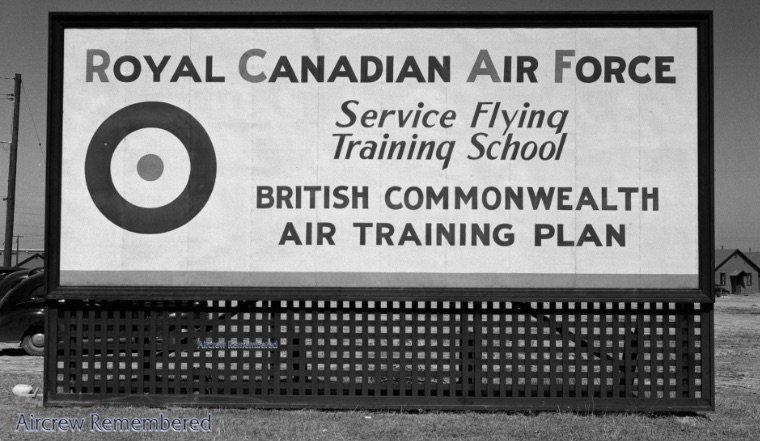
Grant trained through No. 6 Elementary Flying Training School, Prince Albert; No. 10 Service Flying Training School, Dauphin, Manitoba; and the Central Flying School, Trenton. His final training assessment at No. 10 S.F.T.S., Dauphin, in June 1941, rated him of “average ability and progress, quiet and keen,” noted above-average night flying and determination and initiative, and recommended him for a fighter squadron. He was awarded his Pilot's Flying Badge on 21st June 1941.
Like a number of experienced pilots of his era, Grant subsequently spent time as a flying instructor. His individual flying record shows duty at No. 1 Operational Training Unit, Bagotville, Quebec, in mid-1943, by which point he had logged nearly 250 hours of total flying time.
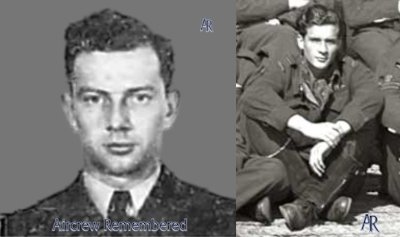
Above: Fl/Lt. Grant on left with Fl Lt. Driver
The Accident
By June 1944, Flight Lieutenant Grant was flying Spitfire IXs with No. 421 Squadron, operating from a forward RCAF landing strip in Normandy, less than three weeks after the D-Day invasion. On the evening of 25th June 1944, at approximately 1930 to 1940 hours, 421 and 403 Squadrons were scrambled from opposite ends of the same landing strip, while a third unit, 341 Squadron, was simultaneously cleared to take off. All three squadrons were operating in the thick dust thrown up by aircraft using the unpaved strip, which obscured both pilots' visibility and the flying control officer's warning signals.
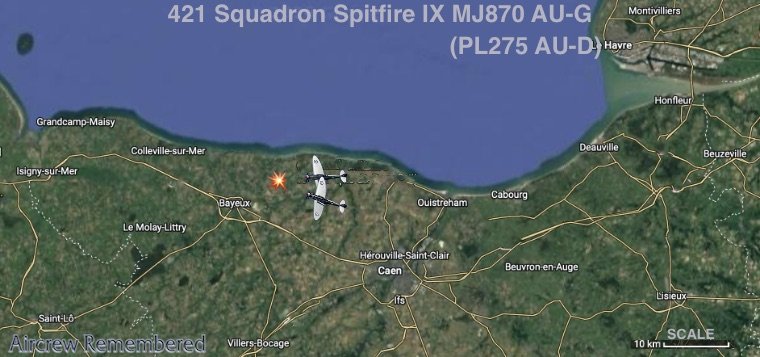
421 and 403 Squadrons were at readiness at either end of the landing strip. If scrambled, 403 Squadron was to take off first with six aircraft, and 421 Squadron would then take off in the opposite direction. F/Lt. Paul Gilbert Johnson J/20050 (note), leading 421 Squadron, counted six aircraft take off over his head and at once proceeded to take off with his No. 2. A short way down the strip, he saw a red light directed at him from the control tent and brought his aircraft to a stop on the port side of the landing strip.
Right; F/Lt. Paul Gilbert Johnson
F/Lt. Grant, his No. 2, did the same, but stopped on the starboard side. After a reasonable interval, F/O. Driver, the third man to take off in 421 Squadron, his vision of the strip obscured by dust, assumed that the first two aircraft were already airborne and proceeded to take off. As Driver came down the runway, Grant suddenly taxied across it from starboard to port, with the apparent intention of rejoining his No. 1. In doing so, he taxied directly into Driver's path, and the collision occurred.
When the pilots of 341 Squadron were given permission to take off, the flying control officer had not told them that a squadron was positioned at either end of the landing strip and might be scrambled. Nor were they aware that one of these squadrons might take off downwind. Once the pilots of 341 Squadron saw 403 Squadron take off, with no further sign of aircraft movement in that direction, they proceeded to take off themselves. This caused the two leading aircraft of 421 Squadron to be signalled to a stop by the flying control officer partway down their take-off run. The next aircraft to take off from 421 Squadron then collided with one of those stopped aircraft. Had 341 Squadron been properly briefed before take-off, the accident probably would not have happened. The flying control officer did all in his power to stop 341 Squadron taking off, flashing red Aldis signals and firing red Very cartridges at them, but the dust raised by the scrambling aircraft was so thick that these signals were obscured. Had it not been for the dust, F/O. Driver would probably have seen both the signals from the flying control tent and the aircraft ahead of him on the runway.
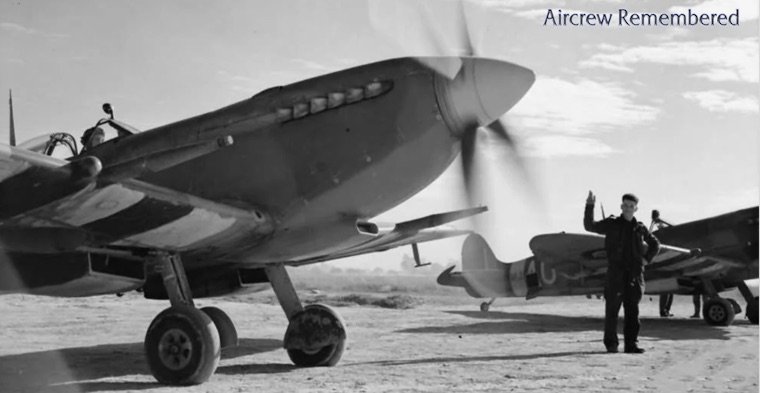
421 Squadron A.L.G. B.2, Bazenville, France
The subsequent Court of Inquiry found that the accident's main contributory cause was the dust, which impaired everyone's vision and obscured the warning signals. Its second contributory factor was the failure to properly brief the leader of 341 Squadron before take-off. The Court concluded that the only way to prevent similar accidents was for all aircraft operating from the strip to be strictly controlled by radio, with little reliance placed on visual signals. It further noted that, at the time of the accident, flying control at the field had no equipment beyond two Very pistols and two Aldis lamps, the rest having been lost at sea; it was understood that new equipment had since been supplied.
Flight Lieutenant J.A. McLean, Medical Officer, 416 Squadron, RCAF, reported on the aftermath:
“On June 25th, 1944, at approximately 1940 hours, in response to a call from the flying control tent, F/Lt. Munroe and I attended the scene of an accident on the landing strip near the control tent. I supervised and helped to remove the body of a pilot in a wrecked Spitfire aircraft. The body was later identified as F/Lt. C.D. Grant. He had met instantaneous death and had suffered almost total decapitation. The pilot of the other aircraft involved in the collision, F/O. R.G. Driver, was taken to wing sick quarters and, on examination, was found to be suffering from multiple abrasions and lacerations of the face and scalp, a fractured nasal bone, a fractured left wrist, and an injury to the ligaments of the right knee. After first aid treatment, he was removed by ambulance to 52 Mobile Field Hospital.”
Burial Details
Fl/Lt. Charles Donald Grant. Hottot-les-Bagues War Cemetery, Grave 1.A.11. Born 27th May 1920 in Ontario, Canada. Son of Charles Grant and of Mary Grant, of Consecon, Ontario, Canada. Epitaph: “There Is A Link Death Cannot Sever, Love And Remembrance Last For Ever.”
Grant never married. His father, Charles Wood Grant, had died in 1937; his mother, Mary Agnes (née Campbell), had since remarried and was living as Mrs. Hugh Weir, of Consecon, Ontario, at the time of his death. He had a brother, Cpl. W.D. Grant, serving overseas with the 3rd Canadian Infantry Division's Ordnance Field Park, and a sister, Janet Agnes Kimmett, of Deseronto, Ontario.
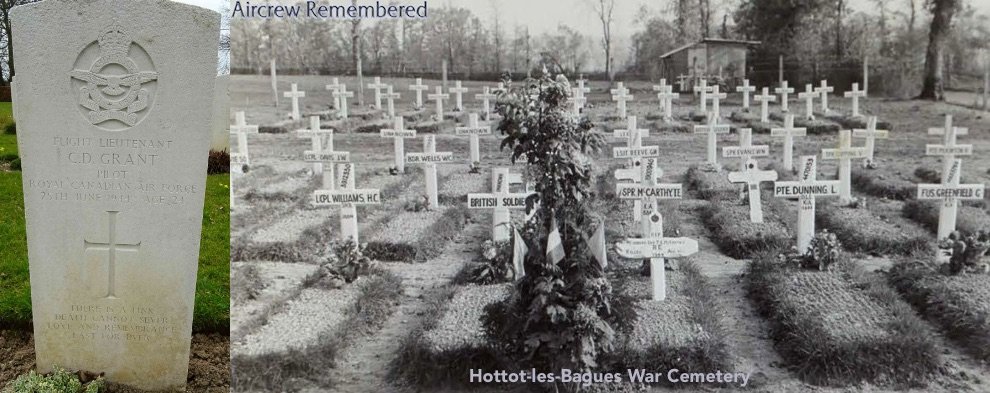 Hottot-les-Bagues War Cemetery (right post WW2)
Hottot-les-Bagues is a village some fourteen kilometres south-east of Bayeux, in the Calvados department of Normandy. The war cemetery lies on rising ground beside the D9, between Hottot-les-Bagues and Juvigny-sur-Seulles. It holds over 1,000 Commonwealth burials of the Second World War, the great majority of them brought in after the war from graves and small burial grounds across the surrounding district, where fierce fighting raged through June and July 1944 as Commonwealth forces pressed south from Bayeux in the effort to encircle Caen, including the heavy engagements around nearby Tilly-sur-Seulles.
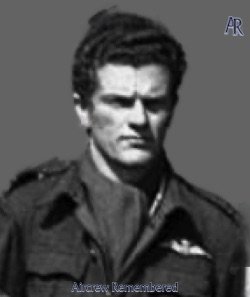
Note: 24-year-old Fl/Lt. Paul Gilbert Johnson (DFC) was killed on the 18th Jult 1944. He was engaged in strafing enemy transport when the port wing of his Spitfire LFIX aircraft MK 809 hit a tree. He could not bail out and attempted to return to base. He was killed when the Spitfire went out of control while flying at 7,000 feet and crashed one mile west of the landing strip northwest of Caen, France. Flight Lieutenant Johnson was an ace, having destroyed five enemy aircraft (Ace status).
Beny-sur-Mer Canadian War Cemetery, Calvados, Basse-Normandie, France. Plot XVI. Row H. Grave 8. Born on the 05 th March 1930Son of Paul S. Johnson and Daisy I. Johnson, of Bridgeport, Epitaph: 'There Is A Link Death Cannot Sever Love And Remembrance Last For EverConnecticut, USA.
Supplementary Notes
Two Burial location: F/L Grant's RCAF service file records that he was originally buried on 26th June 1944 in the Arromanches Military Plot, Grave B-4, close to where he fell. Hottot-les-Bagues War Cemetery, his permanent resting place, was established chiefly as a concentration cemetery, gathering in burials from smaller wartime grave sites across the district after the war. It therefore appears that his remains were later moved from the original Arromanches Military Plot to their permanent grave at Hottot-les-Bagues, in the ordinary course of the Commonwealth War Graves Commission's post-war reburial programme, though no separate exhumation record has yet been found to confirm this directly.
Sources and Acknowledgements
- Paradie-Dutil RCAF Archives
- Fly For Your Life - WW2 Pilots
- Aircrew Remembered Archives
- Commonwealth War Graves Commission
- Library and Archives Canada - RCAF Personnel and Estates File, F/L C.D. Grant, J5807


