




Operation: Patrol
Date: 7th June 1944 (Wednesday)
Unit: No. 421 Squadron RCAF (motto: Bellicum Cecinere - They Have Sounded the War Trumpet)
Type: Spitfire IX
Serial: NH183
Code: AU-K
Base: RAF Tangmere, West Sussex
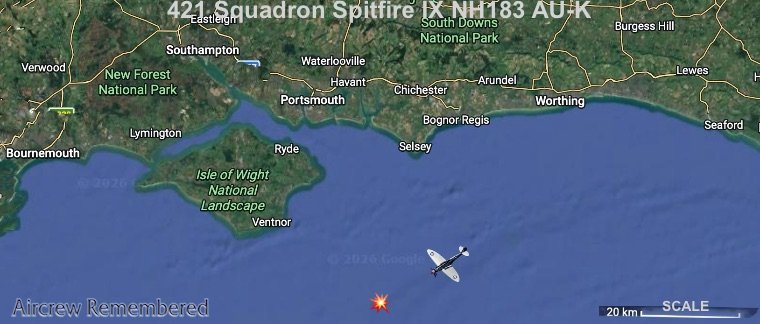
Location: English Channel, 10-12 miles off St. Catherine's Point, Isle of Wight
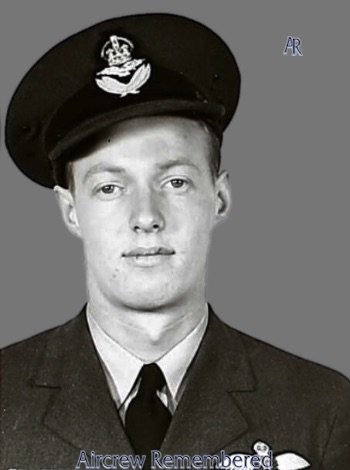
Pilot: F/O. Robert Jackson Grigg, J/21140, RCAF, Age 22 - Missing, presumed killed
Reason for Loss
On the day after D-Day, No. 421 Squadron flew four patrols over the Western Assault Area, covering the American beaches in Normandy. Earlier in the day the squadron had already lost Fl/Lt. William John Drope, who baled out off Maisy on the second patrol and whose parachute failed to open.
F/O. Grigg took off on the evening of 7th June on the fourth and final patrol of the day, Operation No. 127/21, flying as the squadron's spare pilot. A spare aircraft accompanied a squadron in case another pilot had to drop out, and returned to base if it was not needed. A short distance off the English coast on the way out he was seen to turn back, apparently returning to base as ordered. No one went with him, as it was assumed he was having no difficulty.
A few moments later, at approximately 20:15 hrs, he made a brief emergency "Mayday" call over the radio, indicating that he expected to abandon his aircraft or attempt a landing in the sea. His last known position was 10 to 12 miles off St. Catherine's Point, Isle of Wight. Although his position was known quite accurately and an extensive search was organised, no trace of him was found. No reason for the emergency was ever established.

Operations Record Book detail entry:
"127/21. Patrol of Western Assault Area. Patrol uneventful. No enemy aircraft, light flak, inaccurate and moderate. Weather over target, about 1500-5000 ft. En route very hazy. F/O R.J. Grigg returning as spare man, missing. Particulars unknown. Believed 10-12 miles off St. Catherines point. Approx. 2015 hours, pilot heard to give Mayday."

Operations Record Book daily summary:
"7.6.44. D+1 arrived and squadron once again carrying out patrols. Boys felt very discouraged upon hearing that 126 Airfield had bagged a flock of JU 88's meanwhile we had not even seen enemy aircraft let alone mixed with them. On top of this the squadron suffered the loss of two popular members of the squadron. On the second patrol of the day F/L W.J. Drope was forced to bale out off MOISY, due to mechanical trouble and his parachute did not open. This was a very poor way for JOHNNY to 'buy it' since he was very popular and one of the best and most consistent members of the squadron. On the last patrol of the day F/O R.J. Grigg gave a brief 'May day' over the R/T. He became separated from the rest of the squadron while flying spare on this patrol and he was never seen or heard from again. He failed to return to base and at the writing of this note he still remains missing."
Three days after his loss the squadron wrote to his grandfather and next of kin, James Grigg Sr., at Bruce Mines, Ontario:
"10th June, 1944.
Dear Mr. Grigg: As you already know, your grandson, Flying Officer R.J. Grigg, has been reported missing from operations. I am writing this to offer my condolences and to give you what information I can. Flying Officer Grigg took off with the Squadron on the evening of June 7, on an operational sortie over enemy territory. He was flying as spare man to the Squadron. When a short distance off the English coast on the way out, he was seen to turn back, ostensibly to return to base as ordered. No one accompanied him since it was assumed that he was experiencing no difficulty. A few moments later he was heard to give an emergency radio transmission, indicating that he expected to abandon his aircraft somewhere off the English Coast. Nothing further was heard from him, and although an extensive search was organized, and his position known quite accurately, he was not found that evening. Since then we have had no further news of him. There was considerable shipping in the area where he presumably abandoned his aircraft, and without wishing to buoy up your hopes unduly it would seem reasonable to assume that he was picked up by one of these ships.
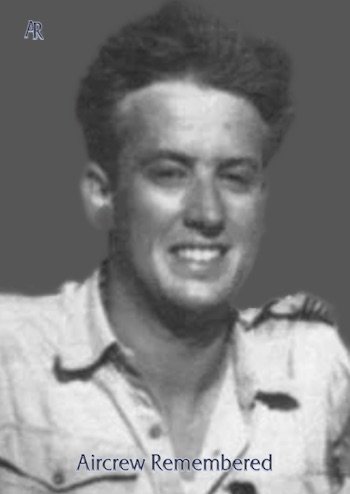
Right: His Commanding Officer, Sq/Ldr. Walter Allen Grenfell "Wally" Conrad
At any rate by the time you receive this letter, you will have had definite news from official sources as to whether or not he was found. Unfortunately I am afraid no definite reason can be given as to why he may have had to bail out, nor can I be sure that he got safely away from his aircraft if and when he definitely decided to abandon it. As with yourself we are hoping for the best.
Bob had only been with the squadron for a short time since returning from the hospital only a few months ago, but he had been extremely keen and conscientious and his loss has been keenly felt by the whole squadron. As his Commanding Officer I had a very high regard for his qualities as a pilot and an officer.
His personal kit will be taken care of at this end and depending on whatever further information we have will be either held here for him, or forwarded to you eventually. If I can be of any further assistance in any way please don't hesitate to call on me; as a personal friend of Bob's I should only be too glad to help.
In closing may I offer the sincerest sympathy from myself and all members of the Squadron. Very sincerely yours, (W.A.G. Conrad), for Officer Commanding, No. 421 Squadron, RCAF."
On 15th June 1944 the RCAF Casualty Officer in Ottawa wrote to confirm the news:
"Dear Mr. Grigg: It is with deep regret that I must confirm our recent telegram informing you that your grandson, Flying Officer Robert Jackson Grigg, is reported missing on Active Service.
Advice has been received from the Royal Canadian Air Force Casualties Officer, Overseas, that your grandson was the sole occupant of an aircraft which failed to return to its base after taking off to carry out air operations on June 7th, 1944. He was last heard from at a position ten or twelve miles off St. Catherines Point, Isle of Wight, when he gave a signal that he was preparing to attempt a landing in the sea. Nothing further has been heard.
The term 'missing' is used only to indicate that his whereabouts is not immediately known and does not necessarily mean that your grandson has been killed or wounded. Enquiries have been made through the International Red Cross Society and all other appropriate sources and I wish to assure you that any further information received will be communicated to you immediately.
Your grandson's name will not appear on the official casualty list for five weeks. You may, however, release to the Press or Radio the fact that he is reported missing, but not disclosing the date, place, or his unit.
Permit me to extend to you my heartfelt sympathy during this period of uncertainty and I join with you and the members of your family in the hope that better news will be forthcoming in the near future. Yours sincerely, R.C.A.F. Casualty Officer, for Chief of the Air Staff."
No further news was ever received. On 31st May 1945 the RCAF issued a Certificate of Presumption of Death, stating that he was presumed for official purposes to have died on or since 7th June 1944.
Burial Details
F/O. Robert Jackson Grigg. Runnymede Memorial, Panel 246. Born on 1st July 1921 in Sault Ste. Marie, Ontario, Canada. Son of Dr. William George Grigg, a dentist who died of pneumonia in 1930, age 36, and Isabel Bush Grigg, who was killed in a motor accident in 1932, age 32. Both parents had died before he enlisted. After his mother's death he and his sister, Marjorie Isabel, were cared for by his uncle and aunt, Fred S. Dent and Florence Elizabeth Dent, at 9 Coulson Avenue, Sault Ste. Marie. In his will he left each of them a token sum "as a token of my deep appreciation of what they have done for me and my sister Marjorie Isabel Grigg during the years since my mother's death." He also had a brother, James Bush Grigg. His official next of kin was his grandfather, James Grigg Sr., of Bruce Mines, Ontario.
The CWGC and other sources state that he was 23 at the time of his loss. This is incorrect: his attestation paper, service records and Ontario death registration all give his date of birth as 1st July 1921, which made him 22.
 Before the War
He attended Alexander Muir School (1926-35), Sault Collegiate Institute (1935-40), where he gained his Senior Matriculation, and Sault Technical School (1940-41), where he studied typing. He worked as a clerk for Canada Packers Ltd. and served as a private in the Sault Ste. Marie and Sudbury Regiment (NPAM) in 1940-41. He played the trumpet in military and dance bands in the Sault, listed tennis, hockey and badminton as his sports, and gave music and model aeroplane building as his hobbies. His recruiting officer noted that he "neither smokes nor drinks". At enlistment he stood 5 ft 10½ in tall, with a fair complexion, fair hair and blue eyes.
Service and Training
- 13th October 1941 - Enlisted at North Bay, Ontario, as AC2, R/130138
- No. 2 Manning Depot, Brandon, Manitoba, and No. 12 Equipment Depot, Montreal
- No. 3 Initial Training School, Victoriaville, Quebec (Course 48, 2nd March to 24th April 1942)
- No. 4 Elementary Flying Training School, Windsor Mills, Quebec (Course 57, 7th June to 31st July 1942) - Tiger Moth
- No. 2 Service Flying Training School, Uplands, Ottawa (Course 61, 3rd August to 20th November 1942) - Harvard
- 20th November 1942 - Awarded pilot's wings and commissioned as Pilot Officer, J/21140
- December 1942 - Sailed from Halifax; disembarked in the UK on 29th December 1942
- 20th May 1943 - Promoted to Flying Officer
- No. 57 Operational Training Unit (Course 50, 2nd June to 10th August 1943) - Spitfire
- 23rd October 1943 - Posted to No. 421 Squadron RCAF
His instructors' reports were consistently positive. At Uplands he was described as "a good average pilot... Likeable, cheerful, enthusiastic. A hard worker", and was recommended for a commission. At No. 57 OTU he was assessed as "a sensible and reliable type of officer who is very well disciplined. A good section leader and an asset to any squadron."
An Earlier Crash - 23rd November 1943
At 11:15 hrs on 23rd November 1943, on a non-operational cine-camera exercise over Kent, his Spitfire IX, BS398, suffered an engine failure. The accident report records a fire and the aircraft was written off (Category E). F/O. Grigg was injured, with a small bone broken in his leg, and was admitted to Barming Military Hospital, Maidstone. The cause of the engine failure was recorded as unknown, and a Court of Inquiry was convened. This explains the reference in his Commanding Officer's letter to his "returning from the hospital only a few months ago."
 Runnymede Memorial
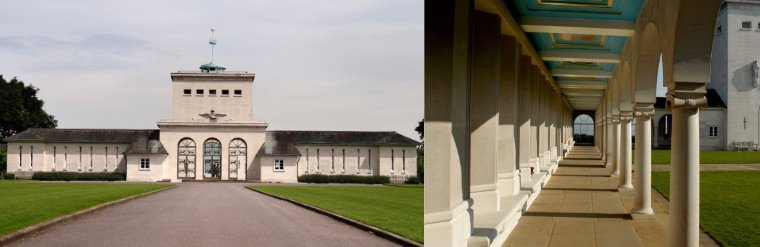
The Air Forces Memorial at Runnymede, Englefield Green, Surrey, overlooks the River Thames on Cooper's Hill. It commemorates by name more than 20,000 airmen and women of the Commonwealth air forces who were lost during the Second World War in operations from bases in the United Kingdom and north and western Europe, and who have no known grave. The memorial was designed by Sir Edward Maufe and unveiled by Her Majesty Queen Elizabeth II in October 1953.
Sources and Acknowledgements
- National Archives, Kew - AIR 27/1828 (No. 421 Squadron Operations Record Book, June 1944)
- Library and Archives Canada - Service file of F/O. R.J. Grigg, J/21140
- Commonwealth War Graves Commission
- Veterans Affairs Canada - Canadian Virtual War Memorial
- Paradie-Dutil RCAF Archive
- Canadian Aircraft Serials Personnel Information Resource (CASPIR)
- Aircrew Remembered Archives
Supplement - Additional Information
The following details were found in F/O. Grigg's RCAF service file during research for this page. They may be added to the main report as required.
The Officially Recorded Outcome
His service record cards note him as missing after air operations on 7th June 1944 (Casualty List No. 740, dated 12th June 1944) and later as presumed dead (Casualty List No. 1030). The RCAF Casualty Notification of 31st May 1945 records him as "previously reported 'missing' 7-June-44 after air operations (overseas), now 'presumed dead' 7-June-44 for official purposes". His Ontario death registration, completed in June 1945, gives his age as 22.
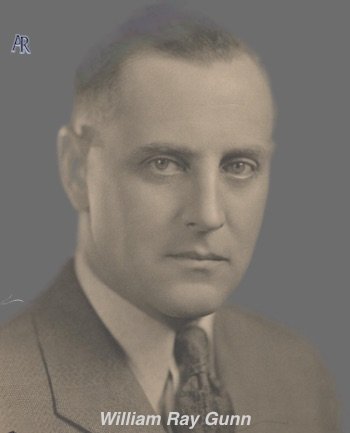
On 26th May 1952, eight years after his loss, Wing Commander W.R. Gunn, the RCAF Casualties Officer, wrote to his grandfather that "due to the lack of any information concerning him since he was reported missing, it must be regretfully accepted and officially recorded that he does not have a 'known' grave", and that his name would appear on the memorial to be erected at Runnymede.
His Estate
His personal effects were inventoried at the station on 8th June 1944, the day after his loss, and included a Kodak Bullet camera, a zip music case, four photo albums, two diaries and his officer's camp kit. A Triumph motorcycle was held at the unit pending disposal instructions and was later sold. In September 1945 the Director of Estates recorded his service estate as $234.24, made up of cash found in his effects ($2.68), the sale of the motorcycle ($22.35), the proceeds of his account with the Royal Bank in London ($63.29) and the balance of his pay account ($145.92). His War Service Gratuity was assessed in June 1948 at $543.20.
He made his will on 23rd October 1941, ten days after enlisting, naming Tracy Earl Carmichael of Sault Ste. Marie, a solicitor, as his executor. After the gifts to Fred and Florence Dent, the remainder of his estate was to be divided equally between his grandfather, his brother and his sister. Probate was granted by the Surrogate Court of the District of Algoma on 7th December 1948.
Medals
His medal card records the 1939-45 Star, the Aircrew Europe Star (with clasp), the France and Germany Star, the Defence Medal, the War Medal 1939-45 and the Canadian Volunteer Service Medal with clasp. His medals were sent to his executor, Tracy E. Carmichael, and the Memorial Bar to Mr. James A. Grigg of 328 Wellington Street East, Sault Ste. Marie. The Royal Message of condolence was sent to his grandfather on 15th June 1945.
Commanding Officer
At the time of his loss No. 421 Squadron was commanded by Walter Allen Grenfell "Wally" Conrad. The squadron's letter of 10th June 1944 to F/O. Grigg's grandfather is signed in Conrad's name, and the writer describes himself as both Grigg's Commanding Officer and "a personal friend of Bob's".


