





Operation: Armed reconnaissance
Date: 17th August 1944 (Thursday)
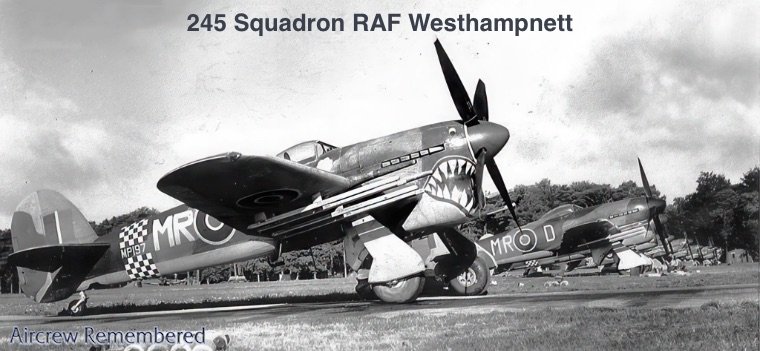
Unit: No. 245 Squadron (motto: Fugo Non Fugio - I put to fight, I do not flee)
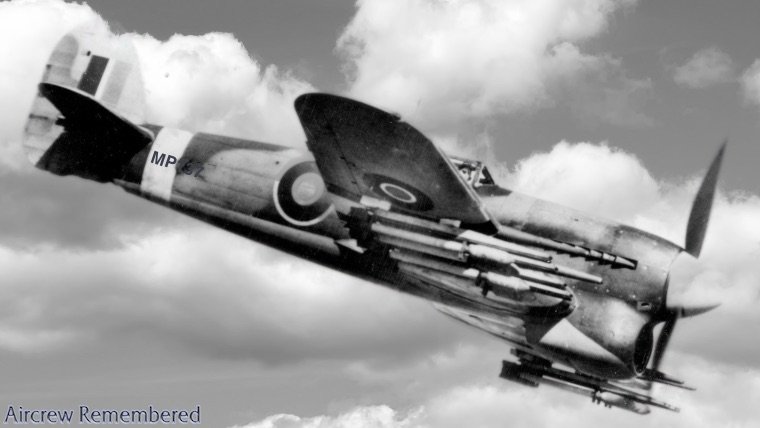
Type: Typhoon Ib
Serial: MP137
Code: MR-?
Base: RAF Westhampnett, West Sussex - ALG B.5 Le Fresne-Camilly
Location: Near Les Autels-Sai-Bazilent
Pilot: Fl/Lt. Arthur Eugene Miron, J/5144, RCAF, Age 25 - Missing, believed killed
Reason for Loss
Early Life and Enlistment
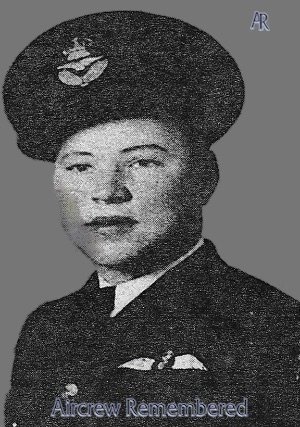
Born on 23rd January 1919 in Sudbury, Ontario, Canada, Miron grew up in the town, attending Sudbury Separate School (1926-33) and Sudbury High School (1933-39), reaching Senior Matriculation. He spoke French fluently. Before the war he worked briefly as a clerk at Loblaws (1939) and then as assistant manager of the Inco Employees' Club in Sudbury, organising recreational and social club activities. He played rugby, swam, dived, and played basketball, baseball, hockey and badminton. A 1989 newspaper account states that he had represented his province at the 1937 coronation of King George VI.
He enlisted in the RCAF at North Bay, Ontario, on 17th September 1940, signing his attestation papers and oath of allegiance the same day. On his Occupational History Form, completed shortly before his death in May 1944, he listed his ambition simply as "Aviation."
Medical Board and Flight Training
A medical selection board held at Regina, Saskatchewan, on 23rd November 1940 recorded a childhood mastoidectomy (age 5) and a bout of diphtheria (age 6) with complications, but otherwise found him fit, describing his physique as "Athletic" and his mentality as "Standard." He was passed fit for aircrew category A1B/A3B. He earned his Pilot’s Flying Badge on 18th April 1941 and was commissioned as a Pilot Officer on 5th May 1941.
Overseas Service and Career as an Instructor
Miron embarked for overseas service on 30th May 1941. His service summary card traces an active flying career: he trained and served overseas, was repatriated to Canada, and by 1942-44 was posted as a flying instructor at No. 1 Operational Training Unit, Bagotville, Quebec. Confidential reports from this period rated him as carrying out his instructional duties satisfactorily, and by February 1944 his commanding officers described him as "a good pilot" and "a capable officer."
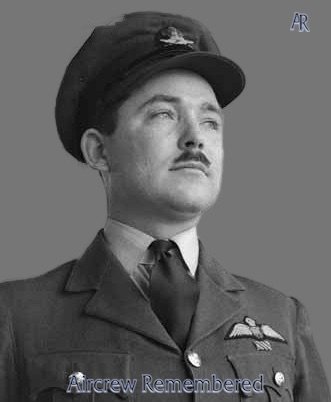
Despite his posting as an instructor, Miron was eager to return to operational flying. In March 1943 he personally submitted a formal application to his Chief Flying Instructor, Squadron Leader Schwab, DFC, (show right) requesting a posting back to operations overseas, noting 357 hours of fighter experience (352 of them on Hurricanes, including 40 operational hours) and writing that "it is my earnest desire to return and finish my tour of duty on operations."
A Close Call: The Hurn Incident, April 1944
Once back on operations, flying Typhoons with No. 245 Squadron, Miron survived a serious incident on 9th April 1944. During a night-flying and formation-cloud-flying test, his aircraft's port tyre burst on take-off. Flying Control ordered him to land wheels-up at RAF Hurn, Hampshire, which he did, damaging the airscrew, radiator and flaps but escaping uninjured. His own witness statement describing the incident survives in his personnel file.
 Killed in Action, 17th August 1944
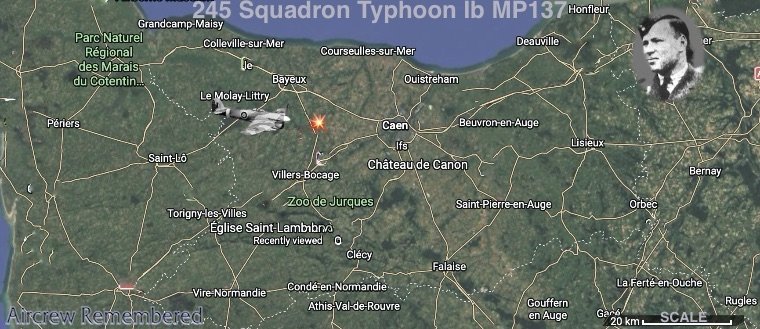
Four months later, on 17th August 1944, Flight Lieutenant Miron was killed in action. He was leading No. 245 Squadron on a rocket-armed reconnaissance sortie over the Falaise Gap, where Allied forces were working to trap retreating German divisions during the Normandy campaign. Witnesses reported that his Typhoon was hit by flak (or, per a later French account, a German shell), rolled onto its back, and spun into the ground near Tilly-sur-Seulles, crashing in a swampy area and exploding on impact. No parachute was seen. He was 25 years old.
He was officially listed as missing and, since no remains were recovered at the time, his name was later inscribed on the Commonwealth War Graves Commission's Runnymede Memorial in England, commemorating airmen with no known grave.
 Miron never married and had no children. Following his death, the RCAF's Estates Branch corresponded with his mother, Marie Jeanne Miron, to settle his affairs. The family statement in his file records his parents' marriage (Sault Ste. Marie, 23rd January 1912), his father's death in May 1945, and his surviving siblings: brothers Rodolphe Rosario Miron (Royal Canadian Engineers), F/O Ernest Joseph Miron (RCAF, England) and Pte. Gerald Miron; and sisters Marie Jeannette Miron, Irene Miesler and Therese White.
(1) Recovery and Burial, 1989-1990
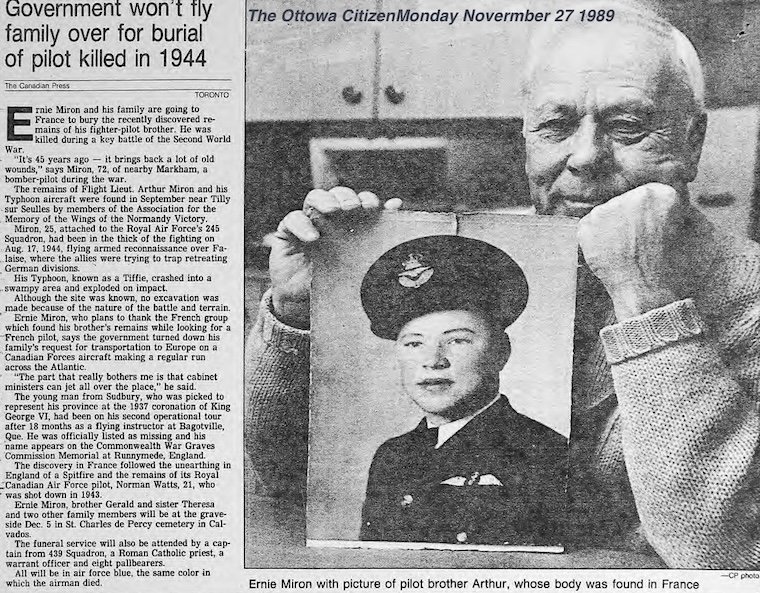
Arthur Miron’s remains lay undiscovered for 45 years. In September 1989 they were located near Tilly-sur-Seulles, not far from the Falaise Gap battle site, by members of a French historical association dedicated to the memory of Allied airmen lost during the Battle of Normandy (reported in the Canadian press as the "Association for the Memory of the Wings of the Normandy Victory," or "Wings of Victory"). Canadian Forces Headquarters Europe was tasked with arranging burial at St. Charles de Percy Cemetery in accordance with Commonwealth War Graves Commission recommendations.
 Locating next of kin took considerable effort, since both of Miron's parents had died and the family had since moved from Sudbury. National Defence Headquarters eventually traced two brothers and two sisters. Press coverage at the time reported that the government had initially declined to fund the family's travel to France; Defence Minister Bill McKnight subsequently authorised seats on a regular RCAF flight to Europe after the story drew national attention. Miron's brother Ernie (a wartime bomber pilot) told reporters, “It's 45 years ago - it brings back a lot of old wounds.”
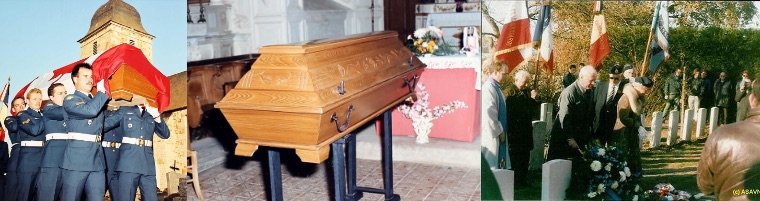
The burial ceremony took place as planned on 5th December 1989 at St. Charles de Percy
Cemetery, attended by his brother Gerald Miron, his sister Theresa White, and his wartime wingman, John Thompson (shown left), alongside a Canadian Forces honour guard, a Roman Catholic priest and pallbearers, all in air force blue - "the same colour in which the airman died." An after-action report filed by the Base Administrative Officer in February 1990 noted that the operation was "greatly gratifying to all concerned to have the privilege of participating in this historical event," and records that Miron’s original pilot’s log book was recovered along with his personnel file and returned to the family’s attention.
 Burial Details
Fl/Lt. Arthur Eugene Miron. St. Charles de Percy War Cemetery, Grave II.B.4. Son of Alphonse Oliver Miron and Marie Jeanne (née Demers) Miron, of Sudbury, Ontario. His father died on 24th May 1945, at age 68. Epitaph: 'We Remember'. His mother died on 27th January 1946, aged 58.
 His brother, Ernest Miron (shown above), was born on 16th September 1917 in Sudbury, Ontario, and passed away after a long battle with cancer on 20th September 2012, aged 95. His wife, Jean Isabelle (née Dennee) Miron, was born on 19th July 1923 in Kingston, Ontario, and passed away on 14th June 2014, aged 91. Both are interred in the family plot at Cataraqui Cemetery in Kingston, Canada.
Supplementary Information
The following additional details, not present in Fl/Lt. Miron's personnel file, were located in the course of preparing this page and are added here as a supplement.
Appearance and CharacterRCAF records describe his physique: he stood 5 feet 5¼ inches tall and weighed 142 pounds, with hazel eyes and brown hair. A training assessment described him as "a nice youngster, well mannered, pleasing, very keen to become a pilot," and predicted he would make "a good subject for training as such."
Flying Training Record
At No. 1 Initial Training School in Regina in November 1940 he placed 13th out of a class of 84. At No. 4 Elementary Flying Training School in Prince Albert, Saskatchewan (December 1940-February 1941), he was assessed as a "good, steady type" who "needs encouragement," placing 6th out of 31; his instructors noted he was "rough on controls at times" but expected improvement with experience. At No. 2 Service Flying Training School in Uplands, Ontario (February-April 1941), where he received his pilot’s wings on 18th April 1941, he was described as having "nice control in flying, possibly not very fast in reactions," and was noted as a strong ground-school student who was popular and had a good sense of humour.
The Loss, in the Squadron's Own Words
Archival research located the text of the eyewitness combat report referred to above. Pilot Officer W. N. Waudby, flying as Blue 1, reported that at approximately 1500 hours on 17th August 1944 the squadron was attacking motor transport on roads about twelve miles south-west of Bernay. Pulling up from an attack at roughly 3,500 feet, he saw an aircraft below him "turn on its back and spin, hitting the ground without pulling out," followed by "a column of flame and smoke." He saw no parachute leave the aircraft, which was subsequently confirmed to be Miron’s. Light but accurate flak had been reported in the area at the time, and Intelligence concluded from interrogation of the other pilots that flak had caused the aircraft to roll and spin into the ground.
A Wartime Search for the Wreck, 1946
Surviving records show that the crash site was investigated once before the 1989 recovery. In April 1946 a Flight Lieutenant Mortimer examined a wrecked aircraft in a field near Les Autels-Sai-Bazilent, reporting that a body was believed to lie beneath the wreckage, which was badly submerged in a water-filled crater; the state of the wreck did not allow formal confirmation of the aircraft type, although a Gendarmerie report suggested it was a Typhoon. Local witnesses said the aircraft had struck a tree some eighteen inches in diameter just before impact, had not penetrated more than eight to ten feet into the ground, and had burned for about three hours. Recovery was not carried out at that time.
It is worth noting for future researchers that this source gives the crash and recovery site as Les Autels-Saint-Bazile rather than Tilly-sur-Seulles. Both places lie in the same corner of Normandy south-west of Bernay and Falaise, and the discrepancy most likely reflects differing map references recorded across the file rather than two different incidents; it has not been possible to resolve it fully from the sources consulted.
The 1989 Excavation
When the wreck was finally excavated in September 1989, only the aircraft's four machine guns and a single rocket were recovered along with Miron's remains.
Sources and Acknowledgements
- Fl/Lt. Miron's original 103-page RCAF personnel and estates file (enlistment, medical, training, confidential reports, accident report, estate settlement, and 1989-90 recovery/burial correspondence)
- Contemporary press clippings retained in the same file (Ottawa Citizen, La Presse, and The Gazette, November-December 1989)
- Paradie-Dutil Archives
- Aircrew Remembered Archives
- Joseph Robert Leo Gauthier (parents' grave image)
- The Typhoon Project (Anne Gafiuk), thetyphoonproject.org
- Find a Grave Memorial, Arthur Eugène Miron
- Commonwealth War Graves Commission
- No. 245 Squadron RAF entry, Wikipedia (squadron motto and badge)


