




Operation: Dūsseldorf
Date: 30/01st July 1941 (Monday/Tuesday)
Unit: No. 83 Squadron (motto: 'Strike to Defend') (1)
Type: Handley Page Hampden I (2)
Serial: AD916
Code: 0L-Z
Base: RAF Scampton, Lincolnshire
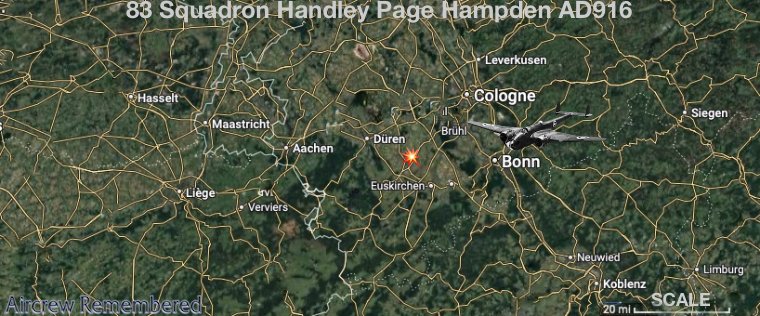
Location: Wűrm / Düren
Pilot: F/Lt 'Herbie' Neil Hyland Svendsen DFC. 40327 RAF PoW No. 1387 Camp: Stalag Luft Sagan
Pilot: P/O 'Jimmy' Desmond Irving 88407 RAFVR Age 20. Missing believed killed
Obs/Air/Bmr: P/O. Stanley Carter 79230 RAFVR PoW No: 1386 Camp: Stalag Luft Sagan
W/Op/Air/Gnr: Sgt. Leonard Charles Coldwell 759269 RAFVR PoW No: 39251 Stalag Lamsdorf/Kopernikus
REASON FOR LOSS:
A Night Over the Reich - The Düsseldorf Raid, 30 June / 1 July 1941
A narrative account of No. 83 Squadron and the crews who did not come home
Briefing
The summer of 1941 had settled into a grim and relentless rhythm for RAF Bomber Command. Night after night, crews climbed into their aircraft and headed east over the blacked-out continent of occupied Europe, dropping bombs on German cities while their counterparts in Fighter Command guarded the skies at home. The strategic bombing campaign was costly, imprecise, and deeply dangerous - but it was also, at that stage of the war, almost the only way Britain could strike back.
On the evening of 30 June 1941, twenty-three aircraft were briefed for an operation to Düsseldorf, the industrial city on the Rhine that would become one of Bomber Command's most frequent targets. Among them, the crews of No. 83 Squadron at RAF Scampton prepared their Handley Page Hampdens - twin-engine medium bombers that aircrew had nicknamed the 'Flying Suitcase' for their extraordinarily cramped, rectangular fuselages. Despite the nickname, the Hampden had earned a certain affection among its pilots for its surprising agility. It could be thrown around the sky almost like a single-engine fighter, and its pilot sat high in the cockpit with excellent visibility. But it was also vulnerable, and the men who flew it knew the risks.
Four aircraft would not return. What follows is their story and the stories of the men inside them.
Take-Off from Scampton
At 23:15 local time, as the last light faded from the English summer sky, the Hampdens of 83 Squadron began their take-off runs from Scampton's grass airfield in Lincolnshire. Among them was one particular aircraft, its crew of four settling in for what they hoped would be a routine operation: Flight Lieutenant Neil Svendsen at the controls; Pilot Officer Desmond Irving as second pilot; Sergeant Leonard Coldwell; and Pilot Officer Stanley Carter.
Svendsen, a New Zealander from Papakura, Auckland, was no stranger to the dangers of the campaign. Less than a year earlier, on the night of 25–26 August 1940, he had ditched his Hampden in The Wash after returning from one of the RAF's first raids on Berlin, the aircraft running dry after nearly eleven hours in the air. All four crew had been pulled from the water by an Air Sea Rescue launch, cold and exhausted but alive. It was the kind of experience that either broke a man or hardened him, and Svendsen had returned to operations.
Desmond Irving, his second pilot that night, was twenty years old - born in Northumberland on 17 September 1920, commissioned into the Royal Air Force Volunteer Reserve only the previous November. He had been posted to 83 Squadron in May 1941 and had already flown nine sorties: marshalling yards at Koblenz, the docks at Brest, the cities of Cologne, Bremen and Kiel. He was, by the standards of that summer, an experienced young man. But experience was relative.
Irving carried with him the particular weight of a family already touched by loss. His younger brother Charles - a Leading Aircraftman with the Royal Navy, stationed at HMS Daedalus - had died the previous August, killed when a Hawker Hart trainer spun in and crashed at Deeping St Nicholas near Spalding during an instrument flying exercise from RAF Peterborough. Charles was nineteen. The parents, Norman and Jane Irving of Pinner Green, Middlesex, had already given one son to the war.
 Over Enemy Territory
The aircraft crossed the North Sea and entered occupied Europe, navigating by dead reckoning and the stars. The Hampden's route would take them over the flat lowlands of Holland and into Germany's industrial heartland. For much of the flight, the skies were quiet - the Nachtjagd, the German night fighter arm, reacted only weakly to the night's raids, and the searchlight belts along the route posed the most visible threat.
But then came the flak.
Somewhere over the area of Würm, in the Kreis Geilenkirchen district near the Dutch-German border, the batteries of 1. and 3./Reserve-Flak-Abteilung 404 and 1./Reserve-Flak-Abteilung 241 opened fire. A shell struck Svendsen's Hampden in the starboard engine. The aircraft lurched and began to spin downward through the darkness.
What happened next speaks to Svendsen's skill and nerve. He fought the controls, brought the stricken machine out of its spin, and recovered. For a moment, it seemed possible that they might press on - or at least limp home. But the damage was too severe. The starboard engine was gone, and a Hampden on one engine, still deep over enemy territory, was a machine that could not be trusted to reach England.
Svendsen made his decision. He called his crew forward and ordered them to bail out.
The Last Moments of P/O Irving
Four men were in the aircraft. Three responded to Svendsen's order and jumped. One did not.
Desmond Irving - Pilot Officer, 83 Squadron, son of Norman and Jane - never left the aircraft. Svendsen assumed, at the time, that his second pilot had already gone. It was only later, from Sergeant Coldwell, that he learned the truth: Irving had been killed, almost certainly by the anti-aircraft fire that had first struck the Hampden. He may have been hit at the moment of impact; he may have been wounded and unable to move. The precise moment of his death, in the cold darkness somewhere over the German-Dutch borderlands, remains unknown.
The Hampden flew on without crew until it could fly no more.
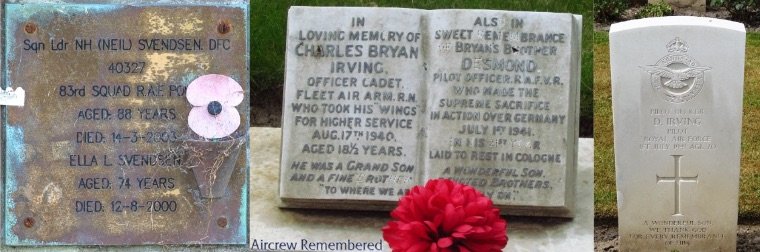
Desmond Irving was buried at Rheinberg War Cemetery, Grave 1.A.7. His parents chose as his epitaph the words: 'We Thank God For Every Remembrance Of Him.' Within the space of less than a year, they had buried both their sons.
Those Who Came Down
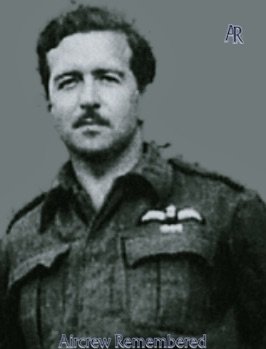
Flight Lieutenant Neil Svendsen
Svendsen l(shown left) anded safely and spent what remained of the night hidden in a cornfield, listening for sounds of pursuit. When dawn came, he began to walk. He had not gone far - moving through a village, trying to pass as an ordinary traveller - when two policemen sitting outside the local station stopped and questioned him. When they established that he was a New Zealand pilot, the game was up.
He was handed over to the authorities and sent to Dulag Luft, the Luftwaffe's primary transit and interrogation centre for captured Allied airmen, located at Oberursel near Frankfurt. There, like all prisoners, he was strip-searched and subjected to extended interrogation before being transferred to a permanent camp. He would spend the rest of the war as a prisoner of war.
Neil Svendsen survived. He returned to New Zealand after the war, eventually reaching the rank of Squadron Leader and being awarded the Distinguished Flying Cross. He married Ella Lorraine Vickers in February 1959 and lived in Papakura, Auckland. He died peacefully on 4 March 2003, aged 87. His ashes were interred at Papakura Cemetery that August.
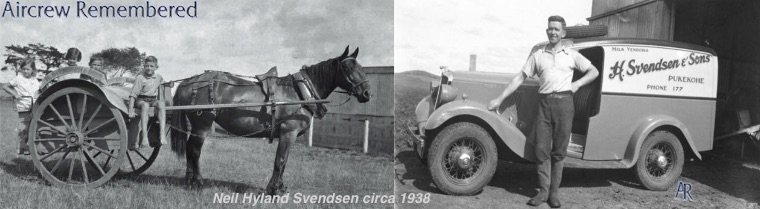
(Above: Courtesy Franklin Heritage Collection, Pukekohe Library, Auckland, New Zealand)
Pilot Officer Stanley Carter
Stanley Carter, born in Bradford in 1905 and thus considerably older than most of his crewmates, also came down safely and was taken prisoner. His war, however, was far from over.
Carter proved to be a persistent and determined escapee. He made repeated attempts to break out of captivity - enough that the German authorities eventually transferred him to the most secure facility they had: Stalag Luft III, the camp that would later become famous as the site of the Great Escape of March 1944. Carter was there when it happened.

His story did not fully come to light until many decades after the war, when television presenter Kate Humble (shown left) traced her maternal grandfather's history on the BBC programme Who Do You Think You Are? She read his diary of the forced marches that prisoners endured in the bitter winter of 1944–45, as the Germans drove their captives westward ahead of the Soviet advance, and she met a fellow survivor of the same ordeal. At the National Archives at Kew, she discovered his prisoner of war liberation report - and learned that the family's long-held belief that Stanley had been held at Colditz was mistaken. He had passed through several camps, Stalag Luft III among them. [Source: BBC Who Do You Think You Are?, Kate Humble episode; National Archives Kew, WO 416/59/225]
Carter was eventually liberated and returned to England. He relinquished his commission in May 1954, retaining the rank of Squadron Leader. He had survived everything the war could throw at him.
Sergeant Leonard Coldwell
The third man to bail out that night was Sergeant Leonard Coldwell, son of Charles and Sarah Ann Coldwell of Sheffield. He too was captured and spent the remainder of the war as a prisoner.
Coldwell carried with him a particular poignancy: he had married Doreen Benson in the early months of 1941 - just weeks, perhaps, before the operation that brought him down. The marriage was registered in the Sheffield district in the first quarter of that year. He had been married for barely a few months when he disappeared into captivity.
The Other Losses
Svendsen's crew were not the only one who did not make it home. Across the night's operation, four aircraft in total were lost, each with its own story of sudden violence and hard luck.
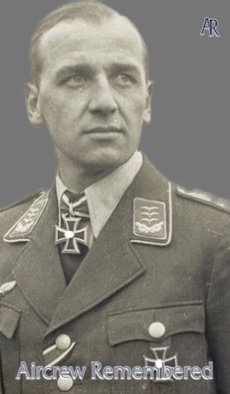
A 102 Squadron Whitley, T4233, was shot down by the night fighter ace Hauptmann Werner Streib (shown right) of I./NJG1 at 01:19, crashing near Diergaarde in the Dutch province of Limburg, twelve kilometres south-southwest of Roermond. All five men aboard were killed. Their aircraft was one of the twin-engine Whitleys - slower and heavier than the Hampdens, and considered by many crews to be more vulnerable to interception.
()A second 102 Squadron Whitley, Z6584, was hit by a night fighter and struggled back as far as Norfolk before crashing near Thetford on its return. Sergeant Alan Beveridge was killed, along with one other crew member; two survived.
A third Whitley, P5018, was struck by heavy flak and went down with its pilot, Pilot Officer John Barrett, and one other crewman killed. Four of those aboard survived to become prisoners of war.
A 49 Squadron Hampden, X3134, had a different kind of crisis. Its pilot, Sergeant Bryan Woolston, suffered engine failure over the North Sea and was forced to ditch his aircraft in the water. He and his crew were rescued - but only after nine days adrift, plucked finally from the sea by an RAF Walrus amphibious aircraft. It was an extraordinary ordeal, and a reminder that the sea itself was as dangerous as any enemy fighter.
A further Hampden, AD916, came down near Düren in Germany. One of its crew was killed; three became prisoners of war.
(1) No. 83 Squadron
No. 83 Squadron was re-formed at RAF Turnhouse in Scotland on 4 August 1936, initially equipped with Hawker Hinds. It transferred to No. 5 Group at Scampton in March 1938 and converted to Handley Page Hampdens shortly thereafter.
Opening of the War: The squadron went to war on the very first day of the conflict. On 3 September 1939, while much of Bomber Command was still mobilising, 83 Squadron was already airborne on a sweep over the North Sea seeking German warships. Offensive bombing operations began the following spring, delayed until after the German invasion of Norway in April 1940.
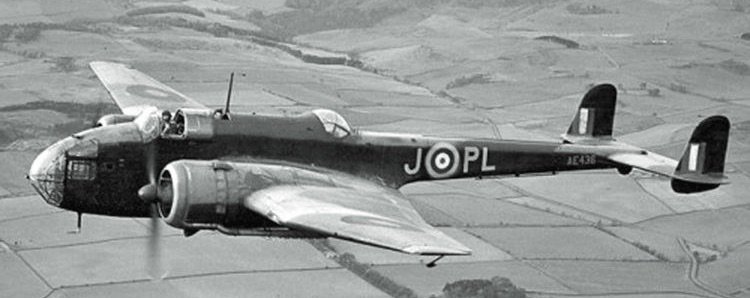 In the months that followed, the squadron flew precision raids against naval and coastal targets before the growing cost of daylight sorties forced a transition to night operations - a shift that mirrored the experience of Bomber Command as a whole.
Victoria Cross - Flight Sergeant John Hannah: During the late summer and autumn of 1940, No. 83 Squadron attacked the build-up of German invasion barges in the Channel ports. It was on the night of 15 September 1940, during a raid on Antwerp, that wireless operator and air gunner Flight Sergeant John Hannah performed an act of exceptional courage - manually fighting a fire that had taken hold inside his burning aircraft, sustaining severe burns in the process, and allowing the pilot to bring the machine safely home. He was awarded the Victoria Cross for this action.
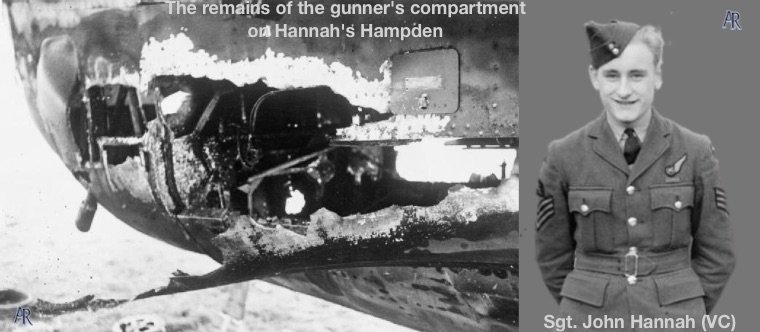 Hannah's subsequent life was marked by hardship. The injuries he had sustained left him physically weakened, and when tuberculosis took hold in the latter part of 1941, his body had little resilience to fight it. Discharged from the RAF on medical grounds in December 1942 with a full disability pension, he found himself unable to maintain regular employment and struggled to provide for his wife and their three young daughters. His health continued to deteriorate, and he died on 7 June 1947 at Markfield Sanatorium in Leicestershire, aged just thirty-one. He is buried at St James the Great Church in Birstall, north of Leicester, where his wife Janet is also interred. His Victoria Cross is held at the RAF Museum, Hendon. [Sources: RAF Museum records; Commonwealth War Graves Commission]
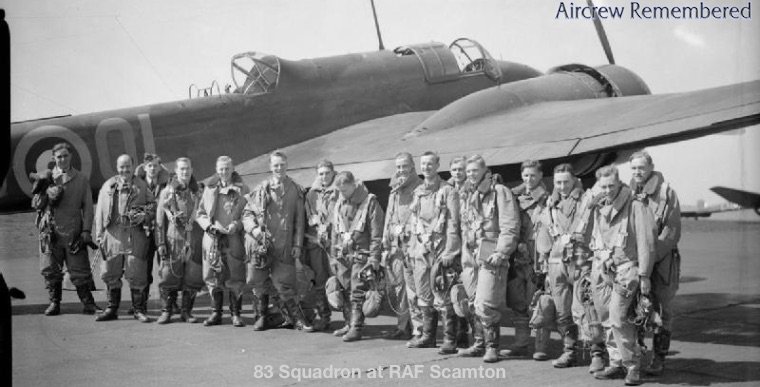 Aircraft Transitions: In December 1941, the squadron exchanged its Hampdens for Avro Manchesters, flying the type's first operational mission on 28 January 1942. The Manchester proved deeply unreliable in service, and after only four months it was withdrawn in favour of the Avro Lancaster - the aircraft the squadron would fly for the remainder of the war.
Pathfinder Force: In August 1942, No. 83 Squadron was among the founding units of the Pathfinder Force, taking on the specialised role of marking targets ahead of the main bomber stream. In April 1944 it returned to No. 5 Group at RAF Coningsby, serving as that group's dedicated pathfinder unit for independent operations until the war's end.
It was a distinguished record - active from the first day of the war to VE Day, evolving through three aircraft types and earning a place among Bomber Command's most experienced and decorated units.
(2) The Aircraft: Handley Page Hampden
By the time Svendsen's crew climbed aboard their aircraft on the night of 30 June 1941, the Handley Page Hampden was already showing its age as a front-line bomber. Designed in the mid-1930s to meet an Air Ministry requirement for a fast, versatile medium bomber, it had entered service with genuine strengths - most notably a manoeuvrability unusual for a twin-engine aircraft of its weight and size. Pilots who flew it often remarked that it handled more like a fighter than a bomber, responsive to the controls in a way that gave it a fighting chance when caught in a tight spot.
Its defining physical characteristic was a fuselage so narrow and deep that it seemed almost absurd from certain angles - a design that earned it the inevitable nickname 'Flying Suitcase.' The four men inside it were packed into fixed positions with little room for movement or comfort, a significant operational drawback on sorties that could last ten hours or more.
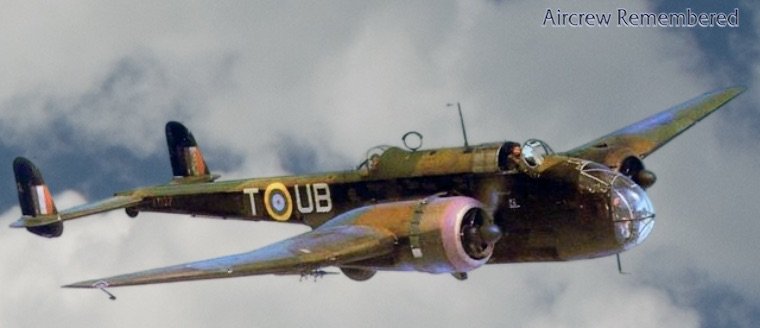 As the war progressed and the Luftwaffe's night fighter arm became increasingly capable, the Hampden's limitations grew harder to overlook. It lacked the defensive firepower of newer designs and offered little protection for its crew. By the end of 1942 it had been retired from Bomber Command operations entirely, replaced by the Avro Lancaster and Handley Page Halifax. A small number of surplus airframes were converted for torpedo-bomber duties and served on with Coastal Command into 1943.
Of the roughly 1,430 Hampdens produced during the war, only three complete airframes are known to survive: two currently undergoing restoration, and one on permanent public display at the Canadian Museum of Flight in Langley, British Columbia. [Sources: Handley Page Association; Canadian Museum of Flight]
Crew Records
F/Lt 'Herbie' Neil Hyland Svendsen DFC
Born 27 January 1915, Papakura, Auckland, New Zealand. Son of Herbert Neil Svendsen (died 1972, aged 85) and Ada Jane Deverell (née Craig; died 1982, aged 92; married 1913). Husband of Ella Lorraine (née Vickers; died 2000, aged 74; married 18 February 1959) of Papakura, Auckland, New Zealand.
P/O Desmond Irving
Rheinberg War Cemetery, Grave 1.A.7. Born 17 September 1920, Northumberland, England. Son of Norman and Jane Martin Macdonald Irving, of 'Oakhurst', 7 Pinner Road, Pinner Green, Middlesex, England.
P/O Stanley Carter
Born 22 October 1905, Bradford, England. Further next-of-kin and family details require additional research.
Sgt. Leonard Charles Coldwell
Son of Charles Coldwell and Sarah Ann Coldwell (née Taylor). Husband of Doreen M. Coldwell (née Benson). Further next-of-kin details require additional research.
 Closing
In the small hours of 1 July 1941, as the surviving aircraft of the night's operation turned westward and began the long flight home across the darkened continent, Desmond Irving's parents in Pinner Green, Middlesex, were asleep - not yet knowing that both their sons were gone. Neil Svendsen was hiding in a cornfield, listening to the sounds of the German countryside and thinking, perhaps, about what came next. Stanley Carter was somewhere in the darkness, making his way toward captivity and the long years of escape attempts that lay ahead. Leonard Coldwell, newly married, was also coming down somewhere over Germany.
Twenty-three aircraft had gone out. Four had not come back. The losses were, by the standards of Bomber Command's brutal arithmetic, not unusual. The operation was recorded in the squadron records, the crews were listed as missing, and the next night's briefing would begin as all the others had.
But behind every name on every casualty list was a life - a family, a story, a set of letters waiting at home. This account is offered in memory of those who flew that night, and especially of Pilot Officer Desmond Irving, who was twenty years old, who had nine sorties behind him, and who never left the aircraft.
Sources and Acknowledgements
Researched and dedicated to the relatives of this crew. If you would like to sponsor any of the thousands of pages see here.
This account draws on the following primary and secondary sources. Factual claims derived from specific works are noted in-line where appropriate.
Errol Martyn, For Your Tomorrow, Vols. 1–3
New Zealand Cenotaph (online database)
Air Museum of New Zealand
National Archives, Kew: WO-416/59/225; AIR-20/2336
Theo Boiten, Nachtjagd Combat Archives
Franklin Heritage Collection, Pukekohe Library, Auckland, New Zealand (Ancestry)
BBC, Who Do You Think You Are? (Kate Humble episode)
Aircrew Remembered Archives
RAF Museum, Hendon (John Hannah VC records)
Commonwealth War Graves Commission
Kracker Luftwaffe Archives
Handley Page Association
Canadian Museum of Flight, Langley, British Columbia
Papers Past New Zealand
Other sources as quoted belod:


