




Operation: Training
Date: 1st September 1940 (Sunday)
Unit: No. 15 Flying Training School
Type: Harvard I
Serial: N7194
Code: -
Base: RAF Kidlington, Oxfordshire
Location: Clanfield, Oxfordshire
Pilot: Sgt. Edmund Alexander Teviotdale, 748400, RAFVR, Age 21 - Killed
Reason for Loss
On 1st September 1940 the school’s main base was RAF Kidlington, just north of Oxford. It had only been there about two weeks. Parts of 15 SFTS had come to Brize Norton from Middle Wallop on 11th June 1940 because Fighter Command needed that airfield, and they stayed until 18th August, when Kidlington became available.
The dates mean he probably trained at more than one airfield. A service flying course lasted several months, so he probably began at Middle Wallop or Brize Norton. During the Brize Norton period the Harvard flight was based there, while the rest of the unit was split between South Cerney and Chipping Norton. The school soon became entirely Harvard-equipped, with 28 aircraft at Brize Norton. That fits his aircraft, a Harvard from the first RAF batch, which was delivered between December 1938 and October 1939 and numbered N7000 to N7199.
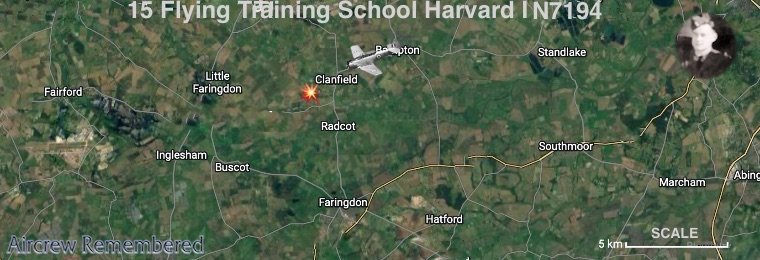 Very few details of the accident have been found. The aircraft dived into the ground during low flying at Clanfield, Oxfordshire. It was therefore a training accident in England, not a combat loss. It happened at the height of the Battle of Britain, when pilot training was being pushed through very fast.
 Clanfield lies about 4 miles south of Brize Norton and about 15 miles south-west of Kidlington. Besides its parent airfields, 15 SFTS used relief landing grounds for circuit flying. One of the first units at RAF Windrush, 4 miles west of Burford, when it opened in early summer 1940 was 15 SFTS, flying Harvards and Oxfords. The school also used Weston-on-the-Green as a relief landing ground while at Kidlington.
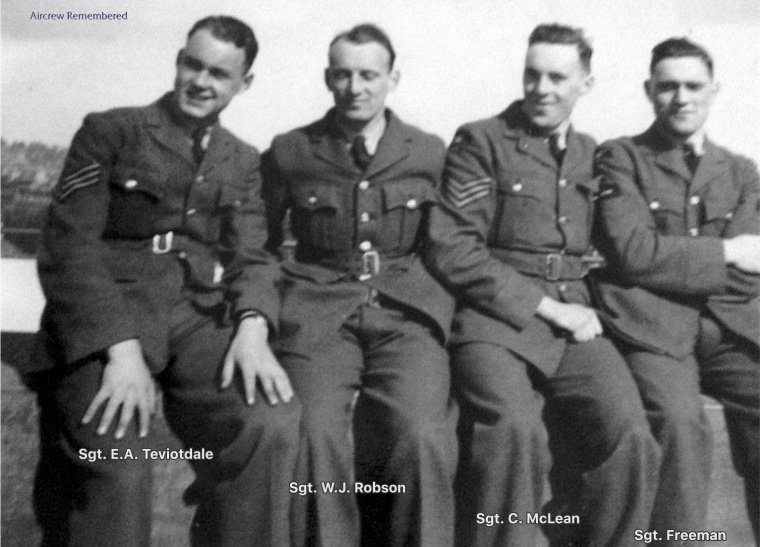
Above L-R: Sgt. E.A. Teviotdale, Sgt.W.J. Robson, Sgt. C, McLean and Sgt. Freeman. (courtesy Donald Price and family) Read more here
 Burial Details
Sgt. Edmund Alexander Teviotdale. Edinburgh (Morningside) Cemetery. Section E. Grave 1030. Son of Edmund (died 1940, age 59) and Isabella Weir Teviotdale (née Brown), of Selkirk, Scotland.
Edinburgh (Morningside) Cemetery
A Victorian cemetery in south Edinburgh, it is quieter and less famous than Dean or Warriston.
Origins. The Metropolitan Cemetery Company opened it in 1878 on 13 acres (5.3 ha). It was one of a new generation of cemeteries built at the edge of the city, but the city soon grew around it. The company’s own 1881 promotional text described it as sitting just outside the city boundary, with wide views of the Pentlands, close to the tram terminus, and with a station planned on the new Suburban Railway near the gate. Today it lies between Balcarres Street to the north and Morningside Drive to the south.
A shrinking site. Parts of the original grounds were sold off for housing. These developments include the former Belhaven Terrace entrance on the east side, the old Morningside Drive boundary to the south, and the western portion, now Morningside Court and Balcarres Court. Wikipedia describes this as essentially asset-stripping during a period of private ownership, which ended when the City of Edinburgh Council bought the site by compulsory purchase in February 1992. One reminder of the old layout is the original eastern gateway. Its ornate 1878 gatepiers and wrought-iron railings are now Category C listed, but they stand cut off from the cemetery on Belhaven Place.
Notable burials. These include the Nobel Prize-winning physicist Sir Edward Appleton, geologist James Geikie, poet James Logie Robertson (“Hugh Haliburton”), architects John McLachlan and Robert Morham, and Alison “Cummy” Cunningham, Robert Louis Stevenson’s much-loved childhood nurse. There are also 81 military graves cared for by the Commonwealth War Graves Commission (49 from the First World War and 32 from the Second), and many people who died at the City Poorhouse at Craiglockhart lie here in unmarked graves. A Cross of Remembrance stands in the north-east section of the cemetery.
Today. It is still used for burials and the interment of ashes and, unusually for a city cemetery, it is open 24 hours a day. Since taking over, the council has laid many monuments flat because of safety concerns. The council’s 2026 burial plan says the site is mostly managed with a low-intervention approach. There are two ways in: the main vehicle and pedestrian entrance on Morningside Drive, and a pedestrian-only gate on Balcarres Street. The Friends of Morningside Cemetery, a volunteer group, hold gardening work parties and run occasional guided tours. If you are looking for a particular grave, Morningside Library keeps an index of the stones.
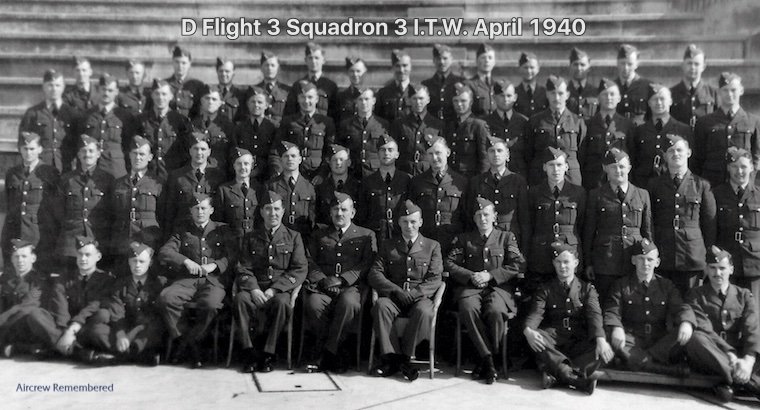
D Flight 3 Squadron Initial Training Wing - April 1940.
Rear Row: W.J. Robson, Hobson, T.A. Ross, D.C. Paterson, R.W. Owen, E.K. Creswell, D.G. Blakely, P.J. Fisher, G.A. Skelly, B. Hemmings, R. Fairclough, C.E. Musgrave, Clarke, W. Roland Smale.
3rd Row: L.Y. Collier, A.K. Johnson, Charles McLean, Freeman, G.E. Taylor, H.F.M. Taylor, Sayers, Peter Rathie, Duncan Walker, E.L. Littlewood, George Davison, R. Innes, Larry Wilford, K.M. Newton.
2nd Row: R.W. Parish, P.W. Smith, W.G. Fothergill, S.F.M. Gunnis, P.S. Patterson, Gordon Turnbull, S.D. Ormiston, B.C. Kelly Kelvin Sayers, Cambrae, H.M. Owens, D.L. Heald, W.R. Oldfield, London.
Front Row: J.R. Wallace, E.A. Teviotdale, F.M. Cole, McTaggart, Hill, Harrison, Hardie, Robertson, James V.R. Taylor, H. Badland, C.E.O. Hamilton-Williams. (supplied and kindly typed out by Donald Price and family) Read more here
Sources and Acknowledgements
- Donald Price for image
- Susan Barnes (volunteer at Edinburgh (Morningside) Cemetery)
- National Archives, Kew, AIR 81/2956
- Aircrew Remembered Archives
- Find A Grave
- Commonwealth War Graves Commission (CWGC)
- RAF Brize Norton history 1935-1942 (rafbrizenorton.yolasite.com); simplyplanes.co.uk
- Airshows Present - RAF Windrush history
- Aviadejavu / Flight archive - early RAF Harvard deliveries


