





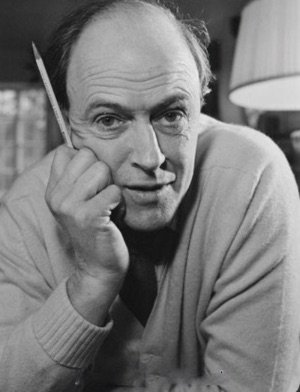
“Future author Roald Dahl, shown here during his flight training in Kenya, flew Gladiators and nearly died in one, surviving he said, ‘only by the skin of my teeth.’” Credit: ©The Roald Dahl Story Company, UK, ©roalddahlmuseum.org, The Roald Dahl Museum & Story Centre

“Somewhere in Britain, RAF pilots scramble to their Gladiators. The RAF tried to keep its Gladiators away from the Luftwaffe’s much superior Me-109.” Egypt was, for a time at least quite far away from the Luftwaffe. Credit: IWM HU 106295, public domain.
Overview: This aircraft accident and the hospitalization which took Dahl out of the action and on an introspective recovery had a major impact on his future as a writer, starting with his article Shot Down Over Libya (1942). As we will see, it also forms a major focal point of his autobiographical book, Going Solo (Puffin Books, London and New York, 1984, 1986)
Who/Dahl: Roald Dahl lived from 1916 to 1990. An author born in Wales of Norwegian parents, following a posting to East Africa for Shell he joined the RAF and after a stint as a pilot in the Eastern Med including combat, he was a spy then a writer, marrying prominent women. Among many funny and dark children’s books he wrote Charlie and the Chocolate Factory and Matilda, as well as memoirs filled with pathos including Boy and Going Solo. He was immensely popular, selling millions of books, wrote screenplays, poems, and novels, and has also been criticized for some of his behaviors. He died in Oxford at age 74. His books continue to be made into films (Fantastic Mr. Fox), and he wrote about his RAF years.
Who/Wiberg: Found a plane on a reef in The Bahamas – then a colony – growing up. In his 40s went back to find more. Tracked 178 RAF, RAFTC, USAAF, USN, and other aircraft accidents. Found half a dozen WWII aircraft in water, parts of others on land in US and The Bahamas. Has searched for aircraft in the UK and Sweden, where he holds citizenship. A yacht captain he sailed from Antigua to Belgium to attend Oxford, and after university from Panama to New Zealand to operate tankers from Singapore for three years. Maritime lawyer (rarely practiced), he is the author of 48 books, thousands of articles, and worked with TV & feature-length film, including writing a script. Over a million miles, 600 vessels boarded, he has focused on World War II aviation and maritime history Cuba-Canada.
Background: Reading Dahl makes me cry. With empathy, pathos, and envy. An adherent of Admiral Samuel Eliot Morison (he wrote the history of the USN in WWII), I learned to “dream dreams then write them – aye but live them first.” I learned how to study, then to write about studies, but the important fulcrum is to get outdoors and test the waters, look for what you seek, and if at all possible, find it. If you are a freelance writer, chances are like me you need to obtain funding to find artifacts which are far away. Learning that not only has Dahl’s 1940 plane wreck not been found, but that no one apparently has even bothered to look for it in the field galvanized me to start looking.
This year I contacted every Egyptian aviation historian I could find, from Mersa Mutrah to Medford, all the UK RAF experts I knew. Thank you Wing Commander Pitchfork and Wing Commander Cummings and the exceptional UK RAF historical and museum community for your help. This week we found that the landing ground at Sidi Heneish was not only unlit at night but camouflaged, meaning that Pilot Officer Roald Dahl, disadvantaged already as a relative rookie and with poor directions and low fuel, stood basically no chance, and crashed in the desert, causing grievous bodily harm – mostly above the neck – and destroying the aircraft.
What is sought?: Funding for a film, an expedition, a TV show, or any variant. I need air tickets, accommodation, a car rental to get to the site, meet locals, find the wreckage. We need to take the research component to the final level and ascertain where “two miles west of Mersa Mutrah” the aircraft remains are. There is lots of sand in that sector (west, north, south of the existing airfield so military permission may be required) and go and find it. Then we would photograph it, meet those on the ground who knew and helped the Brits, share what we learned and go home. We need to find someone who shares a belief in the worthiness and efficacy of this effort, and folks willing to put boots on the ground and spend a week or so looking for Roald Dahl’s lost Gladiator. An I ask that I be included.
When?: Now (please).
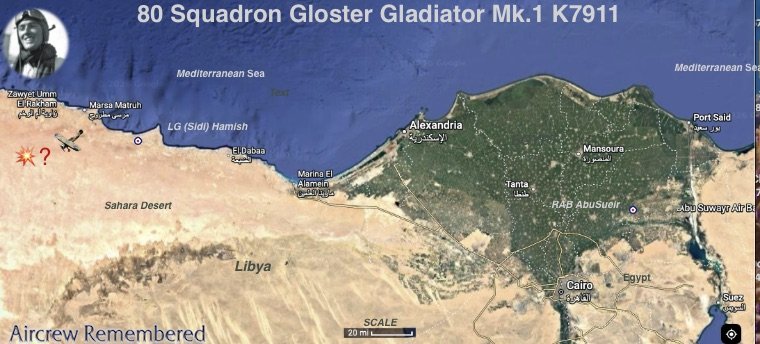
Overview: There is a tendency in this terrain and timeframe to use different words for the same place (Ismailia is also Abu Suwir and Sueir), and misleading terms. This of course makes it even more difficult to find lost items like aircraft. The fact that the general region of fighting between the British (with New Zealand, South African, English, Indian, Australian and many other colonies participating) and the Axis (Italy, Germany, etc.) is conflated as the Western Desert (referenced from Cairo), the Libyan Desert and – to the south the Sahara Desert) should not hide the fact that Dahl’s main assigned route was never, once he reached Fouk on the Mediterranean Sea coast of Egypt, more than 25 miles south of the coast. He is believe – by the RAF who reported it and this author, to have crashed 2 miles west of Mersa Matruh – a present day sprawling air field – and less than 3-5 miles from the coast. In this study we will read in detail of aircraft, images, words, textual documents, and comparable mishaps as well as what the plane might look like today.

Source: britannica.com/place/Libyan-Desert

Egypt’s coast: lower right is Dahl’s destination: an air field near the village of Heneish, and upper left is where he ended up, Mersa Matruh, a town or small city. This author’s theory that Dahl flew over the camouflaged landing ground near Heneish, proceeded on course and over desert, then, having overshot Mersa Matruh and run out of fuel. He crashed as indicated in the official RAF report, two miles west of Mersa Matruh where a British patrol was at leisure to find him and there were no Italain or other enemy about. He was incipacitated at the time and next “came to” in a Cairo officer’s hospital. The green arrow is this aircraft researcher’s best theory on the final track. Open to correction. Credit: Google Earth Pro, 8.9.26. Note: This is the only map used in this report: too soon.


Aircraft: Gloster Gladiator Mk1 built 1937, biplane, Mercury II engine No. 114485, tail # K7911, Royal Air Force Middle East command, 80 Squadron, Signal # X3954. “The Gladiator …was the last British biplane fighter, an anomaly that the Air Ministry clung to out of both necessity and romanticism. As an aerobatic plaything for the finest flying club in the world—the boys of the RAF’s Volunteer Reserve prewar university squadrons at Cambridge and Oxford—there was no lovelier airplane.” (Source: The Gloster Gladiator Looked Outdated When WWII Started, Stephan Wilkinson, 2023) There were 747 Gladiator’s built, and many of them went to 13 nations aside from the UK (Wikipedia.org). The British biplane fighter, it was the first to feature an enclosed cockpit. This is relevant to Dahl trying to escape a burning wrecked one with a 6’6” or 1.98 meter high body! According to Wikipedia, “Most accidents were caused by pilots being caught out by the fighter's increased wing loading, and many aviators had little experience in landing aircraft with such a wide flap area. The aircraft had a tendency to stall more abruptly, frequently dropping a wing while doing so. The Gladiator very easily entered a flat spin, and great skill was needed to recover.” (Source: en.wikipedia.org/wiki/Gloster_Gladiator)

This photo most accurately approximates what Pilot Officer Dahl would have encountered as he boarded K7911. The tail numbers: 3 up at K7914 and 62 up at K7973. In June of 1940 K7914’s history records “21/06/40 16:26-16:40 Aborted patrol; P/O A. H. Cholmeley. 28/06/40 18:56-19:45 Defensive patrol; Sgt Casbolt.” The aircraft behind had survived an accident near Alexandria: “26/03/40 Lost power on attempted overshoot at night and hit ground avoiding hangar at Amriya; P/O G. T. Baynham safe and the aircraft repaired. (?) 16/08/40 07:45-09:15 Patrol; F/O J. Lapsley.” No wonder Dahl’s aircraft needed mechanical repair and overhaul – in the same month, June 1940, the aircraft survived no fewer than 8 patrols, roughly one every two days, or every other day:
1. 11/06/40 04:30-05:55 Dawn patrol; F/L Jones.
2. 12/06/40 15:52-16:18 Patrol; Sgt J. C. Hulbert.
3. 13/06/40 11:34-12:36 Patrol; Sgt J. C. Hulbert.
4. 15/06/40 15:50-16:35 Patrol; P/O Dowding.
5. 16/06/40 11:08-12:15 Patrol; P/O Dowding.
6. 18/06/40 08:35-09:20 Patrol; Sgt J. C. Hulbert.
7. 20/06/40 07:35-08:40 Patrol; P/O Dowding.
8. 29/06/40 14:!0-14:50 Defensive patrol; P/O E. Mason.”
(Source: http://surfcity.kund.dalnet.se/gladiator_raf_80)
suggests his plane is probably in this mix. The location – Ismailia or Abu Suwir or Abu Sueir (now Abu Suwayr Air Base, west of Lake is precisely where he began his final delivery flight from RAF No. 102 Maintenance Unit (102 MU), which was a key logistics and aircraft repair establishment mostly repairing Allied aircraft in the Middle East at the time of Dahl’s crash. Their duty was to repair, assemble, modify, and distribute aircraft and equipment for the Desert Air Force commands in North Africa.

“Abu Suier, home of No. 4 Flying Training School.” Dahl trained in No. 4 RAF FTS, his six months’ fighter training were mainly in Iraq before Egypt. Clearly though, he was almost a month in Abu Sueir (Ismailia on the Suez Canal, now known as Abu Suwayr Air Base, a sprawling complex of the Egyptian Air Force) from 20 Aug. to 19 Sept. 1940, and so was No. 4 FTS. Note the large hangars in center and accommodation / barracks in center left and repair sheds/Quonset huts off to the left. Dahl took of from here on his injurious flight. Credit: K Files: The Royal Air Force of the 1930’s, James J. Halley, 1995, an Air-Britain Publication, UK.
Entitled “Gauntlets of No. 111 Squadron refueling from a three-point tanker,” this photo clearly illustrates a similar aircraft (predecessor to Gladiator – the Gauntlet), being refueled three aircraft at a time from a single truck (CMM 154 at right) and just 2 or 3 men. There is a Quonset hut to the right and a contraption like a rigid fishing pole in the middle from which a more flexible fuel hose is lowered to the aircraft’s two tanks; 64 gallons in main tank and 20 in auxiliary. One tail number has “52” but not relevant they are a different type and squadron. Dahl would have used similar means to refuel first in Ismailia, then in Amiriya, then in Fouk, before his fateful crash an hour and 35 minutes after takeoff. Credit: K Files: The Royal Air Force of the 1930’s, James J. Halley, 1995, an Air-Britain Publication, UK.
“Atlas K1498 of No. 4 Flying Training School, Abu Sueir.” While Dahl is attributed to having trained in No. 4 RAF FTS, his six months where he got his fighter training and pilot officer status was in Iraq, not primarily in Egypt. Clearly though he was almost a month in Abu Sueir (Ismailia on the Suez Canal) from 20 Aug. to 19 Sept. 1940, and so was No. 4 FTS. Note this is not the same type of aircraft Dahl crashed in. Credit: K Files: The Royal Air Force of the 1930’s, James J. Halley, 1995, an Air-Britain Publication, UK.
Heraldry, markings, symbols of 80 Sqdn.:

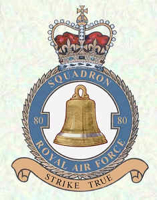
Left: 80 Squadron Roundel. Credit: en.wikipedia.org/wiki/No._80_Squadron_RAF. These visual details are important for identifying and matching artefacts if found on the ground or in the homes or museums of collectors. Detail of tail marking on right, copyright RAFweb: rafweb.org/Squadrons/Sqn%20Markings/SqnMark080, UK

Bell symbol, emblem, or badge of RAF 80 Squadron. Credit:
dasisbiz.com/il2/Hurricane/RAF-80Sqn.html

This shows the 80 Squadron tail symbol in red white black and yellow. This is specific to Gloster Gladiator Mk1 model aircraft between May 1937 and November 1940 – when Dahl flew. Credit: surfcity.kund.dalnet.se/gladiator_raf_80, Gloster Gladiator in 80 RAF Squadron service.
80 Squadron: The only to which Dahl was assigned in the war: 80 Squadron Henlow, March 1937 to June 1937. Debden [UK], June 1937 to April 1938. Egypt, May 1938 to November 1940. Greece, November 1940 to April 1941. Code letters: "OD", and as war approached the code letters were changed first to "GK" and finally to "YK". This was the code Dahl flew under between June 1940 and Jan. 1941. “The squadron was reformed in March 1937 again as No. 80 Squadron, now equipped with Gloster Gauntlet fighter. However, by now the Gauntlet was considered by many to be outdated, and as a result the Gauntlets were replaced by the Gloster Gladiator just two months later. In 1938, the squadron again returned to Egypt as an 'air defence unit'. After Italy's declaration of war on Britain on 10 June 1940, No. 80 Squadron was moved to the Egyptian-Libyan border but was subsequently one of the units sent to aid the Greeks during the Greco-Italian War, initially flying Gladiators and then re-equipping with the Hawker Hurricane from February 1941.” (Source: en.wikipedia.org/wiki/No._80_Squadron_RAF
RAF 102 MU: It had strategic bases in Egypt, including Abu Sueir, which Dahl flew out of, and Aboukir then Amriya. This unit repaired diverse aircraft types including Gloster Gauntlets and performed modifications on Beaufighters and repurposed damaged Italian and German Dornier airframes. As a footnote, the code allocation for 80 Squadron as per The K File was OD/GK (The K File The Royal Air Force of the 1930’s, An Air-Britain Publication, Tunbridge Wells, Kent, 1995, James J. Halley, MBE, pp. 44, 65, 447, 451, 190)
Gloster Gladiator Mk1 Specs: The specifications of a Gloster Gladiator I are “single-seat fighter, Bristol Mercury IX engine, wingspan 32’3” (about 10 meters), loaded weight 4,594 pounds, max speed 253 mph.” (Halley, The K File, p.451). Light the aircraft weighed 3,214 lbs., max takeoff weight was 4,590 lbs, suggesting a load capacity (pilot, fuel, bombs, etc) of 1,376 lbs. Max ceiling was 32,800’, the single engine was radial, and 830 hp, their designer was Henry Folland, and range was 428 miles or 372 nautical miles (conversion is 1.18). The square footage area of both wings was 323’. The aircraft was 11’9” high, meaning at 6’6’” with arms about 3’ long, Dahl could not reach the plane’s highest spot. (Source: flugzeuginfo.net/acdata_php/acdata_gloster_gladiator_en.php) According to RAF 3 Sqdn., and this data is not easily available, “A main tank and a gravity tank had a fuel capacity of 64 gallons and 20 gallons respectively.” (Source: 3sqnraafasn.net/subpages/gladiator.htm)
According to AI (Google, 11 Aug. 2026, ETW), “The Gloster Gladiator Mk I powered by a Bristol Mercury IX radial engine had an internal fuel capacity of 76 imperial gallons (345 liters), providing an operational endurance of roughly 2 hours at cruising speed and a maximum range of about 440 miles (710 km). At typical cruise power settings, its specific fuel consumption averaged approximately 0.49 to 0.55 lb/(hp·h), resulting in a burn rate of roughly 35 to 45 imperial gallons per hour (160 to 200 liters/hour) depending on altitude and throttle.”

The distance of the purple arrow is 2 miles. If Dahl crashed 2 miles west of Mersa Matruh and could see the darkness of the ocean ahead and decided to ditch on land rather than the more likely fatal water, then he may have done, despite having .5 hours and 90 miles of flying time and fuel capacity left. This is a theory only, without concrete route data.
Sub-conclusion: Not being a pilot and not knowing how much fuel Dahl loaded in Fouk, he took off with fuel for a 15 mile flight to Sidi Henseih village, or the air field 20 miles south of it (according to Halley and contemporary accounts – a plane that crashed there a few days before), and had about an hour of daylight – to 7.15. Per the RAF
“80 Squadron’s Gladiators baking in the desert sun at their first base, RAF Ismaila, right next to the Suez Canal.” In Egypt. Dahl’s aircraft – for a few hours only – was K7911, or 3 digits from the firs aircraft in this photo. The plane behind is K7973. It is possible that Dahl’s plane is one of the at least 3 aircraft visible tapering to the right.
Credit: forum.largescaleplanes.com, LSP-Members. According to The K File (p.42)

The cockpit of at Gladiator Mk1 which Dahl had to struggle out of while it was aflame. Credit: forum.largescaleplanes.com/index.php?/topic/106020-silver-gladiator-80- squadron-in-egypt-before-the-war/
Geography: Mersa (Masra) Matruh is on the Mediter
Date: Take off 6:15pm, crash 7.50pm, night of Thursday into Friday 19-20 September, 1940.
From / to: Abu Sueir Egypt to Fouka Landing Ground (LG), destination Heneish L/G, Ismailia is on the Suez Canal. Aka Abu Sawir aka Abu Sueir. It is Midway beteen Port Said and Port Suez. Distance from Ismailia to Fouka is 325 miles / 520km (estimate)
Data: Top speed of c.257 mph (land miles) / 414 kmh / 223 knots (nautical miles)
Causes: Causes of the crash include that Dahl has been given incorrect directions to No. 80 Squadron's forward airstrip.
Memoir account: The story which is detailed in his charming and engaging memoir Going Solo, the RAF climax of which is his participation in the Battle of Athens, and in stories and articles by the author, who conceded late in life that actual circumstances and crash details. This hackneyed account is excerpted from Roald Dahl’s Boy and Going Solo, (Puffin Books, Penguin Group (USA), Inc., 1999 and 2009, London and New York). The words belong the Mr. Dahl.
There are several illustrations but what is germane is that his log books survived the crash and he has written textual proof of this. He openly corrects the stories run as “Shot Down in Libya,” in the Saturday Evening Post, which he says had combat details “inserted by the editors of an American magazine….” (Going Solo, p.97), citing “the war years and the more dramatic the story, the better it was.” (Going Solo, p.97). In doing so he also conflates and contradicts the British-facing article ‘A Piece of Cake,’ which arguably helped start his public recognition as a writer. The issue here is only getting at the actual non fictional facts.
Dahl has some errata even in Going Solo – the correction of earlier versions – as he conflates Egypt with Libya – the closest he got to Libya was Mersa Mutra, about 70 miles to the east of the border. There are discrepancies about dates – when a telegram was received in the UK (21 Sep. 1940) versus when it was sent from Ismailia (19 Sep. 1940 or before). Also the important detail that first he stopped in Amiriya, an RAF air base just inland / southeast of Alexandria, which was arguably the largest most important naval / military base the Allies / Brits kept in the Eastern Med.
Now, in his own words, from page 93-96 of his chapter “Flying Training,” to page 104, pages 97-104 of “Survival” including speculation as to cause. I am only excerpting those passages which are directly relevant to the effort to find the remnants of the author’s aircraft:
“My Log Book tells me that we were at Habbaniya from 20 February 1940 to 20 August 1940.” (p.93): His log book survived the fiery wreck later, likely as it was strapped to his knee with his charts and he got out with them. “I became a Pilot Officer and a fighter pilot.” (p.93). I found myself at a large RAF station on the Suez Canal called Ismailia, where they told me I had been posted to 80 Squadron who were flying Gladiators against the Italians in the Western Desert of Libya. The Gloster Gladiator was an out-of-date fighter….” (p.93).
“At Ismailia, a rather supercilious Flight-Lieutenant point to a parked Gladiator on the tarmac and said to me, ‘That one’s yours. You’ll be flying it out to your squadron tomorrow.” (p.95) Since Dahl was then forced to teach himself with touch and go landings etc. (it was a single person plane, and when he crashed he had no radio so no one could tutor him). We assume this was about three weeks after leaving Iraq and about a week before leaving Ismailia.
Dahl is brilliant about critiques of management, not all of which is recorded here: suffice to say “Nobody in Ismailia was going to teach me anything about air-to-air-combat, and they were certainly not going to take time off to instruct me when I joined a busy operational squadron. There is no questions that we were flung in at the deep end, totally unprepared for actual fighting in the air, and this, in my opinion, accounted for the very great losses of young pilots that were suffered out there. I myself survived only by the skin of my teeth.” (p.96)
(Going Solo, (Puffin Books, Penguin Group (USA), Inc., 1999 and 2009, London and New York, pages 93 to 104, excerpted).
Injuries, treatment: Dahl’s medical injuries were severe. He smashed his nose on the canopy, fractured his skull, was temporarily blinded, and managed to drag himself from the burning wreckage. He related gaining consciousness and crawling away from the burning plane. Then he was found unconscious by a search party, or a group of British soldiers on patrol drawn to the site by the sounds and sights of a fire in the desert. They were not under fire at the time. The young pilot officer was treated at a First Aid post and local hospital in Mersa Matruh. In a detailed account on HistoryNet. Contrary to later accounts which depict two men flying two machines and landing in between enemy and friendly lines, there was in fact one occupant and no fatalities that night.
Final flight: Take off was from Fouka Landing Ground (LG) and Dahl’s destination was Heneish Landing Ground. The crash site for Dahl was said to be “about 48km south of Mersa Matruh,” or 30 statute or US miles. One account (with errata) claims that “Two Gloster Gladiators left the RAF base at Abu Sueir in Egypt bound for a forward landing ground at Heneish on the Libyan Plateau. After intermediate stops for fuel the two planes arrived at Fouka LG near the Egyptian coast where the pilots were given the co-ordinates for the forward airfield where the squadron they were joining, [RAF Squadron] No.80, was operating.”
“The aircraft took off from Fouka at 1815 L/T [6.15pm] with a little over an hour of daylight left. The flight was estimated to take about 50 minutes. After the estimated arrival time had passed, the pilots were unable to sight the airfield. With insufficient fuel to return to Fouka and daylight rapidly running out, the two pilots had little choice but to attempt an emergency landing in the desert. One of the Gladiators landed safely, but the other struck a boulder with its undercarriage and crashed, bursting into flames.”
“The pilot [Dahl] suffered serious head injuries which left him temporarily blinded, but was able to get clear with the assistance of his colleague. Pilot-Officer Roald Dahl recovered from his injuries and took part in the air fighting over Greece the following year, where he was credited with five air victories. He survived the war and became a famous writer. (Source: aviation-safety.net/wikibase/68941).
Evidence: This RAF Form 540 (summary of events, aka ORB, or Operational Record Book) details from officialdom that contrary to all other accounts, including even those by Dahl (historians tend to favor first hand accounts by participants for obvious reasons, and being a lawyer, I do as well – usually – when their brains have not been toggled around like an apple in a blender then roasted by blinding fire).

Credit: See Nick Thorne, 2022, thegenealogist.co.uk, RAF Form 540. Most relevant part is:

Note: Form shows Sied [Sidi] Heneish South in the upper left. It is for 80 Sqdrn. RAF M.East:

Credit: Nick Thorne, Genealogist, from R.A.F. Operations Record Books that tell a storyteller’s story; Explore how Roald Dahl's wartime experiences shaped his life and writings, thegenealogist.co.uk/featuredarticles, 2020

Roald Dahl's Leather Flying Helmet. Photo: DeFacto, CC BY-SA 4.0 via Wikimedia Commons, Credit: Nick Thorne, Genealogist, from R.A.F. Operations Record Books that tell a storyteller’s story; thegenealogist.co.uk/featuredarticles, 2020

“Old Airplane Wreck, Matruh Governate, Libyan Desert, Sahara Desert.” Credit: Bildagentur / Mauritius images.

“An Austrilan soldier surveying the wreckage of a burned out airplane.” Credit: Getty Images, FPG, Google Images

“Crashed fiat CR42 Libya 1940.” Note that the round markings identifying nationality have been cut from the canvas. The Akubra hats suggest the two men at right are ANZ troops. “The pilot of this plane was not badly hurt, but was wearing one infantry boot and one flying boot.”
Credit: Alamy images, Public Domain, Accession Number 024940, IWM collection.

“Roald Dahl (Willy Wonka Author) in front of a Gloster Gladiator Mk1 Similar to the one he force landed in Libya.” Credit: Halogen Fisk R/WWII planes

RAAF Gloster Gladiator aircraft of No. 3 Squadron at Salum, Egypt in January 1941. Credit: IWM, Imperial War Museum, public domain, Wikimedia.org 1939-1943 CM354.jpg Salum is west of Mersa Mutrah on the Med coast of Egypt.

A Gloucester Gladiator biplane being worked on by RAF in Egypt in WWII. Credit: uncertain.

“Ine of the remains of 87 wrecked Italian aircraft found on the airfield” at El Adem in Libya. Credit: IWM RAF ME 576 Imperial War Museum London UK. RAF aircraft in background.

Gladiators of 80 Squadron with K8008 in foreground at North Africa in summer of 1938. Credit: John Blair, provided by Iaian Blair.

“P/O Roald Dahl wounded.” The history of K7911 from manufacture’s delivery on 20 April 1937 to demise at 20 Sept. 1940. Credit: surfcity.kund.dalnet.se/gladiator_raf_80 and James J. Halley, M.B.E.: The K. File, The Royal Air Force in the 1930s, Hillman Printers, 1995, An Air- Britain Publication,. Page 190, which reads: “Crashlanded while lost at night near Mersa Matruh, 20.9.40, DBF, SOC 25.9.40.” She was at Aboukir on 28 April 1938.

Gloster Gladiator Mk1 biplane with Mercury engine K7985 restored and flying today. Credit: Historynet.com/gloster-gladiator-ww2/

Evidence that even decades later, skeletons of burnt-out aircraft can be found on deserts. In July of 2009 searchers in the desert south of Mersa Matruh found this WWII plane wreck near Tobruk, and other examples are provided.
Credit: Alamy / Shutterstock / Basiljo

“Wreck of K1012 near Abu Sueir, December 1934.” Before Dahl’s time but it illustrates how much of an aircraft was left above the desert surface to be found later, even if burnt. Also notice the large round cockpit center top. And RAF markings. Credit: K Files: The Royal Air Force of the 1930’s, James J. Halley, 1995, an Air-Britain Publication, UK.
APPENDICES:
Dahl’s accounts: Since these tend to be – naturally for a young writer – romanticized, we will just extract salient details: “They hung a label around my neck which said “Flying Officer ––. Possible fractured skull base. Concussion and facial injuries. Church of England. Then slowly it all came back; not clearly and brightly at first, but a little dimly, as though by moonlight. In the end, I got it all. Operational order No.- from Fighter H.Q. Western Desert to No.- Squadron STOP Recco reports large number Italian vehicles parked close together 100 yards north of road 41 miles west of Sidi Barrani STOP Six Hurricanes attack at dusk.”
Several pages detail how six Hurricane fighters – not the plodding Gladiator biplanes - took off to attack Italian supply columns as they did every day. This is not an accurate account. “I sighted about fifty yards in front of a large petrol lorry and pressed the button, and kept it pressed right on through it, so I couldn’t miss. Four little sheets of flame burst from each wing, but with your helmet on you don’t hear much – just a quick, muffled sort of rattle.”….. Then struck by enemy bullets: “Hell’s bells, what was that? Felt like she was hit somewhere. Blast this stick; it won’t come back. They must have got my tail plane and jammed my elevators. Can’t go up or down: engine seems O.K., though. Height? What is –– Five hundred? Johnny tried to bail out from 500 over camp last week when he came back with his engine on fire, but he hit the ground before she opened. Funny what a big hole he made in the sand. Try the tail trimmer. That’s stuck too. Probably be able to pancake down later by throttling back slowly. That ought to be easy. Yes, easy. Should be over our own lines again soon, but it’s getting dark.”
“And then Shorty’s voice, “What’s the matter with you? I’m just behind.”
“Hello Shorty. Elevators jammed; otherwise O.K. Think I can make it.”
“Good. I’ll stay with you.”
Then it happened. I don’t know what it was that had jammed the elevators on my tail plane, but it had suddenly been shaken loose, and there they were, flapping in the slip stream, completely disconnected. The Hurricane dipped its nose and dived toward the ground, and there wasn’t a thing I could do. Pulling the stick back made no difference, but I closed the throttle as soon as possible, in an effort to slow down the dive a little. I was doing about 250 miles an hour, so I suppose it took, roughly, two seconds to hit the deck, but it seemed a long two seconds. I remember looking down the nose of the machine at the ground and seeing a little clump of camel thorn growing there all by itself, and my stomach felt as though someone were using it as a pincushion for rusty hatpins.”
“And then I knew I was still alive, because I could feel the heat around my legs, but I couldn’t see a thing. I remember trying to get out, and catching hold of my straps and pulling away at them, but they wouldn’t come. I couldn’t for the life of me remember where the quick-release pin was placed, and all the time the fire was roasting my legs and hands. Maybe that’s what stimulated my brain, because suddenly I remembered it. Of course, the pin was just down in front below the chest, holding all four straps together, and all one had to do was to pull it out. I released it and tried to get out again, but there was something else there weighting me down, and I couldn’t move. Once more I sat still and thought, and I could see a lot of red circles going around inside my head, and once more it came back to me suddenly. The parachute. Twist the release and press it in, and now let’s get out of this fire. I didn’t seem so strong as I used to be, and I couldn’t see a thing, so it took some time to get out and tumble over the side.”
“Something still seemed to be burning, so I rolled about in the sand to put it out, crawled away from the fire on all fours and lay down. My face hurt most. I slowly put a hand up to feel it. It was very sticky. My nose didn’t seem to be there. I tried to feel my teeth to see if they were still there, but it seemed as though one or two were missing. And then the machine guns started off. I knew right away what it was. There were about fifty rounds of ammunition left in each of my eight guns and, without thinking, I had crawled away from the fire out in front of the machine, and they were going off in the heat. I could hear them hitting the sand and stones all round, but I didn’t feel like getting up and moving right then, so I dozed off.”
“Then, all of a sudden, there was Shorty, dancing around and yelling like a madman, and shaking my hand and saying, “I thought you were still inside! How did you get out? I couldn’t land right by you, it was too bumpy, so I came down half a mile away and ran like hell. Are you all right?”
I said, “Shorty, where’s my blasted nose?” and he said, “What d’you mean, where’s your blasted nose?”
“It’s not here,” I said.
I heard him striking a match in the dark, and then he said, “Where’s your blasted nose? What a mess! Does it hurt?”
“Don’t be a damn fool. Of course it hurts.”
“And then he said he was going back to his machine to get some morphia out of the emergency pack which we always carry in the fuselage, but he came back again soon and said he couldn’t find the machine in the dark. And then it started to get cold. It always gets cold at night in the desert, and Shorty lay down close alongside, so that we could both keep a little warmer.”
After about “four or five hours …. two or three British soldiers came up and wanted to know if we were Italians. Shorty said, no, we damn well weren’t and how far were we from Mersa Matruh? I don’t remember much more, except that I was shoved about a lot, and someone kept saying “Take it easy.” I believe someone had some morphia.
Middle East war communique , Cairo: There was little air activity yesterday on either side. A formation of our fighters attacked enemy transport on the ground near Sidi Barrani, damaging a number of vehicles. One of our planes is missing, but the pilot is safe.
(Source: The Saturday Evening Post , 1942, Kristine Howard, 2026)
There are other versions of the Dahl-as-hero narrative, some by him, others by third parties. None of them bring a great deal of clarity to the need for a Lat/Long position of the wreckage of the aircraft.
Dahl on the Gladiator: He didn’t admire the Gloster Gladiator, telling Stephan Wikinson (The Story of the RAF’s Last Biplane…., Aug. 16, 2023) “They have taut canvas wings, covered with magnificently inflammable dope, and underneath there are hundreds of small thin sticks, the kind you put under the logs for kindling, only these are drier and thinner,” wrote Dahl. “If a clever man said, ‘I am going to build a big thing that will burn better and quicker than anything else in the world,’ and if he applied himself diligently to his task, he would probably finish up by building something very like a Gladiator.” Then Wilkinson opines how “Dahl’s understanding of his airplane’s structure was lacking, since its wings were all metal, but he nearly died in a flaming crash of his own Gladiator in the North African desert, so we’ll give him some leeway.”
One interpretation of Dahl’s motives from reading Going Solo is that he simply wanted to catch up to his assigned RAF Squadron (80) before he was killed, the war was over, or all of they were killed. As readers find out, all three outcomes very nearly played out and it was only his staggering height, the confines of fighter cockpits, and some serious head injuries causing blackouts in combat that had young Dahl invalided out and sent home to the UK. Those who can read the final scenes in the Battle of Athens, his retrospective on all his crewmates killed, being jumped in London but released by the thugs when they saw he was a pilot.
Then, finally seeing his aching Mum waiting outside a country cottage for his bus without flushing with some kind of emotion are of tougher mettle than this reader. To say Dahl writes with exemplary self-control, subtly yet is concurrently emotionally wrenching as if you are the only reader and are able to feel some of what he endured would be an understatement – even for a Brit, Dahl takes understatement down a few notches.
Why not?: A Britmodeller user opined that “the aircraft was entirely destroyed by the impact and subsequent fire after striking an unseen boulder, meaning the physical wreckage remains lost and consumed by the desert.” This account contains several inaccuracies – direction from Mersa Mutrah, name of desert, etc.: “Roald Dahl crashed his first plane in the Western Desert of Libya, about 30 miles south of Mersa Matruh, Egypt, on September 19, 1940. Running low on fuel and disoriented by incorrect directions, he attempted an emergency landing in his Gloster Gladiator, but snagged a boulder, causing the aircraft to crash.” (Source: Britmodeller.com various Glost Gladiator forum posts).
Conclusion: There are several threads to this story: the actual events, which we as historians must untangle (done). The fictionalized events, which we must study for clues (done). The official versions, which provide further detailed facts (incomplete). And finally, the setting off into the field, armed with enough accurate data and intel, to ask locals, probe around, perhaps metal detect, and get a fuller version of events and ideally good photos / film / artifacts. What is clear is that the facts were not as exciting as author Roald Dahl’s versions, however this is offset by the apparent fact that his government withheld from him that the lights at his destination were effectively turned off.
How could he have been expected to find a landing field which was camouflaged? Not only was this ‘not his fault’ but he almost died following nearly impossible orders. It is my opinion that we owe it to Dahl – whatever his subsequent faults – to find where he crashed and fix the wildly erroneous records which place his wreck nearly 50 miles south of the actual spot.
While some reading this may feel that this is a pyrrhic effort (pun intentional, given Dah’s plane engulfed him in flames), I disagree. To me the unforgiveable path is not failing, but failing to try. We must try to find Roald Dahl’s missing aircraft because nobody else has tried, it has not been found by accident, it should still be out there – remnants of it and near a city – and finally because, with your help, we have better access to what really happened and where than even he did himself. Who is willing to help? Because sitting in a garret overlooking Boston’s Logan Airport, I cannot find this extraordinary aviator and writer’s wreckage alone.
ENDS


