




Operation: Le Havre
Date: 9th September 1944 (Saturday)
Unit: No. 426 (Thunderbird) Squadron RCAF (motto: ‘On Wings of Fire’)
Type: Halifax VII
Serial: NP681
Code: OW-J
Base: RAF Linton-on-Ouse, Yorkshire
Location: Newnham Murren, Oxfordshire (then within the historic county of Berkshire)
Pilot: F/O. John Archibald Wilding DFC. MiD. (Posth.), J/27908, RCAF, Age 23 - Killed
Flight Engineer: Sgt. John Francis Andrew, MiD (Posth.), 1199065, RAFVR, Age 22 - Killed
Navigator: F/O. Edward Nicholas O’Meara, J/29525, RCAF - Survived
Air Bomber: Fl/Sgt. Robert M. Irving, R/169222, RCAF - Survived
Wireless Operator/Air Gunner: Fl/Sgt. Russell Thorbe Thompson, R/176195, RCAF - Survived
Air Gunner: Fl/Sgt. Grant W. McCreary, R/223650, RCAF - Slightly Injured
Air Gunner: Fl/Sgt. Peter W. MacKay, R/146566, RCAF - Survived (Uninjured)
Reason for Loss
F/O Wilding and his crew took off from RAF Linton-on-Ouse at 6.30 a.m. on the morning of 9th September 1944, detailed to attack enemy installations at Le Havre, France. The raid was not completed: heavy cloud over the target that morning led to the attack being abandoned, and NP681 was returning to England still carrying its full bomb load when the accident occurred. Other units on the same raid record the same outcome - No. 640 Squadron’s operations record for the day, for instance, notes its Le Havre sortie simply as “Abandoned – cloud” - and a contemporary account of the Le Havre operations describes 9th September as “a stormy day” in which the bombing largely missed its targets.
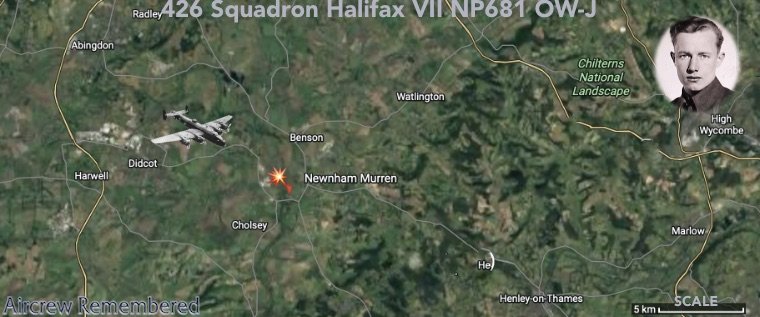 At approximately 9.05 a.m., while flying at around 8,000 feet near Wallingford, other crews in the returning force saw the port outer engine of NP681 burst into flames. Five parachutes were seen to leave the aircraft before the wing exploded; the Halifax then turned over and dived into the ground near Newnham Murren, exploding on contact.
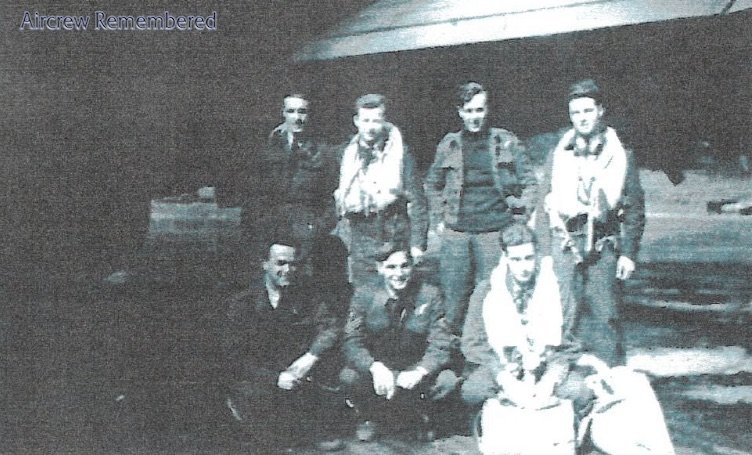
Above: Back row: John Andrew, Johnny Wilding, Grant McCreary, Robert Irving
Front row: Tommy Thompson, Pete MacKay, Edward O'Meara
A subsequent technical examination of the wreckage found that the No. 7 cylinder of the port outer Hercules XVI engine had blown off. This cylinder sat directly above the exhaust tail pipe, and it was concluded that oil escaping from the crankcase at this point had been ignited by the exhaust. The resulting fire was judged to have burned through the wing and ignited a fuel tank, causing the explosion that was witnessed by the other crews.
The Unit Commander’s report (RAF Form 765(C)) recorded that this was the third accident at the Station attributable to cylinders blowing off Hercules XVI engines built by the Standard Motor Company - two of the three having proved fatal - and recommended that the fault be corrected as soon as possible and that all captains be reminded to order their crews to bale out at once wherever any doubt existed as to a fire being brought under control. The Base Commander’s endorsement of 16th September 1944 echoed this, warning that the loss of life and material from this recurring engine defect “is no longer a negligible amount” and urging that all aircraft then using Hercules engines built by Standard Motor Co. be rectified as a matter of urgency.
 Five of the crew - the Navigator, Air Bomber, Wireless Operator/Air Gunner and both Air Gunners - baled out successfully. F/O Wilding and his Flight Engineer, Sgt. John Francis Andrew, remained in the aircraft and were killed instantly.
Writing to Wilding’s mother on 17th September 1944, the Squadron’s Wing Commander described him as “one of our most capable and experienced Captains of aircraft,” noting that he and his crew “had completed 20 missions over enemy territory” and that he “died in the line of duty.”

Above: The 2026 annual memorial - for wording see 'dedication' below (courtesy Wallingford Town Council))
Every September, Wallingford Town Council organises a memorial service at the commemorative cairn and is attended by the Mayor of Wallingford and Town Councillors, representatives from the RCAF, RAF, Canadian House, the Andrew and Wilding family, the Royal British Legion and others. A short service is followed by laying of the wreaths. The Town Council invites members of the public to attend the short informal service to honour the two airmen who sacrificed their lives.

Above: Original unveiling in 1960 (courtesy Wallingford Town Council)
The Cairn with a plaque bearing the squadrons badge was built in 1960 at the junction of Andrew Road and Wilding Road. Two roads in Wallingford have been named after the servicemen so that they will always be part of the map of the town. It is very important that they are not forgotten.
Since 1998, the Canadian Flag has been flown over the Town Hall on the anniversary of their crash.
The memorial plaque placed at the renamed Wilding and Andrew Road junction, reads:
'On the 9th. September 1944, F/O J.A. Wilding and Sgt. J.F. Andrew of No. 426 Squadron, Royal Canadian Air Force, by remaining at the controls of their damaged and bomb laden aircraft steered it clear of Wallingford to crash and explode in open fields. Their supreme sacrifice and conspicuous gallantry almost certainly saved the lives of many of the town's inhabitants. These roads have been named after them, and this plaque has been erected in grateful thanks by the Borough of Wallingford. 'Their name liveth for evermore.'
Decorations and Mentions
F/O Wilding was awarded the Distinguished Flying Cross, gazetted 1st December 1944. The official citation read:
“This officer has taken part in many sorties to heavily defended targets in Germany, including Hamburg, Stuttgart and Kiel. On three occasions his aircraft has been attacked by enemy fighters and during one sortie to Stuttgart, eight separate attacks by hostile aircraft were discouraged and his aircraft badly damaged. In the face of the enemy Flying Officer Wilding has consistently displayed courage and determination to complete his mission. A fine captain of aircraft, he has destroyed one Focke Wulf 190.”
He was also Mentioned in Despatches, gazetted 14th June 1945, and had earlier qualified for his Pilot’s Flying Badge at No. 8 Service Flying Training School, Moncton, New Brunswick, on 25th June 1943, when he was simultaneously commissioned Pilot Officer.
Burial Details
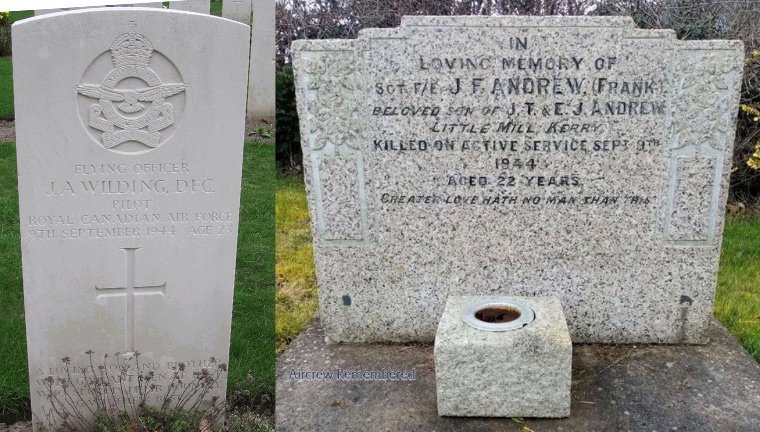
F/O. John Archibald Wilding DFC.. MiD. Brookwood Military Cemetery, Surrey. Grave 55. A. 8. Born 27th December 1920. Son of Archibald Wilding and of Rachel Wilding (née Hullock), of New York City, USA.
Epitaph: ‘A Loving Son And Brother With Gallant Men At Rest Who Served Their Country, Gave Their Best.’
Sgt. John Francis Andrew, MiD. Kerry Cemetery, Montgomeryshire, Wales. Unconsecrated Section, Grave 13. Son of John Thomas Andrew and Ethel Jane Andrew, of Abermule.
Interment for both airmen took place on 13th September 1944. F/O Wilding was buried with full service honours in the RCAF Section of Brookwood Military Cemetery; the Squadron was represented at the funeral, and wreaths were sent by the Sergeants’ Mess, the Officers’ Mess and the Station from which No. 426 Squadron operated.
Family and Personal History
John Archibald Wilding was born on 27th December 1920 in the Barnoldswick district of the City of York, England, and was baptised at St. Joseph’s, Barnoldswick, on 9th January 1921, the son of Archibald Wilding and Rachel Wilding (née Hullock); his godparents were John and Dorothy Wilding.
The family emigrated to the United States when John was an infant, sailing from Liverpool aboard the S.S. Cedric and arriving in New York on 8th April 1921. They settled at 480 East 183rd Street, the Bronx, New York City, later moving to 2298 Washington Avenue, Bronx, where his mother remained throughout the war.
His father, Archibald Wilding, was born in Blackburn, England, and ran a candy and stationery store in the Bronx; he died on 8th April 1943, a year before his son. His mother, Rachel Wilding (née Hullock), was born in Manchester, England. John had two younger sisters, Mary Elizabeth Wilding (aged 25 in 1944) and Clarice Veronica Wilding (aged 12–13 in 1944), both living with their mother at the time of his death.
He was educated at Haaren High School in New York City, graduating with a high school diploma, and later studied mathematics at T.R. Evening School in 1941. Before enlisting he worked as an usher at the Valentine Theatre (1936–1940) and the Roxy Theatre (1940–1941) in New York, and then as a file clerk with the Inspection Board of the United Kingdom in Canada (1941–1942), based in Ottawa.
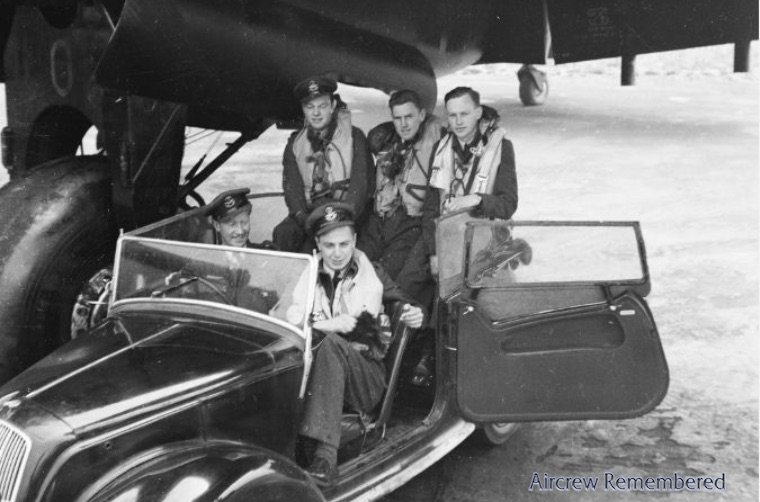
Crew of NP681- as yet no individual names
On 25th March 1941 he filed a Declaration of Intention to become a citizen of the United States in the Supreme Court of Bronx County, New York, describing his occupation as engine mechanic and recording a scar on his right knee - the same distinguishing mark noted on his later RCAF and immigration papers.
He enlisted in the Royal Canadian Air Force at No. 12 Recruiting Centre, Ottawa, on 11th May 1942 (service number R.161806), initially as an Aircraftman 2nd Class, and was assessed by the Selection Board as a “good type lad who should do well as Observer or Pilot. Well mannered and groomed.” His educational assessment recorded: “Applicant has 4 yrs. High School – N.Y. State. C.T. Score shows fair ability to learn. Personal background satisfactory.”
He trained through No. 1 Manning Depot, Toronto; No. 5 Initial Training School; No. 13 Elementary Flying Training School, St. Eugene, Ontario; and No. 8 Service Flying Training School, Moncton, New Brunswick, graduating with his Pilot’s Flying Badge and a commission as Pilot Officer on 25th June 1943. His final S.F.T.S. course report assessed him as “above average, keen and reliable.” An earlier report from No. 24 Operational Training Unit had been more measured, describing him as “a very confident pilot who experienced no difficulty in converting to the Whitley aircraft,” adding that “with more care he has the ability to become an above average pilot. As a captain, he has shaped well and has a good control over his crew.”
He was posted overseas in mid-1943 and, after further training at No. 24 Operational Training Unit and No. 1659 Heavy Conversion Unit, joined No. 426 (Thunderbird) Squadron RCAF at RAF Linton-on-Ouse, Yorkshire. He was promoted Flying Officer during his operational tour and was killed in action on 9th September 1944, aged 23, while flying his crew home from Le Havre.
He made his will on 12th May 1942 at No. 1 Manning Depot, RCAF, Toronto, appointing his mother, Mrs. Rachel Wilding, as sole executrix and beneficiary of his entire estate.
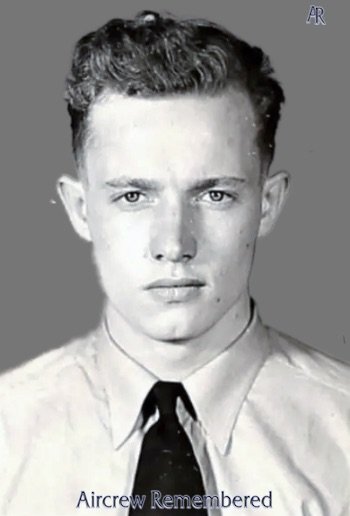
Personal Effects
An inventory of F/O Wilding’s personal effects, compiled on 14th March 1945 and forwarded via the R.A.F. Depository to the Administrator of Estates, Ottawa, listed the contents of his suitcase and package, including shirts, handkerchiefs and stockings; his two pilot’s brevets and epaulettes; a brown leather shaving case; a Parker wristwatch on an expanding bracelet (noted as unserviceable); a Kodak Brownie autographic camera, serial No. 11206 (noted as “badly damaged”); his RCAF pilot’s brevet; an ivory Chinese souvenir; photographs, letters and airgraphs; and a British passport, No. 081776. The effects were received by the Estates Branch on 18th March 1946, together with a Treasury cheque for $479.30 representing his outstanding pay and war service gratuity.
Correspondence
The surviving family correspondence - exchanged between Mrs. Rachel Wilding, her daughter Clarice, an aunt in Massachusetts, and the RCAF - gives a vivid picture of a family separated by the Atlantic trying, over almost a decade, to learn the full circumstances of John’s death and to trace his grave. Extracts are given below.
Wing Commander, No. 426 (R.C.A.F.) Squadron, to Mrs. Wilding - 17th September 1944
Dear Mrs. Wilding:
Before you receive this letter you will have had a telegram informing you of the very sad loss of your son Flying Officer John Archie Wilding. I am extremely sorry that I have been unable to write to you sooner to give you such details as were available.
Your son was the Captain and Pilot of an aircraft detailed to attack enemy installations at Le Havre, France. He and his crew took off at 6.30 a.m. on the morning of the 9th September 1944 and set course for the target. They successfully carried out their mission and upon returning to this country the aircraft encountered difficulties which caused it to crash. Five of the crew, namely the Navigator, Wireless Operator, Bomb Aimer and the two Air Gunners, managed to bail out successfully. Your son, John, and the remaining member of his crew were killed instantly in the crash.
Owing to the time taken to communicate under present conditions, it was not possible to ascertain your wishes regarding the funeral in the time available, and I had therefore to arrange for his burial without reference to you. You will, I am sure, understand the necessity for this action, and I sincerely trust that the arrangements made were such as you would have wished.

Your son was buried with full service honours, and interment took place at the R.C.A.F. Section, Royal Air Force Cemetery, Brookwood, Surrey. Members of the Squadron attended the funeral and wreaths were sent by the Sergeants’ Mess, Officers’ Mess and the Station from which this Squadron operates.
You will wish to know that all War Graves are taken care of by the Imperial War Graves Commission, who will erect a temporary wooden cross and ultimately a permanent headstone.
The personal effects of your son have been gathered together and forwarded to the Royal Air Force Depository, from where they will be sent to the Administrator of Estates, Ottawa, who will be writing to you in this regard in due course.
The news of your son’s tragic death came as a severe blow to the members of this Squadron. John was one of our most capable and experienced Captains of aircraft and he and his crew had completed 20 missions over enemy territory. He died in the line of duty and this Squadron will miss him. We join with you in sorrow at his passing, and I wish to extend to you the deep felt sympathy of the officers and men of this unit in your bereavement.
There may be something I have not mentioned here which you might possibly wish to know. If so, please do not hesitate to write to me, Mrs. Wilding, as I am only too anxious to give you any information that it is possible to release which may help you to bear the sad loss you have sustained.
Yours very sincerely,
Wing Commander, Commanding, No. 426 (R.C.A.F.) Squadron, R.C.A.F. Overseas
The Wing Commander’s statement that the crew “successfully carried out their mission” does not match the accident report, which records the aircraft returning with a full bomb load because the sortie was abortive, or the record of other squadrons on the same raid, several of which noted the Le Havre attack that morning as abandoned owing to cloud over the target. It seems likely that this was a simplification made for the sake of a grieving mother rather than a considered account of the operation.
Air Commodore D. E. MacKell, Acting Air Member for Personnel, to Mrs. Wilding - 15th September 1944
Researcher’s Note
The place of loss is likewise given in two forms in the surviving papers: the squadron and next-of-kin correspondence records the crash as occurring “near Wallingford, Berkshire,” while the CWGC and family records give the crash site as Newnham Murren, Oxfordshire. Newnham Murren is a small hamlet immediately south-east of Wallingford; at the time of the crash it lay within the historic county of Berkshire, the Berkshire–Oxfordshire boundary in this area having since been redrawn (1974) to place Wallingford and its surrounding villages within Oxfordshire. Both descriptions therefore refer to the same location.
Sources and Acknowledgements
- Royal Canadian Air Force Service Record of Service and Record of Service Airmen, Air Force No. J.27908 / R.161806 (Library and Archives Canada)
- RCAF Attestation Paper, Occupational History Form and Medical Examination papers, 11th May 1942
- Declaration of Intention and Permit to Re-enter the United States, U.S. Department of Justice, Immigration and Naturalization Service
- Wallingford Town Council
- Certificate of Baptism, St. Joseph’s, Barnoldswick
- Last Will and Testament, R.C.A.F. Form, 12th May 1942
- RAF Form 765(C), Report on Flying Accident, No. 426 Squadron, 9th September 1944
- Official Royal Canadian Air Force Casualty Notification, and Estates Branch, Department of National Defence, Ottawa - correspondence and file J.27908 FD-255
- Decoration Digest for Press Release (DFC and Mention in Despatches), Royal Canadian Air Force
- Statement of War Service Gratuity, 4th October 1945
- Personal and family correspondence, 1944–1953
- Commonwealth War Graves Commission, Brookwood Military Cemetery and Kerry Cemetery records
- London Gazette
- No. 640 Squadron RAF operations record, 9th September 1944 (via Wikipedia)
- Commodore James E. Arnold, USN, “USNAAB Le Havre,” U.S. Naval Institute Proceedings, February 1947
Compiled from official RCAF service and casualty records, RAF accident investigation papers, and personal and family correspondence supplied for this report.


