




Operation: Torpedo attack
Date: 3rd January 1943 (Sunday)
Unit: No. 14 Squadron RAF (motto: أنا نشر الأجنحة بلدي وابقى على وعد - 'I spread my wings and keep my promise')
Type: Martin Marauder Mk. Ia (B-26)
Serial: FK375
Code: 'D' - 'Dominion Revenge'
Base: RAF Shallufa, Egypt (LG-215)
Location: Aegean Sea
Pilot: Lt. Bruce W. Young 103095V SAAF. PoW No. 3223 Stalag Luft Sagan
Pilot 2: Fl/Sgt. Edward Arthur Meadwell 1066549 RAFVR Age 30. Killed
Obs: F/O. James Ernest Foli-Brickley 126991 RAFVR. Missing - believed killed
W/Op/Air/Gnr: F/O. Kenneth Jack Bennett Aus/401409 RAAF Age 25. Missing - believed killed
W/Op/Air/Gnr: F/O. Dudley Thomas Ray NZ/403029 RNZAF Age 25. Missing - believed killed
Air/Gnr: Sgt. Stanley Hunt 1238830 RAFVR. Missing - believed killed
REASON FOR LOSS
The Mission - 3 January 1943
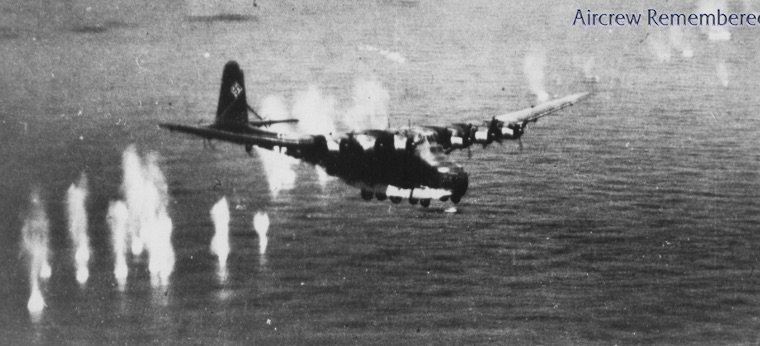
Marauder FK375 of No. 14 Squadron RAF took off at 09:05 hours on 3 January 1943 from Shallufa, in company of a second Marauder, to carry out a torpedo attack against enemy shipping in the Aegean Sea. The weather was bad and visibility poor. Shortly after passing Kea Island, north of the Cyclades Group, on a south-westerly course, a small vessel was observed. This turned out to be part of a convoy of five vessels escorted by several aircraft, including an autogyro. The two Marauders separated to launch their attack.
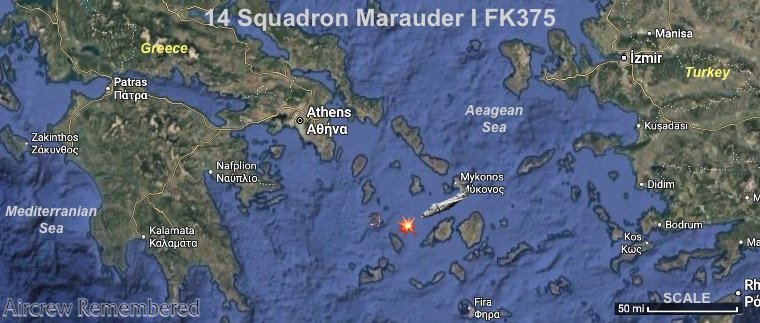 Two radio messages were received from FK375 - one reporting that fighters were attacking, and another that the aircraft was damaged and would have to force-land, but that the torpedo attack had been delivered before the fighter engagement. No further news was received from the aircraft or crew.
The Aircraft
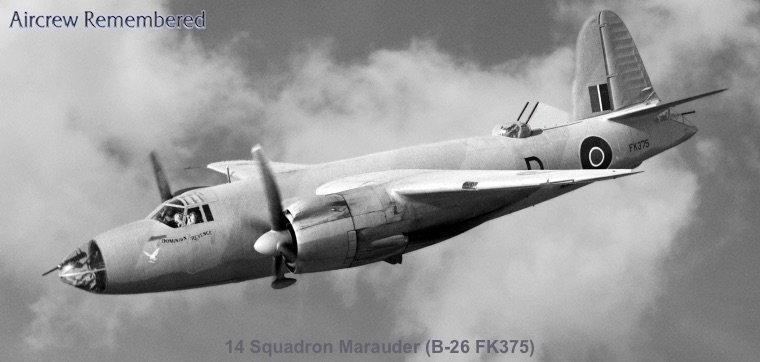
FK375 'D' Dominion Revenge was Wing Commander Maydwell's aircraft, used on torpedo operations. The Marauder Mk. Is operated by 14 Squadron were from a batch of 52, equivalent to the USAAF's B-26A-MA and B-26A-1-MA versions, delivered under Lend-Lease terms to the RAF. The aircraft was based at Fayid, Egypt.
The Ditching and Its Aftermath
The pilot, Lt. Young, who survived as a prisoner of war, later gave a harrowing account: the aircraft was forced to ditch in the sea off Seriphos Island. He reported that after freeing himself, he saw F/O. Bennett sitting on top of the fuselage near his escape hatch. Bennett then climbed back inside in an attempt to rescue the Air Observer, who was still trapped - but the aircraft sank nose-first almost immediately, and Bennett was never seen again, having given his life attempting to save a crewmate.
This explains the confusing post-war records around Dudley Ray. His service record noted that an incorrect report was received through the International Red Cross that he had been buried at Seriphos Island - this referred to Fl/Sgt. Meadwell, the second pilot, who was actually buried there. A post-war casualty search denied the Red Cross report concerning Ray, and he was officially presumed to have lost his life at sea without trace.
 In Summary
FK375 Dominion Revenge was a well-known aircraft in the squadron - formerly used by the squadron's commanding officer. It was lost on a daring low-level torpedo attack against a defended enemy convoy in the Aegean, shot up by fighters after successfully delivering its torpedo. Of the six crew, only the pilot survived.
BURIAL DETAILS
Fl/Sgt. Edward Arthur Meadwell. Phaleron War Cemetery. Grave 23. B. 1. Son of Arthur Edward and Charlotte Meadwell; husband of Lucy Patricia Ethel Meadwell, of Holloway, London. Epitaph: 'At The Going Down Of The Sun And In The Morning We Will Remember Them'.
F/O. James Ernest Foli-Brickley. Alamein Memorial. Column 208. Son of John Baptist Foli-Brickley and Lilian Constance Foli-Brickley, of Paddington, London, England.
F/O. Kenneth Jack Bennett. Alamein Memorial. Column 272. Born on the 28th November 1917 in Geelong, Victoria, Australia. Enlisted on the 3rd February 1941. Son of Samuel Charles and Fanny Severn Bennett, of 71 Isobella Street, West Geelong, Victoria, Australia.
F/O. Dudley Thomas Ray. Alamein Memorial. Column 278. Born on the 21st June 1917 in Te Awamutu, Auckland, New Zealand. Enlisted at the Initial Training Wing, Levin on the 1st September 1940 and embarked for Canada on the 8th October 1940 by the Aorangi, to train under the Empire Air Training Scheme. He attended No. 2 Wireless School, Calgary, Alberta, then on the 15th March 1941 proceeded to No. 3 Bombing and Gunnery School, MacDonald, Manitoba, where he was awarded the Wireless Operator Air Gunner badge and promoted to Sergeant on the 14th April 1941. Later, while serving in the United Kingdom, he was further promoted to Flight Sergeant on the 1st December 1941. He had previously embarked for the United Kingdom from No. 1 'M' Depot, Debert, Nova Scotia on the 21st April 1941. His brother, Fl/Lt. Arthur Lyall Ray NZ/414677 RNZAF was also killed in service on the 24th July 1944. Son of Arthur James Ray (died 1942, age 60) and Ethel Millicent Ray (died 1976), of Te Awamutu, Auckland, New Zealand.
Sgt. Stanley Hunt. Alamein Memorial. Column 270. Son of Francis and Emily Hunt, of 6 Hill Street, Liverpool, England.
NEWSPAPER NOTICE
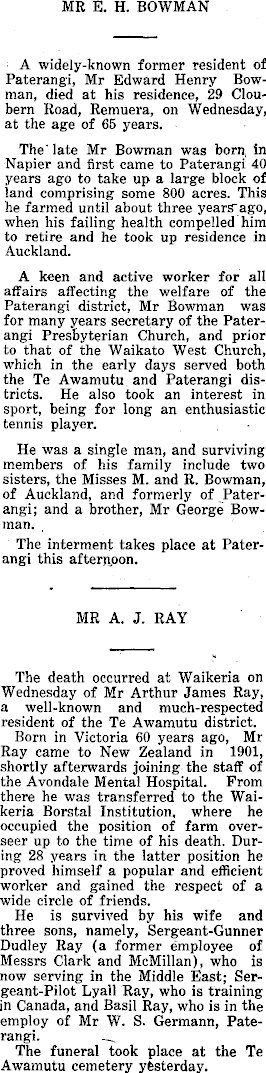
Te Awamutu Courier, 10 July 1942, Page 2
MR A. J. RAY. The death occurred at Waikeria on Wednesday of Mr Arthur James Ray, a well-known and much-respected resident of the Te Awamutu district. Born in Victoria 60 years ago, Mr Ray came to New Zealand in 1901, shortly afterwards joining the staff of the Avondale Mental Hospital. From there he was transferred to the Waikeria Borstal Institution, where he occupied the position of farm overseer up to the time of his death. During 28 years in the latter position he proved himself a popular and efficient worker and gained the respect of a wide circle of friends. He is survived by his wife and three sons, namely, Sergeant-Gunner Dudley Ray (a former employee of Messrs Clark and McMillan), who is now serving in the Middle East; Sergeant-Pilot Lyall Ray, who is training in Canada, and Basil Ray, who is in the employ of Mr W. S. Germann, Paterangi. The funeral took place at the Te Awamutu cemetery yesterday.
NO. 14 SQUADRON RAF - MARTIN MARAUDER MK. I
Background and Selection
The highly experienced No. 14 Squadron had been flying Blenheim Mk. IVs in the light bomber role during all of the major battles fought in the Western Desert, with short rest periods in Palestine and Iraq in between, but by mid-1942 it was the last operational unit still flying the Blenheim in North Africa and was due for a rest from operations. As luck would have it, the first Marauder Mk. Is began to arrive in the Middle East around this time, and No. 14 Squadron was selected as the prime candidate to fly the new type.
Only 52 Marauders received the designation Marauder Mk. I, meaning only one unit could be equipped with the type - No. 14 Squadron in the Middle East.
 The Aircraft
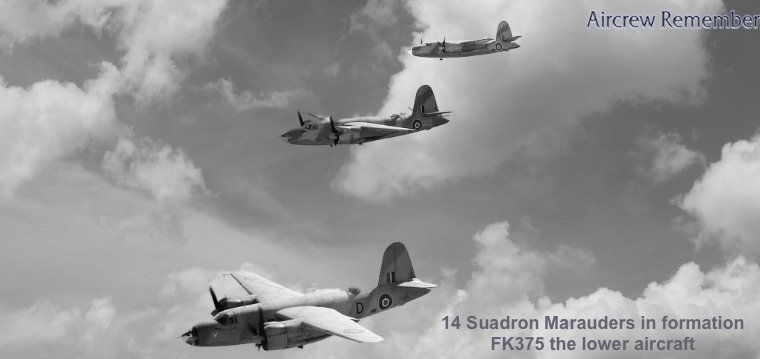
The RAF received three B-26As for evaluation in the summer of 1942 and decided to adopt the type for tactical work in North Africa. Forty-eight Marauder Mk. Is and Mk. IAs already allocated under Lend-Lease were sent directly to the Middle East. In RAF and Commonwealth service the B-26A was known as the Marauder Mk. I and the B-26B as the Marauder Mk. IA - a total of 52 Mk Is and IAs were received. The Marauders cost $102,659.33 each to build and were equivalent to the USAAF's B-26A-MA and B-26A-1-MA versions. Most were delivered directly to North Africa, though four crashed during delivery flights, some were lost in the USA before delivery, and four were sent to the United Kingdom for trials before eventually also going to North Africa.
Conversion and Work-Up
Under the leadership of pre-war RAF regular Wing Commander Wynne S.G. "Dick" Maydwell DFC, the squadron moved to Fayid in the Canal Zone of Egypt during August 1942 to commence conversion. To assist, the unit was assigned a cadre of experienced USAAF instructors led by Colonel Flint Garrison.
The B-26 was regarded as something of a "hot ship" by USAAF pilots, but most of those affected were straight out of flight school. The No. 14 Squadron crews already had plenty of operational experience and were not unduly affected. The aircrew hailed from all four corners of Britain and its Empire - Englishmen, Irishmen, Welshmen and Scots rubbed shoulders with New Zealanders, Canadians, South Africans, Australians, a Kenyan, a Rhodesian and a Dane - including New Zealanders such as Dudley Ray.
 Operations
The squadron flew its first operational mission on 6 November 1942, being used for long-range reconnaissance, mine-laying and anti-shipping strikes. Unlike the USAAF, No. 14 Squadron used equipment for carrying torpedoes, sinking several merchant ships with this weapon. The Marauder also proved useful in disrupting enemy air transport, shooting down considerable numbers of German and Italian transport aircraft flying between Italy and North Africa.
On 21 February 1943, nine Marauders led by Major Eric Lewis SAAF attacked shipping in the harbour at Melos - but despite the success of this action, it was the last time the squadron used torpedoes. The squadron's role then became low-level coastal reconnaissance covering the Mediterranean. In March 1943 they began anti-submarine missions and long-range sea patrols, operating from Blida and then Maison Blanche in Algeria. In May 1943 they briefly added six P-51A Mustangs for attacks, though these were returned in July. In June 1944 they moved completely to Alghero in Sardinia, where they worked with Bristol Beaufighters from No. 39 Squadron - a Marauder would fly offshore and guide Beaufighters to attack any ships spotted. The squadron flew its last Marauder mission on 21 September 1944.
Losses and Legacy
Sorties were normally flown by a single aircraft. The Marauder Mk. I recorded an impressive record against the Luftwaffe, showing the aircraft was well able to defend itself and was far from easy prey - but the squadron sustained heavy losses, with 25 aircraft lost on operations.
No. 14 Squadron Marauders in the Mediterranean theatre were named after Royal Navy submarines and ships based in the Mediterranean. Among them were:
Dominion Revenge - FK375
Dominion Thunderer - FK149
Dominion Triumph - FK142
Dominion Upholder - FK370
In summary, No. 14 Squadron's Marauder Mk. I operations were remarkable - a relatively small number of aircraft, crewed by men from across the Commonwealth, flying dangerous solo maritime missions over the Mediterranean against defended convoys and Luftwaffe transport aircraft for over two years. The loss of FK375 Dominion Revenge on 3 January 1943, with Dudley Ray aboard, was one of those 25 operational losses.
NOTES
Named aircraft - No. 14 Squadron Marauder Mk. I
Dominion Revenge - FK375 - (Mk. I, coded D) On strength 20 August 1942. Lost 3 January 1943 - this report.
Dominion Thunderer - FK149 - No further details recorded.
Dominion Triumph - FK142 - (Mk. I, coded O/Z/A/R) On strength 23 September 1942. Lost 1 February 1944 - missing from a reconnaissance mission from Ghisonaccia, Corsica. Crew: Fl/Sgt. Maurice Cheyne Reid 178071 RAFVR, Fl/Sgt. John Thomas Brown 1314917 RAFVR, W/O. Arthur Western 968412 RAFVR, Fl/Sgt. Thomas Norman Gilchrist 1122992 RAFVR, Fl/Sgt. Walter Horace Carr 1199387 RAFVR, Fl/Sgt. Patrick Daley 1028881 RAFVR.
Dominion Upholder - FK370 - (Mk. IA, coded Z/L) On strength 19 July 1942. Lost 3 December 1943 - nosewheel collapsed during run-up and the aircraft caught fire at Blida. No crew details recorded.
The names were inspired by Royal Navy vessels: HMS Revenge and HMS Thunderer were battleships (the latter decommissioned in 1926), while HMS Triumph and HMS Upholder were submarines operating in the Mediterranean, mostly from Malta. No further "Dominion R" aircraft beyond Dominion Revenge appear in the squadron's records; the other named aircraft in the series all begin with different letters.
Sources and acknowledgements
- National Archives Kew
- NEW Zealand Cenotaph
- Air Force Museum of New Zealand,
- Aircrew Remembered Archives
- National Archives of Australia
- WikipediaI
- International Bomber Command Centre
- 14 Squadron Association
- Imperial War Museums
- Department of Veterans’ Affairs


