




Operation: Escort
Date: 19th May 1940 (Sunday)
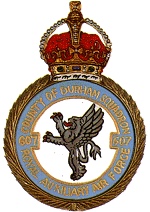
Unit: No. 607 Squadron (City of Durham) (motto: none, the pilots selected 'UP', the heraldic office rejected it as too informal) (1)
Type: Hurricane I (2)
Serial: P3535
Code: AF-P
Base: Vitry-en-Artois, France
Location: Oisy-le-Verger, France
Pilot: Sq/Ldr. 'Morley' George Morley Fidler 34219 RAF Age 27. Missing - believed killed
REASON FOR LOSS:
In 1934, at the age of 21, Fidler enlisted in the Royal Air Force and began his training as a pilot. He earned his wings in June 1935, embarking on a career that would take him far from the Yorkshire countryside. Over the following years, he served overseas postings in Egypt, with shorter tours in Cyprus and India, gaining the breadth of experience that marked him as a professional of considerable promise.
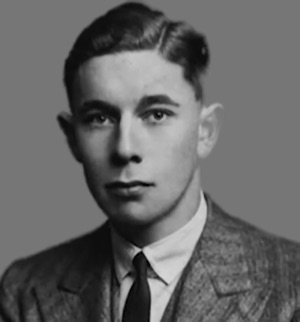
(Sq/Ldr Fidler shown below) His superiors noticed. By 1938, assessors judged him 'exceptional', a rare designation - and he was promoted to Acting Flight Lieutenant. When war was declared in September 1939, Fidler deployed to France as part of the Air Component of the British Expeditionary Force (BEF), initially tasked with administrative flying on Tiger Moths well behind the front line.
On 15 May 1940 - just six days into the campaign - Squadron Leader Lance Smith (), the Commanding Officer of 607 Squadron, was shot down and killed over Dinant, Belgium. Command of the squadron fell immediately to Morley Fidler. At a stroke, after only a matter of days flying Hurricanes under wartime conditions, he found himself responsible for what remained of one of the RAF's most embattled fighter units.
The appointment, while a recognition of his ability, came at the worst possible moment. The situation in France and the Low Countries was deteriorating by the hour. Belgium, the Netherlands, and northern France were being overrun by German armoured and infantry formations. 607 Squadron, like every other RAF unit in theatre, was fighting a desperate rearguard action to protect the retreating British and Allied troops now converging on the Channel coast at Dunkirk.
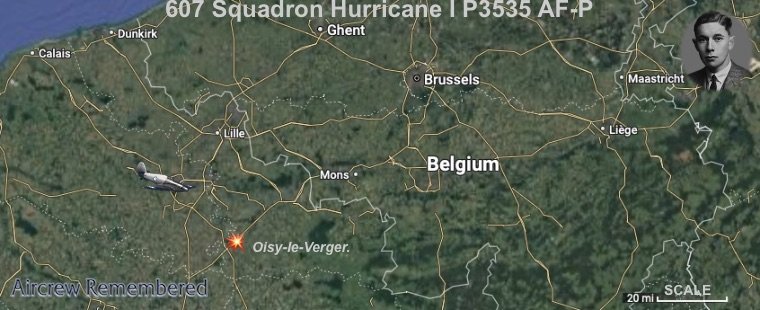
At 16:00 hours on the afternoon of 19 May 1940 - his 27th birthday — Squadron Leader George Morley Fidler was airborne in Hurricane Mk I P3535,', leading a joint patrol with Hurricanes from No. 17 Squadron over the skies above Cambrai in northern France.
The formation encountered a Dornier Do 17 twin-engined bomber escorted by Messerschmitt Bf 109 fighters. In the ensuing engagement, Fidler's Hurricane was struck and brought down by a Bf 109. He did not survive. Twelve other RAF Hurricanes were lost in combat in the same area that day — a measure of the ferocity of the fighting over the Cambrai corridor. Fidler had held command of 607 Squadron for just three days.
In the chaos of the campaign's final days, a downed Hurricane was found in the area where Fidler had been lost. The pilot's body was recovered by soldiers and given a hurried battlefield burial. After the fall of France, local French authorities carried out a more formal re-interment at the village of Bachy, some 20 miles from the presumed crash site. The Commonwealth War Graves Commission subsequently erected a headstone at Bachy bearing Fidler's name and a personal inscription chosen by his mother: 'So he passed over, and all the trumpets sounded for him on the other side' - a quotation from Bunyan's Pilgrim's Progress.
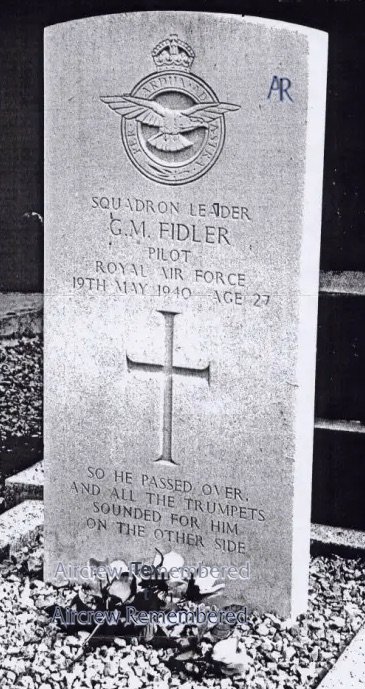
(Left; Fidlers original grave at Batchy) For six decades the grave at Bachy was accepted as Fidler's resting place. His story seemed to have come to a close.
In 2005, metal detectorists exploring the countryside around Oisy-le-Verger - approximately 35 kilometres from Bachy, and 27 miles south of Lille - discovered aircraft wreckage bearing a serial number: P3535. This was the registered serial of Fidler's -. The find was geographically incompatible with the location of the grave at Bachy.
A researcher based in France subsequently contacted the Commonwealth War Graves Commission to flag the discrepancy. The implication was grave: the man buried at Bachy under Fidler's name might not be Fidler at all. Investigations conducted jointly by the CWGC, the Air Historical Branch (AHB), and the Ministry of Defence's Joint Casualty and Compassionate Centre (JCCC) confirmed the researcher's conclusion.
In 2006, Franco-Belgian amateur historians with metal detectors excavated the Bachy crash site and established that the aircraft buried there was not P3535 but Hurricane P2687 — the aircraft flown by Flying Officer James ('Jerry') Strickland of No. 213 Squadron, who had also been shot down on 19 May 1940. Strickland had bailed out and survived. The identity of the man actually buried in the Bachy grave remains unknown to this day, though it is believed he may be one of two flight sergeants who were also lost in the area on that afternoon.
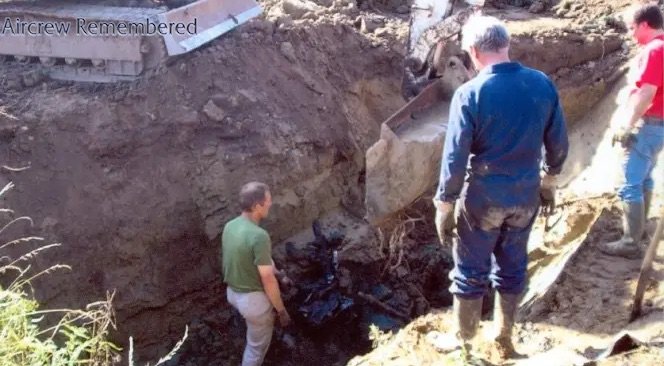
In 2016, the CWGC formally undedicated the grave at Bachy: Fidler's name was removed from the headstone and replaced with the inscription 'Unknown Airman'. He was transferred to the Roll of the Missing and his name was added to the Runnymede Memorial, where the RAF's missing of the Second World War are commemorated. Squadron Leader Fidler was once more among the lost.
The story took an extraordinary turn in 2022. Engineers constructing the Canal Seine-Nord Europe — a major infrastructure project linking the Seine and Scheldt river systems - were working near Oisy-le-Verger when their excavations uncovered the buried remains of a Hawker Hurricane. The aircraft was discovered in the very area where P3535 had last been seen. As the surrounding ground was carefully removed, it became clear that the pilot was still inside the cockpit, seated upright, just as he had been at the moment of impact 82 years earlier.
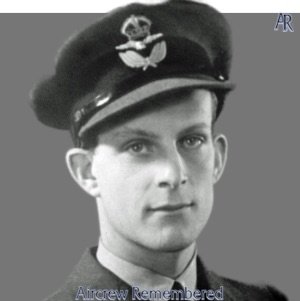
(Right: F/O. James Strickland)
The discovery was reported to the JCCC, whose team - informally known as the 'MOD War Detectives' - took charge of the investigation. Historical records, operational logs, combat reports, and investigation files were analysed to determine which of four missing pilots from that day might be the occupant of the recovered aircraft. However, no surviving component of the Hurricane could be definitively linked to P3535's serial number, meaning the precise identity of the aircraft could not be confirmed by physical evidence alone.
DNA analysis offered the most direct route to identification, but presented an immediate difficulty: Squadron Leader Fidler had no children. His siblings, Harold and Joan, also had no surviving descendants. There was no living relative from whom a familial DNA sample could be taken for direct comparison.
The JCCC team adopted a process of elimination. The remains of the three other pilots reported missing in the Oisy-le-Verger area on 19 May 1940 were identified as candidates. DNA samples from descendants of those pilots were tested against the genetic material recovered from the Hurricane cockpit. None of the three matched. By the process of exhaustion, only one conclusion remained: the remains were those of Squadron Leader George Morly Fidler.
Nicola Nash, who led the JCCC Commemorations Team — the 'war detectives' — stated that the team was '100 per cent certain it is Morley'. She later reflected: 'We are 100 per cent certain it is Morley. It has brought him to life for us.' Dr James Wallis, Head of Commemorations at the CWGC, acknowledged the significance of the recovery: 'It is an honour for the Commission to pay our respects to Sqn Ldr Fidler, following the 2022 discovery of his Hurricane along the route of the future Canal Seine-Nord Europe.'
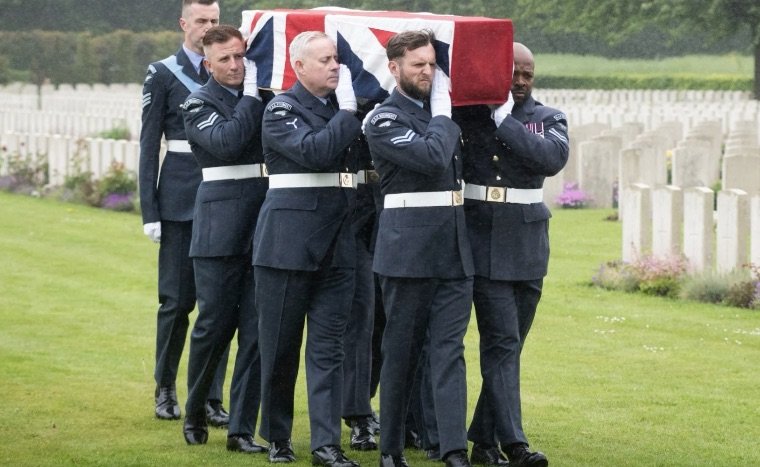
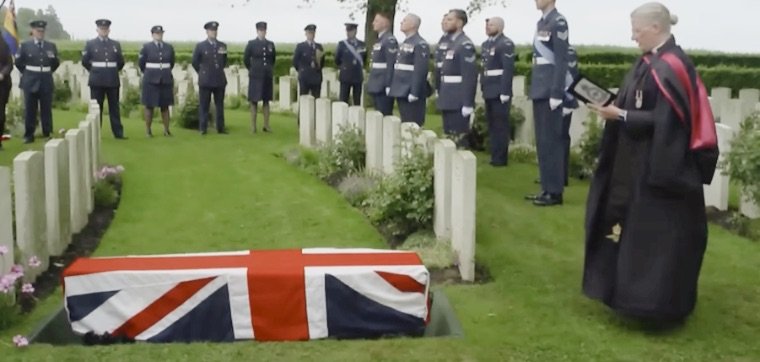
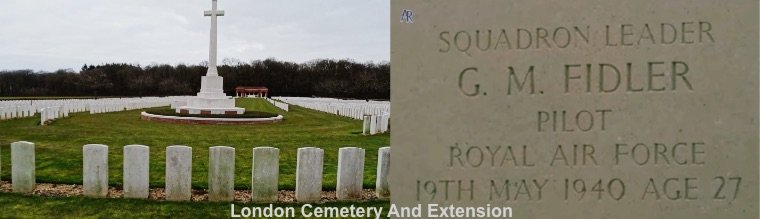
On 19 May 2026 - exactly 86 years to the day after his Hurricane was shot down over Cambrai - Squadron Leader George Morley Fidler was finally laid to rest with full military honours at the London Cemetery and Extension near Longueval, in northern France, where he rests among fellow airmen.
The burial was organised by the JCCC and attended by members of the public, serving RAF personnel, and representatives of 607 Squadron. A bearer party composed of serving personnel from RAF Halton carried the coffin to the graveside. A trumpeter from the Band of the Royal Air Force College sounded the Last Post. Members of RAF Halton and 607 Squadron stood in honour behind the newly inscribed CWGC headstone.
On the same day, a commemorative service was held at his local church in Great Ayton, Yorkshire - the village where he had grown up - reflecting the lasting connection between the fallen officer and his home community.
Nicola Nash of the JCCC said at the graveside: 'Sqn Ldr Fidler has been buried today 86 years after he was killed. His story has been known to us since his grave was unnamed many years ago. It has been wonderful to finally find him and be able to put him to rest. Today we honour him and the sacrifices he made all those years ago.'
He had assumed command of a squadron at war with only three days' notice, in the most demanding aerial environment imaginable, flying an aircraft he had known for mere weeks. He gave his life protecting the retreat to Dunkirk. He has now been given, 86 years later, the burial with honour he always deserved.
 BURIAL DETAILS:
Sq/Ldr. George Morley Fidler. Inertly remembered on the Runnymede Memorial. Later London Cemetery And Extension, Longueva. Plot 13. Row D. Grave 11. Born on the 30th September 1920 in Great Ayton, North Yorkshire, England, the son of George and Christiana Gertrude Fidler, of Great Ayton, Yorkshire, England. Epitaph: 'So he passed over, and all the trumpets sounded for him on the other'.
Sq/Ldr. Sq/Ldr. Launcelot Eustace Smith. Runnymede Memorial. Panel 4. Born in 1908, son of Clarence Dalrymple Smith (died 1941, age 73) and Cicely Smith (died 1952, age 70); husband of Patricia Lydia Frances Smith (née Doyne, died 1964, age 51), of Slaley, Northumberland.
Fl/Lt. James Murray Strickland DFC 39581 RAF. Ivybridge Cemetery. Block B. Grave 3.A. Born Iloilo, Philippines in 1918. Son of James (died 1951, age 62) and Elizabeth Strickland (née Harding - died 1942 - age 54), husband of Betty Stean Strickland (née Harvey), of Ivybridge. Killed, age 22, on 13th August 1931 whilst with 130 Squadron.
(1) 607 Squadron: In February 1940, Flight Lieutenant Fidler was posted to No. 607 (County of Durham) Auxiliary Air Force Squadron, then stationed at Vitry-en-Artois in the Pas-de-Calais. At that point, the squadron was still flying the Gloster Gladiator a biplane that belonged to an earlier era of aerial warfare, and had been in France since November 1939.
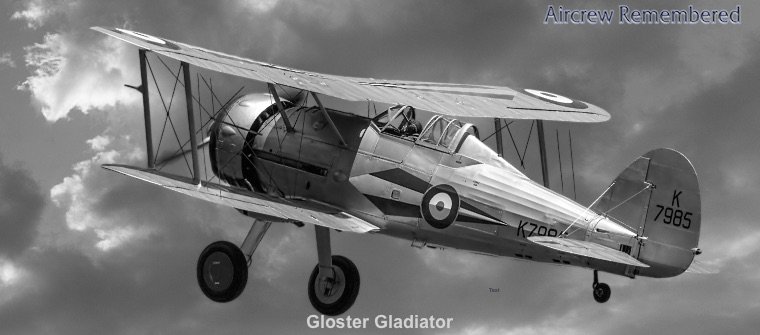
The transition to modern fighters came swiftly. From March 1940 onwards, 607 Squadron began taking delivery of the Hawker Hurricane, and by early May the re-equipment was complete. However, this left the pilots with only limited hours on type: when Germany launched its Blitzkrieg offensive in the West on 10 May 1940, Fidler and his colleagues were hurled into intense aerial combat with an aircraft they were still learning to master.
The opening days of the campaign were ferocious. On the squadron's first day of action, 607 Squadron pilots claimed eighteen enemy aircraft destroyed — a remarkable achievement — but at the cost of three Hurricanes. The tempo was relentless, with pilots sometimes flying multiple sorties in a single day. Despite these early successes the picture darkened rapidly. The speed of the German advance on the ground was matched by the Luftwaffe's growing supremacy in the air, and 607 Squadron, along with the rest of the BEF's air component, was forced into a fighting retreat.
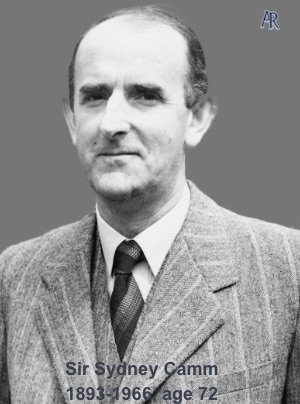
(2) The Hawker Hurricane is one of Britain's most iconic and historically significant fighter aircraft, playing a crucial role in the Second World War.
Origins & Development: Designed by Sidney Camm and built by Hawker Aircraft, the Hurricane first flew in November 1935. It was the RAF's first monoplane fighter capable of speeds exceeding 300 mph — a major leap from the biplane era. It entered service in 1937, making it the RAF's most numerous fighter at the outbreak of war.
Design: The Hurricane blended old and new technologies:A fabric-covered rear fuselage over a metal tube frame (older construction technique) Stressed-metal wings (modern)
A Rolls-Royce Merlin engine producing around 1,030 hp. Eight .303-inch Browning machine guns in the wings Retractable undercarriage.
Its conservative construction made it rugged, easy to repair in the field, and straightforward to manufacture - vital wartime qualities.
The Battle of Britain (1940): The Hurricane is perhaps most famous for its role in the Battle of Britain. Though often overshadowed by the more glamorous Spitfire, Hurricanes actually shot down more enemy aircraft than all other British defences combined during the battle. It was assigned primarily to attack German bombers, while Spitfires typically engaged the fighter escorts. Its stability as a gun platform made it devastating against the Heinkel and Dornier bomber formations.
VARIANTS & ROLES
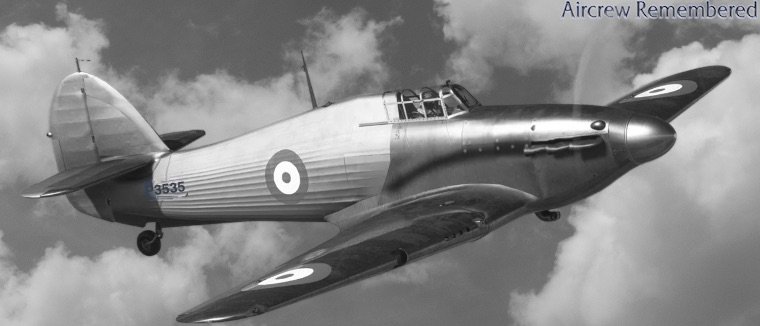 The Hurricane evolved significantly throughout the war:
Mk I - the original eight-gun version: Mk II - upgraded Merlin XX engine; could carry 12 machine guns or four 20mm cannons Mk IID - "tank buster" variant with two 40mm anti-tank guns
Sea Hurricane - navalised version for carrier operations
Hurribomber - fitted with bomb racks for ground attack
It served in virtually every theatre: North Africa, Malta, the Eastern Front (supplied to the Soviet Union), Burma, and the Far East.
Specifications (Mk I): Wingspan: 40 ft (12.19 m) Length: 31 ft 5 in (9.58 m) Max speed:~340 mph (547 km/h) Range:~600 miles (965 km) Ceiling:36,000 ft (10,973 m) EngineRolls-Royce Merlin IIl
Legacy: Over 14,500 Hurricanes were built in total. While it was gradually eclipsed by newer designs like the Typhoon and Tempest, the Hurricane's contribution to winning the Battle of Britain arguably saved Britain from invasion. It represents a transitional masterpiece — bridging the biplane era and the age of modern jet-age fighters. A number of airworthy examples survive to this day and regularly appear at airshows.
Researched and dedicated to the relatives of these pilots with thanks to National Archives Kew, BBC and RAF News, Wikipedia, Aircrew Remembered team and their archives. MOD Joint Casualty and Compassionate Centre (JCCC). RAF Halton; 607 Squadron; Band of the Royal Air Force College, RAF Memorial Flight Club, Great Ayton History Society
Other sources as quoted below:


