




Operation: Benghazi
Date: 04/50th March 1942 (Wednesday/Thursday)
Unit: No. 70 Squadron (motto: Usquam - Anywhere)
Type: Wellington IC
Serial: Z1042
Code: 'S'
Base: LG 104 Qotafiya II, Egypt
Location: 70-80 km south of Bomba, Libya
Pilot: Fl/Lt. Peter John Fisher, 40901, RAF, Age 25 - Missing - believed killed
Nav: P/O. Geoffrey Pender Chambers, NZ/41308, RNZAF, Age 21 - Missing - believed killed
Air/Bmr: F/O. Roger Maggs, 84731, RAFVR, Age ? - Missing - believed killed
W/Op/Air/Gnr: Sgt. Thomas George Middlebrook, 908327, RAFVR, Age ? - Missing - believed killed
Air/Gnr: Fl/Sgt. Robert Cranstoun Vaughan Rogers, 954854, RAFVR, Age ? - Missing - believed killed
Air/Gnr: Sgt. Kenneth Martin Tuck, 1261090, RAFVR, Age 22 - Missing - believed killed
Reason for Loss
Z1042 took off from LG 104 between 22:45 and 22:50 hrs to attack the port of Benghazi. Heavily defended, Benghazi was a vital logistics hub for supplying the Axis forces in North Africa and was a frequent target for Allied air operations.
To safeguard the arrival of reinforcements and supplies through Libyan ports such as Benghazi and Tripoli, the Italian 5th Squadra Aerea (5th Air Fleet) had begun intensified escort and port patrol operations on 1st March 1942. At this time the front line had temporarily stabilised along the Gazala Line to the east. Benghazi remained a heavily damaged front-line supply hub, with roughly 85% of its buildings ultimately damaged or destroyed by aerial bombardment, until it was finally liberated by the British Eighth Army in November 1942.
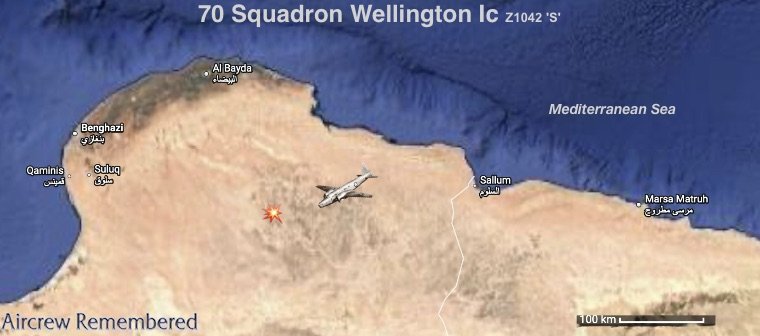 The aircraft was last heard of at 02:49 hrs. It was later found burnt out by army personnel, having crashed in the forward army area 70-80 km south of Bomba. Two bodies were found, but their graves could not be located after the war. A mystery remains as to the fate of the other four crew.
Burial Details
Fl/Lt. Peter John Fisher. Alamein Memorial. Column 247. Educated at Cranleigh School in Surrey, England 1931-1934. Enlisted in 1938 on a Short Service Commission. Son of Albert Oliver Fisher and Margaret Fisher.
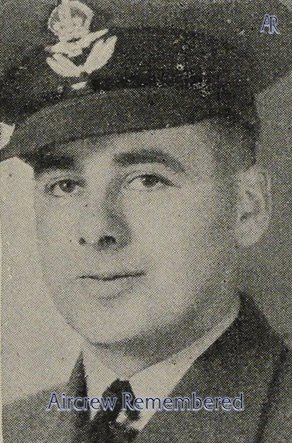
P/O. Geoffrey Pender Chambers. Alamein Memorial. Column 265. Son of John Chambers (died c.1943, age 47) and Susan Chambers (née Hodge, died 1977), of 15 Market Street, Dunedin, later of Wellington, New Zealand.
Gisborne Herald, 6th April 1942:
"Gisborne Airman Killed. A recent Royal Air Force casualty list contained the name of Pilot-Officer Geoffrey P. Chambers, of Wellington, who was in the Gisborne Public Trust Office at the time of his enlistment. During the time he was in Gisborne he was prominent in the Gisborne Amateur Surf and Swimming Club, and before that time had already made his mark in swimming circles, winning a junior New Zealand championship, his time for the 75yds. breaststroke having stood as a record since 1935."
F/O. Roger Maggs. Alamein Memorial. Column 248. Next of kin details unavailable - can you assist?
Sgt. Thomas George Middlebrook. Alamein Memorial. Column 262. Next of kin details unavailable - can you assist?
Fl/Sgt. Robert Cranstoun Vaughan Rogers. Alamein Memorial. Column 250. Next of kin details unavailable - can you assist?
Sgt. Kenneth Martin Tuck. Alamein Memorial. Column 262. Son of Alfred Osman Tuck and Agnes Tuck, of West Hampstead, London, England.
Note: Medals Reunited New Zealand are keen to contact relatives of P/O. Geoffrey Pender Chambers. If you have a medal or medals you would like to return to family or a descendant, they can help - contact them by clicking the logo. They offer a 100% not-for-profit, free service dedicated to reuniting military medals and ephemera with families or close descendants.
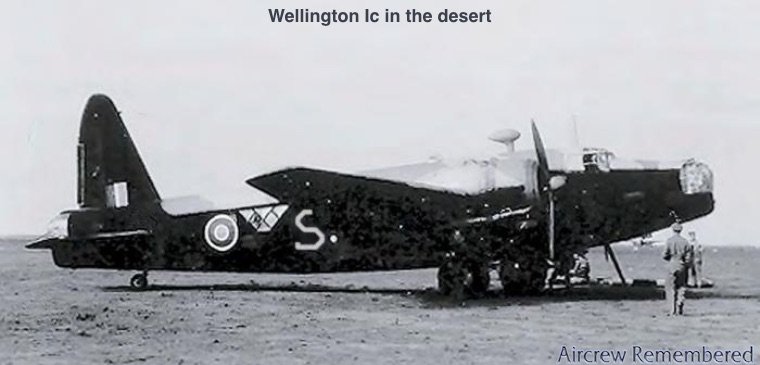 70 Squadron
70 Squadron served as a heavy bomber squadron, first in North Africa and then from bases in Italy.
At the outbreak of the Second World War the squadron was operating the Valentia I bomber-transport and had just moved to Egypt after eighteen years in Iraq.
After Italy entered the war the squadron converted to the Vickers Wellington, and on 18th September 1940 it began operations over the Western Desert. It kept its Wellingtons throughout the war in North Africa, eventually moving west behind the advancing Allied armies, first into Libya and then Tunisia. During 1941 the squadron was also involved in the fighting against the pro-Axis revolt in Iraq and in the campaign to take Vichy-held Syria.
In December 1943 No. 70 Squadron moved to the Foggia area of Italy, remaining there until October 1945, when it returned to the Middle East. The Wellingtons remained in use until the start of 1945, when they were replaced by the long-range Consolidated Liberator. The squadron was already active over the Balkans, but the Liberator gave it the range to drop mines in the Danube, as well as to continue bombing targets in northern Italy.
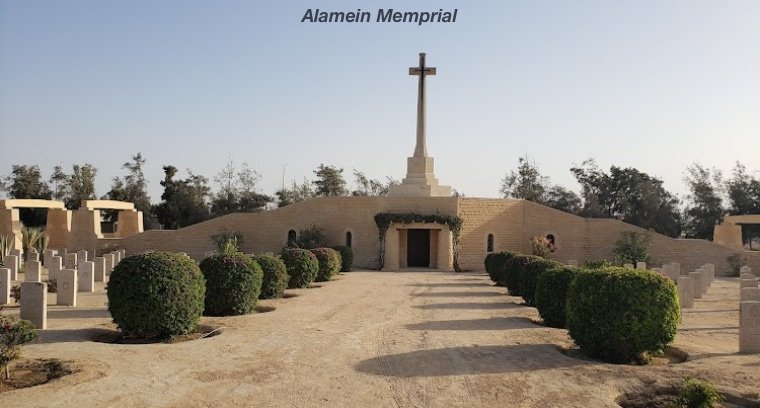 Alamein Memorial
The Alamein Memorial stands at the entrance to El Alamein War Cemetery, about 130 kilometres west of Alexandria on the coast road to Mersa Matruh, Egypt. It was designed by Sir Hubert Worthington and unveiled by Field Marshal Viscount Montgomery of Alamein on 24th October 1954.
The Land Forces panels commemorate more than 8,500 soldiers of the Commonwealth who have no known grave. They died in the campaigns in Egypt and Libya, and in the operations of the Eighth Army in Tunisia up to 19th February 1943. Men who served and died in Syria, Lebanon, Iraq and Persia are also commemorated here.
The Air Forces panels commemorate more than 3,000 airmen of the Commonwealth who lost their lives in operations over Egypt, Libya, Syria, Lebanon, Iraq, Greece, Crete and the Aegean, Ethiopia, Eritrea, the Somalilands, the Sudan, East Africa, Aden and Madagascar, and who have no known grave. Members of the Rhodesian and South African Air Training Scheme with no known grave are also named on the memorial.
A separate memorial, the Alamein Cremation Memorial, stands in the south-eastern part of El Alamein War Cemetery. It commemorates more than 600 men whose remains were cremated in Egypt and Libya during the war, in accordance with their faith.
Sources and Acknowledgements
- National Archives, Kew
- Aircrew Remembered Archives
- Aviation Safety Network
- Find A Grave
- WW2 Cemeteries - Alamein Memorial
- Commonwealth War Graves Commission (CWGC)
- Military History Encyclopedia
- New Zealand War Graves Project
- 70 Squadron association
- Cranleigh School
- Medals Reunited New Zealand
- New Zealand Cenotaph
- Wikipedia
Supplement - Additional Information and Editorial Notes
P/O. Geoffrey Pender Chambers
New Zealand War Graves Project records that Geoff Chambers was born in Dunedin, Otago, on 27th November 1920. He was single, and before the war he worked as a clerk with the Public Trust Office. NZ War Graves gives Wellington, while the Gisborne Herald places him in the Gisborne office when he enlisted. He served with No. 70 (RAF) Squadron and was killed on air operations on 5th March 1942.
Memorials
- Alamein Memorial: all six crew are commemorated here (columns as given in the report).
- Cranleigh School: as a former pupil, Fl/Lt. Fisher is likely to be named on the school's Second World War memorial or roll of honour. This could not be confirmed online, but the school archivist could confirm it.
- New Zealand: P/O. Chambers is recorded by the New Zealand War Graves Project and should also appear on the Auckland War Memorial Museum Online Cenotaph and in the Roll of Honour at the National War Memorial, Wellington. It is also worth checking for Wellington or Gisborne local memorials, and for any memorial at the Gisborne Amateur Surf and Swimming Club.


