




Operation: Intruder
Date: 13th March 1945 (Tuesday)
Unit: 23 Squadron (motto: Semper Aggressus - 'Always on the Attack'), 100 Group
Type: Mosquito VI
Serial: PZ436
Code: YP-Z
Base: RAF Little Snoring, Norfolk (1)
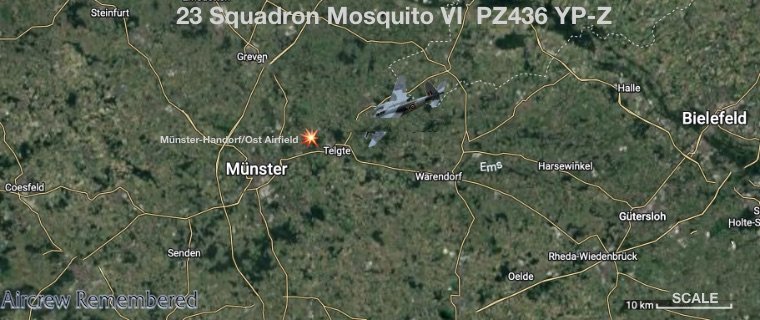
Location: Munster-Handorf Airfield (2)
Pilot: Lt. Edmond Lignon, 30605, FFAF, Age 31 - Killed
Nav: F/O. Manoel Callas, 69541, RAAF, Age 27 - Killed
Reason for Loss
At 18:58 hours on the night of 13th March 1945, Mosquito PZ436 took off from Little Snoring to carry out an intruder patrol of Handorf and Munster airfields, Germany. At 20:32 hours, Flight Lieutenant Thomas, patrolling as 'C', received a message from PZ436 saying they were going to drop their target indicators, and they saw the indicators burning. Since then nothing has been heard from PZ436, and the aircraft failed to return to base. It was later established that the aircraft had crashed at Handorf aerodrome, and that both crew members had been killed.
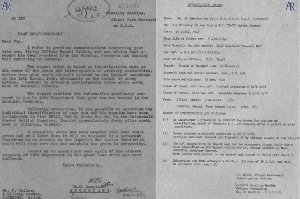
Left: Letter to the father of Manoel Callas, and report of No. 20 Sub-Section, No. 4 M.R.E.U., RAF (Germany)
(Both transcribed below)
Dear Sir, I
I refer to previous communications concerning your late son, Flying Officer Manoel Callas. Advice has been received that a War Graves Unit operating in Germany has established that your son is buried in Field 22, Grave No. 1 of the Lau-Heide Cemetery, Germany. A temporary cross has been erected over his grave, and at a later date it will be replaced by a permanent headstone to be erected by the Imperial War Graves Commission, which will maintain and care for the grave in perpetuity. I regret that no other information surrounding the circumstances of your son's loss has become available; however, the Missing, Research and Enquiry Service is still operating in Germany in an endeavour to establish the fate of missing aircrew members, and should any further details be received they will be conveyed to you without delay. Permit me to assure you of the constant sympathy of this Department in your great loss. Yours faithfully, (M. C. Langslow), Secretary.
From: No. 20 Sub-Section, No. 4 M.R. & E.U., R.A.F. (Germany)
To: Air Ministry P4 Cas, London W.1 (73-77 Oxford Street)
Date: 21 April 1947
Your file or folder ref: P 430491/45
Your Casualty Enquiry number: RAAF CAS. CARD (1944-45) 628
Our ref: 4 M.R.E.U./1111/628/P.4
Name of Search Officer: F/Lt. Hagel
Target: Patrol of Handorf area (W. Munster)
Aircraft type and serial number: Mosq. P.Z. 436
Date reported missing: 15 Mar. 1945
Place of crash, with map ref: Handorf Aerodrome, K 52/B 0078
Place of burial, with map ref: Lauheide Cemetery, K 52/B 0177
Crew:
Pilot: Lt. Edmund Lighnon 30605 FFAF Age 31. Killed
Nav: F/O. Manoel Callas 69541 RAAF Age 27. Killed
Result of investigation and findings:
(1) As instructed, I proceeded to Handorf Aerodrome for the purpose of investigating the crash of Mosquito P.Z. 436, missing after a patrol of the same aerodrome.
(2) Crash occurred on Handorf Aerodrome, K 52/B 0078. Wreckage had been removed and disposed of by salvage squads of the airfield.
(3) The aircraft caught fire on impact, and the two occupants, though badly burnt, were identified as F/O Manoel Callas and Lt. Edmond Lignon by Herr Jonssten, cemetery keeper. Both bodies were placed in one casket and buried in Field XXII, Grave I.
(4) Exhumation has been arranged with Capt. Butcher of 39 G.C.U. and will be enclosed with this C.E.
R. P. Hagel, Flight Lieutenant, Investigation Officer.
(J. Cave) Squadron Leader, Officer Commanding, No. 20 Section - 4 M.R.E.U.
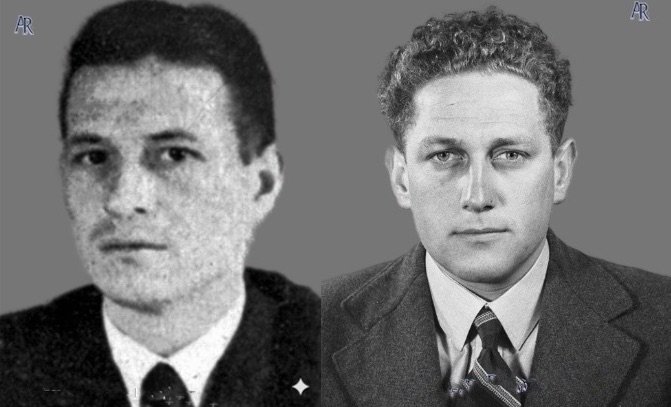
Above L-R: Lt. Edmund Lignon and F/O. Manoel Callas
Burial Details
Lt. Edmond Lignon. Apart from his initial burial, his final resting place has not been confirmed. Born on 19th June 1913 in Arzew, Algeria.
The Daring Escape (July 1940): Stationed in Algeria at the time of the Armistice, Lignon decided to escape with three comrades - Lacombe, Canepa and Chatillon. Claiming they had orders to move their aircraft, they took off in a Potez 65 heading for Gibraltar. Unaware of a makeshift landing strip, they ditched the aircraft in the water near a barge and swam to shore.
Tragedy and Amputation (October 1941): While serving in French Equatorial Africa, he was involved in a serious crash during take-off in Nigeria aboard a Glenn Martin 167. The accident claimed the life of his mechanic, and Lignon's injuries were so severe that his right leg had to be amputated.
Returning to Combat with a "Wooden Leg": Despite his disability, Lignon refused to be sidelined to a desk job. He fought to return to the cockpit and achieved the incredible feat of qualifying for night fighting in one of the most demanding aircraft of the era, the de Havilland Mosquito. He is famously mentioned in Romain Gary's Promise at Dawn, where the author highlights Lignon's exceptional courage in continuing to fly with an artificial leg.
His Final Mission: On 13th March 1945, just two months before the end of the war in Europe, Lieutenant Lignon was attacking Handorf airfield, near Munster, Germany. His Mosquito, serial PZ436, was likely hit by flak (German anti-aircraft fire). The aircraft crashed, instantly killing both Lignon and his Australian navigator, P/O Manoel Callas.
Career Totals: 1,296 total flying hours, including 174 hours of night flying.
F/O. Manoel Callas. Reichswald Forest War Cemetery, Plot 18, Row E, Grave 18. Also remembered on Panel 119, Commemorative Area, Australian War Memorial, Canberra ACT, and on the University of Sydney World War 2 Roll of Honour, Camperdown, NSW.
Born on 23rd February 1918 in Sydney, New South Wales, Australia. Son of Peter Sotiropoulos (died 1951, age 68) and Irene Sotiropoulos (died 1959), of 4 Billong Avenue, Vaucluse, New South Wales, Australia.
Epitaph: 'Dearly Loved, Sadly Missed By Father, Mother, Brothers And Sisters'
He held a Bachelor of Law and, prior to enlisting on 1 September 1942, was associate to the late Chief Justice Jordan (Sir Frederick Jordan, Chief Justice of NSW) - consistent with his 'Solicitor' occupation and 'Articled Law Clerk' title recorded in his enlistment papers and will.
His father, Peter Sotiropoulos, known as Peter Callas, was born in Greece around 1883 and emigrated to Australia in 1909. He returned to Greece to fight in the Balkan Wars of 1912-13 against Turkey and Bulgaria, before returning to Australia in 1914, where he resided for the rest of his life. He was a milk bar proprietor at Newtown for nearly 30 years, and died in 1951, aged 68.
He was awarded the Gold Cross of the Order of Phoenix by King Paul of Greece (equivalent to a British Knight Bachelor), notified approximately three weeks before his death. Only two other people in Australia had received the same honour - Sir Thomas Blamey (Australia's first Field Marshal) and Dr E. C. Vrisakis (Consul-General for Greece in Australia). He was president of a Greek association assisting new arrivals, helped found a school for the education of Greek children in Sydney, and was a past president of the Helmos Association.
Sons: Dr Con Callas (Bankstown); Manoel Callas - killed in WWII as a Pilot Officer/Navigator with the RAAF, flying Mosquito bombers on loan to the RAF, in the last months of the war. Daughters: Cal (Mrs N. Kepreotis, Penrith); Angela (Mrs Coombes, Fairfield); also George Callas (Vaucluse).
Notes
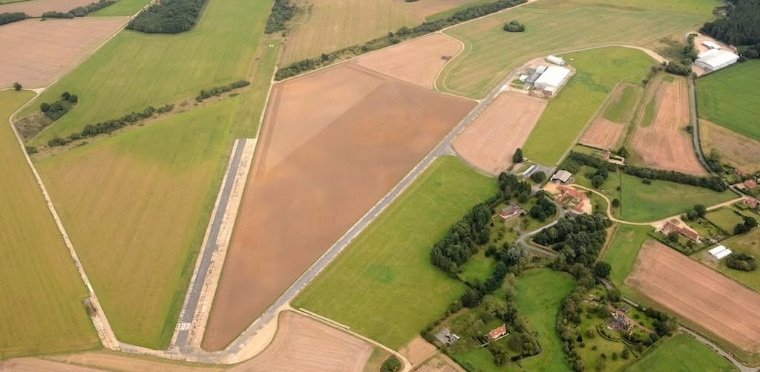 (1) RAF Little Snoring was a Bomber Command airfield in Norfolk, about 3 miles north-east of Fakenham. It was built in 1943 and used from July 1943 to October 1958, with runways controlled successively by Bomber Command, No. 3 Group, and No. 100 (Bomber Support) Group.
It opened in July 1943 as a satellite station for RAF Foulsham, transferring a month later to No. 3 Group as a full station. The first occupants flew Lancaster IIs, and in November 1943 the station moved to No. 100 Group - a secretive unit responsible for developing and testing over 30 electronic countermeasure devices, using code-names like 'Airborne Cigar', 'Jostle', 'Mandrel' and 'Piperack' to jam German radar and radio communications.
23 Squadron spent most of the war as a night fighter and intruder unit, initially flying Blenheims before converting to Mosquitos in December 1942. After operating out of Malta, the squadron transferred to Bomber Command in June 1944 as part of 100 Group, based at Little Snoring, flying intruder missions against German night fighters and their airfields to support Bomber Command operations, as well as daylight bomber escort.
Operational flying by 23 Squadron officially ceased on 25 September 1945, after which the airfield went into care and maintenance under No. 274 Maintenance Unit, becoming a storage site for surplus Mosquitos awaiting scrapping. In 1950 it briefly reopened for an anti-aircraft co-operation unit flying Spitfires, Mosquito target-tugs and Vampires, before shutting for good in 1953 and being sold. It is now used for light civil flying.
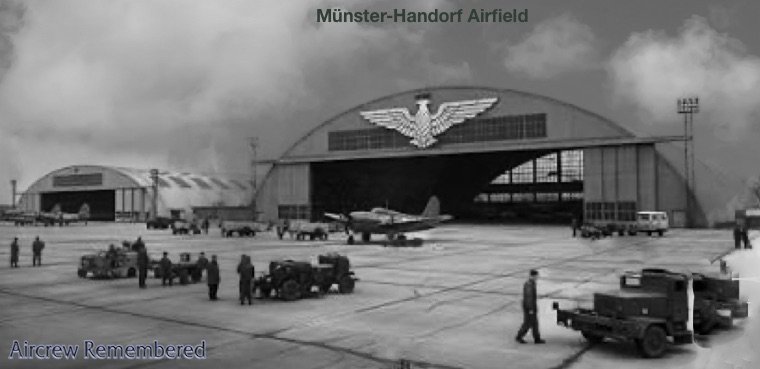
(3) Munster-Handorf Airfield, located east of Munster in North Rhine-Westphalia, Germany, was originally developed in the 1930s as a Luftwaffe operational base. During World War II, it functioned primarily for reconnaissance and training, with its paved runways and dispersal areas reflecting typical German military airfield engineering of the period.
After 1945 the Royal Air Force occupied the site briefly, maintaining the infrastructure for post-war operations and regional security. During the early Cold War, parts of the airfield were adapted to host Dutch Nike surface-to-air missile installations as part of NATO's defensive network, demonstrating the strategic reuse of former military airbases. Many of the runways, taxiways and aircraft dispersal areas have since fallen into disrepair, leaving ghostly remnants visible in aerial photographs and on-site inspections. Today, limited portions of the site are accessible for historical study and landscape observation, while much of the former airfield has reverted to natural vegetation and agricultural use, preserving the engineering footprint of mid-20th-century military aviation infrastructure.
Sources and Acknowledgments
- National Archives, Kew
- Australian National Archives
- Aircrew Remembered Archives
- Wikipedia
- Australian Newspapers
- Ricard E. Flegg (Little Snoring airfield image


