




 Operation: Lorient
Date: 29th January 1943 (Friday)
Unit: 420 Squadron RCAF (motto: Pugnamus finitum - We fight to the finish) 6 Group
Type: Wellington III
Serial: DF626 *
Code: PT-Y
Base: RAF Middleton St. George, County Durham
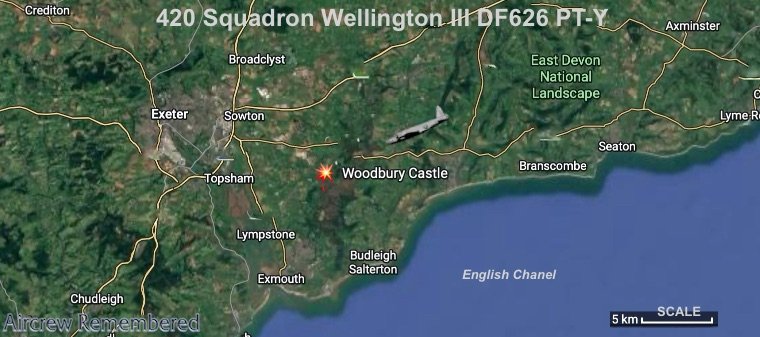
Location: Woodbury Common, near Exeter
Pilot: Sgt. Delmer Ray Sanderson R/103915 RCAF Age 20 - Killed
Nav: Fl/Sgt. Charles Murray Downton R/97522 RCAF Age 21 - Killed
Air/Bmr: Fl/Sgt. Harold Hogarth Sealy R/93087 RCAF Age 22 - Killed
Air/Gnr (front): Fl/Sgt. John Drake Bittner R/137089 RCAF Age 25 - Killed
W/Op/Air/Gnr: Sgt. George Ernest Beauchamp R/101949 RCAF Age 24 - Dangerously injured
Air/Gnr (rear): Sgt. Henry Ronald Ernst R/137649 RCAF Age 21 - Seriously injured
REASON FOR LOSS:
Wellington DF626 was one of twelve aircraft from 420 Squadron that took off from RAF Middleton St. George on the evening of the 29th January 1943. Eight were detailed to bomb the U-boat base at Lorient on the French Atlantic coast and four were detailed for gardening (minelaying). Sgt. Sanderson and his crew were airborne at 16:32 hrs.
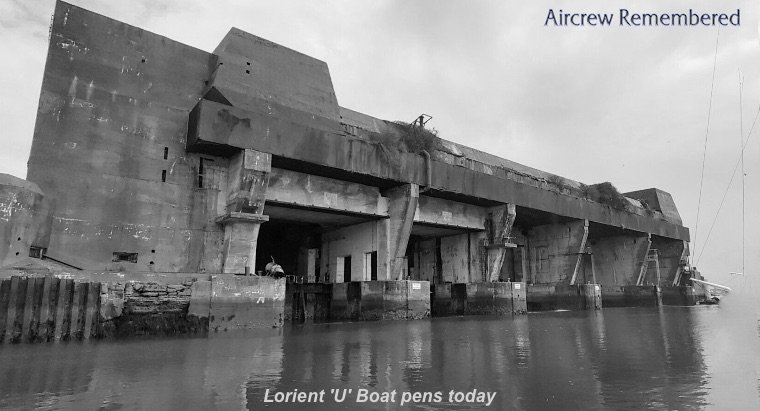 This was not the crew's first trip to Lorient. On the night of the 26th January 1943, flying Wellington BK331, Sgt. Sanderson with Fl/Sgt. Downton, Fl/Sgt. Sealy, Sgt. Beauchamp and Sgt. Bittner had attacked Lorient from 11,000 feet. The aircraft was hit by flak aft of the bomb bay and at the root of the starboard wing, and they landed at RAF Exeter at 21:53 hrs. Sgt. Ernst flew that night as a member of F/Lt. Anderson's crew.
The weather on the 29th was poor. The squadron Operations Record Book (Form 540) recorded:
"Although the weather was clear on take-off, heavy cumulous cloud had been reported all along the trip. The interrogation was a pretty grim one. All captains stated the same thing, terrific rain and electrical storms for a good portion of the trip combined with heavy icing conditions made the operation a very difficult one. One aircraft failed to return and another cracked up on landing at R.A.F. Station Exeter."
 According to Sgt. Ernst, the 4,000 lb bomb would not release over the target. The crew tried everything to free it and then planned to bale out over the coast and let the aircraft go down into the sea. Flying towards that point they strayed over a restricted area and were fired on by British anti-aircraft guns. The bomb then fell away and came down harmlessly on farmland. With fuel running low they diverted to RAF Exeter, which was covered in fog.
The Form 541 entry for DF626 reads:
"This aircraft was airborne at 16.32 hours. It crashed at Exeter at 23.10 hours after jettisoning. Four of crew killed, two injured."
The official accident report (Form 765(c)) gives the time as 22:48 hrs. The aircraft hit high ground while approaching the aerodrome to land, caught fire on the ground and was written off. The specialist officer's report was brief: "Aircraft hit hill on approaching aerodrome to land. Visibility bad." The squadron commander added that visibility was poor and the aerodrome "was a strange one to the pilot." The Station Commander at Middleton St. George concluded on the 8th February 1943:
"Accident caused by error in judgment on part of pilot due in part to poor visibility and unfamiliarity with aerodrome and surrounding country."
Downton's family later learned that, unknown to the crew, a range of hills ran across the north-western side of the aerodrome. In good weather these would not have caused a problem.
The aircraft came down in a wood on Woodbury Common, close to Dalditch Camp near Exmouth, where a party of Royal Marines was out on field training. At about 22:30 hrs they saw the Wellington come out of the low cloud with its landing lights on, and it crashed less than a quarter of a mile away. There were two explosions, the wreck caught fire and ammunition began to go off. The Marines ran to the scene and pulled one airman, who was still moving, clear of the flames. They then found a second man alive under the port engine with a broken leg and serious burns and carried him to safety, before searching the wreckage again for anyone else.
For this action Temporary Lieutenant Oliver St. John Hamlin RM was awarded the MBE, and Corporal (Acting Temporary Sergeant) Jacobus Russell Odendaal Po.X.4187 and Corporal (Acting Temporary Sergeant) Wallace George West Ply.X.100645 were each awarded the British Empire Medal (Military Division). The awards appeared in the London Gazette of the 4th May 1943, "for bravery in saving the life of two airmen when an aircraft crashed in a wood." Sgt. West later served with 40 RM Commando.
 THE SURVIVORS:
The two survivors were taken to the Royal Devon and Exeter Hospital. The squadron record noted that Sgt. Beauchamp was dangerously injured and Sgt. Ernst seriously injured: "Sgt Beauchamp has since been placed on the S.I. List and Sgt. Ernst is taken off this list and doing well." Both men were badly burned and were later treated by Archibald McIndoe at the Queen Victoria Hospital, East Grinstead, becoming members of the Guinea Pig Club.
Sgt. Henry Ronald (Hank) Ernst was born on the 23rd July 1921 at Blockhouse, near Lunenburg, Nova Scotia, the sixth of ten children of William and Effie Ernst. After a two-room schoolhouse education he joined the RCAF in 1941. His nickname, 'Crash', was well earned. After the war he joined Trans-Canada Air Lines, later Air Canada. He married Mary Rose, who predeceased him after 54 years of marriage, and they had four children. In 2004 his story and the search for the crash site were told in the CBC documentary Final Flight: The Search for DF626, shown on the 11th November 2004. He died in Calgary on the 14th September 2016, aged 95.
Sgt. George Ernest Beauchamp R/101949 was the wireless operator/air gunner. He survived his injuries. Born in 1917 and passed away in 2003, at age 86. No further details.
BURIAL DETAILS:
Sgt. Delmer Ray Sanderson. Exeter Higher Cemetery. Sec. Z.K. Grave 58. Born on the 23rd April 1922 in Calgary. He enlisted in Calgary on the 9th June 1941. Son of William Henry (died 1936, age 54) and Margaret Sanderson (née Kealey - died 1953, age 69), of 1626 24th Avenue SE, Calgary. His brother Eldon Russell Sanderson died in 1940 from injuries sustained in a motor accident; he was 22.
Fl/Sgt. Charles Murray Downton. Exeter Higher Cemetery. Sec. Z.K. Grave 28. Son of Geoffrey Murray Downton (died 1972, age 91) and Winifred Heather Downton (died 1972, age 79); husband of Iris Evelyn Downton, of Fleggburgh, Norfolk, England. Epitaph: "Faithful Unto Death" Missed Sadly By His Loving Wife And Baby.
Fl/Sgt. Harold Hogarth Sealy. Bridgwater (St. John's) Cemetery. Sec. 2. Grave 2460. Born on the 28th June 1920 in Toronto, Canada. Son of Leonard Henry John Thomas Sealy and Mabel Sealy (née Hogarth), of 857 Sammon Avenue, East York, Toronto. His younger brother, Air Bomber Fl/Sgt. Albert Edward Sealy R/170739 of 199 Squadron, was lost on the 28th January 1944. His other brother, Jack, served in the Royal Canadian Ordnance Corps and was the only son to survive the war. His parents emigrated in 1913 from Bridgwater, Somerset, England, his grandparents are buried there, which explains why he was buried there rather than at Exeter.
Fl/Sgt. John Drake Bittner. Exeter Higher Cemetery. Sec. Z.K. Grave 29. Born on the 21st December 1917 in Minneapolis, Minnesota, USA. Son of John Henry (died 1969, age 77) and Fern Drake Bittner (née Drake - died 1932, age 43). His father was previously married to Minnie (née Iverso), who also died young, aged 28, in June 1915. Epitaph: "Rest In Peace".
* Wellington DF626 was one of 150 aircraft built by Vickers Armstrongs Ltd. at Squires Gate, Blackpool, under Contract B92439/40/C.4(c). It was delivered to 44 MU on the 27th July 1942 and taken on charge by 420 (Snowy Owl) Squadron on Sunday 25th October 1942. Two days later the aircraft was transferred to 156 Squadron and was finally taken on charge again by 420 (Snowy Owl) Squadron. Wellington DF626 failed to return from the operation to Lorient on the night of Friday 29th January 1943, becoming the 33rd aircraft from the squadron, the 96th squadron aircraft flying out of Middleton St. George, the 5th aircraft from 64 Bomber Base, the 23rd aircraft from 6 (RCAF) Bomber Group, the 205th aircraft from the RCAF squadrons operating in Bomber Command and the 33rd aircraft assigned to attack Lorient to become non-effective and struck off charge. Wellington DF626 coded PT-Y was struck off charge by 420 (Snowy Owl) Squadron on the 28th February 1943 and had recorded a total of 32 hours 55 minutes flying time on the airframe.
At the going down of the sun, and in the morning we will remember them. - Laurence Binyon
Dedicated to the relatives of this crew. We seek additional information and photographs of the crew - please contact us.
SOURCES AND ACKNOWLEDGEMENTS:
Paradie-Dutil RCAF Archive
RCAF Personnel Service Records (Library and Archives Canada) - Sanderson, Downton, Sealy and Bittner
420 Squadron Operations Record Book, Forms 540 and 541, January and February 1943 (AIR 27/1825)
- Form 765(c) Report on Flying Accident, Wellington DF626, 29.01.1943
- Bomber Command Museum of Canada - Canada's Air War 1943
- London Gazette 36001, 4th May 1943
- Noonans Mayfair - medal archive, Sgt. J.R. Odendaal BEM
- Calgary Herald September 2016 - Ernst obituary
- CBC - Final Flight: The Search for DF626 (2004)
- National Archives, Kew
- Francois Dutil RCAF Historian - Beauchamp details
- Malcolm Kelly - Sealy family research
- Aircrew Remembered Archives
- Aviation Safety Network
- Find a Grave
- Commonwealth War Graves Commission (CWGC)
- International Bomber Command Centre
- SUPPLEMENT:
Corrections made to the report
Further details of the loss
Times. Three different times appear in the records. The Royal Marines' recommendation gives about 22:30 hrs, the Form 765(c) gives 22:48 hrs, and the Form 541 gives 23:10 hrs. The Form 765(c) also records 6 hours 38 minutes since take-off, which works out to 23:10 hrs from a 16:32 hrs take-off.
Map reference. The Form 765(c) gives the site as "Map reference sheet 138, 480120, Devonshire".
Pilot experience. Sgt. Sanderson had 67 hrs 50 mins solo on type and 287 hrs total; at night 37 hrs 25 mins on type and 90 hrs 20 mins total; 54 hrs 15 mins instrument flying (Form 765(c)).
A strange aerodrome? The squadron commander described Exeter as "a strange one to the pilot", yet the Form 541 shows that Sgt. Sanderson had landed BK331 at Exeter only three nights earlier, on the 26th January 1943 at 21:53 hrs, after it was damaged by flak.
Rescue recommendation. Asked whether any assistance in rescue work was worthy of recommendation, the Station Commander wrote "Not known". The Royal Marines' awards were put forward through the Admiralty. The London Gazette 36001 lists Lt. Hamlin together with Sgts. Odendaal and West under the same citation, which confirms his MBE.
A different account. The East Grinstead Museum record for Beauchamp says the crew were on a raid to Brest that was called off because of heavy cloud, and that while circling Exeter airfield in low cloud they were nearly hit by another aircraft, after which the fuel and ammunition exploded and the Wellington broke up. This does not agree with the ORB or the accident report, which give Lorient as the target.
Other aircraft that night. Wellington DF615 of 420 Squadron failed to return from the same operation and was presumed missing.
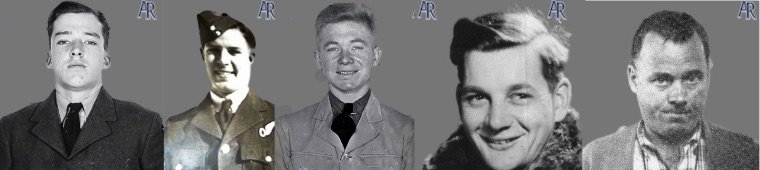
Above L-R: Fl/Sgt. Sanderson, Fl/Sgt. Seely, Sgt. Fl/Sgt. Bittner, Sgt. Beauchamp and Sgt. Ernst (sadly, no image of Fl/Sgt. Downton)
Further details of the crew
Sgt. Sanderson was promoted to Temporary Warrant Officer Class II with effect from the 16th January 1943, two weeks before his death. The promotion came through after he died, and he is listed as WO2 in the Canadian Book of Remembrance. He trained at 4 ITS Edmonton, 5 EFTS High River and 10 SFTS Dauphin, gaining his pilot's wings on the 16th January 1942.
Fl/Sgt. Downton was born on the 12th January 1922 at Lillooet, British Columbia. His father was born at Brooke, Norfolk, and his mother at Brighton. He was a store clerk before enlisting in Vancouver on the 6th March 1941. He began pilot training at 5 EFTS High River but was remustered to observer, passing out from 1 ANS Rivers on the 14th February 1942. His wife, Iris, was an LACW in the WAAF (2012580) stationed at RAF Walney Island. Family sources say they had been married only about 30 days when he was killed. His headstone inscription mentions his wife and baby.
Fl/Sgt. Sealy was a clerk with the T. Eaton Co. before enlisting in Toronto on the 10th February 1941. He began pilot training at 20 EFTS Oshawa but was remustered to observer, passing out from 1 ANS Rivers on the 4th April 1942. He kept homing and racing pigeons. He was buried at Bridgwater on the 5th February 1943, and his brother Jack attended the funeral (IBCC). On the 30th January 1944, while the family was remembering Harold, they received word that Albert was missing.
Fl/Sgt. Bittner was an American, born in Minneapolis. He was an invoice clerk in Chicago and was living in Windsor, Ontario when he enlisted on the 16th October 1941. As a US citizen he made a declaration of willingness to serve and took no oath of allegiance. His next of kin was his uncle, Glen A. Drake of Chicago. He qualified as an air gunner at 5 B&GS Dafoe on the 27th April 1942 and joined 420 Squadron on the 1st October 1942. In October 1944 he was posthumously promoted to Flight Sergeant with effect from the 27th October 1942.
Sgt. Beauchamp was admitted to the Royal Devon and Exeter Hospital with burns to his arms and legs. He was transferred to the Queen Victoria Hospital, East Grinstead, on the 16th February 1943 and had four operations there. A Guinea Pig Club list gives him a later officer number, J50683, which suggests he was commissioned. He died in 2003 (East Grinstead Museum). His obituary appeared in The Guinea Pig, January 2004.
Sgt. Ernst wrote an account of his experience, "How Hank Ernst Became a Guinea Pig", with Fred Bagley in The Guinea Pig, July 2000.
Memorials to the crew
No memorial at the crash site on Woodbury Common has been found.
Canadian Books of Remembrance, Memorial Chamber, Peace Tower, Ottawa: Sanderson page 210, Downton page 155, Bittner page 137, Sealy page 211. Albert Edward Sealy is on page 439.
Bomber Command Memorial Wall, Nanton, Alberta: Sanderson, Downton, Bittner and Sealy (also Albert Edward Sealy).
Lillooet Cenotaph, 615 Main Street, Lillooet, British Columbia: C.M. Downton is named on the 1939-1945 panel.
Lillooet Cemetery lych gate, Lillooet, British Columbia: erected in memory of Charles Murray Downton.
International Bomber Command Centre, Lincoln: Sealy is commemorated, Phase 2, Panel 239. The other three should also be on the Spire walls; their panel numbers have not been checked.
420 Squadron memorials at Croft and Tholthorpe, North Yorkshire, commemorate the squadron as a whole.
Supplement Sources
- Form 765(c) Report on Flying Accident, copy in Bittner service file (LAC)
- RCAF service files of Sanderson, Downton, Sealy and Bittner (LAC)
- East Grinstead Museum - patient record, George Ernest Beauchamp
- London Gazette 36001, 4th May 1943
- Canadian Virtual War Memorial and Books of Remembrance (Veterans Affairs Canada)
- Veterans Affairs Canada - National Inventory of Canadian Military Memorials, Lillooet Cenotaph
- CASPIR - Canadian Aviation and Space Museum
- International Bomber Command Centre Losses Database
- RAF Commands forum - Guinea Pig Club members list
- CWGC - Albert Edward Sealy


