





Operation: Operation Orator - ferry flight to Vaenga, North Russia
Date: 4th/5th September 1942 (Friday/Saturday)
Unit: No. 455 Squadron RAAF, Coastal Command (motto: 'Strike and strike again')
Type: Hampden TB.I
Serial: P5304
Code: UB-H
Base: RAF Sumburgh, Shetland Islands, Scotland
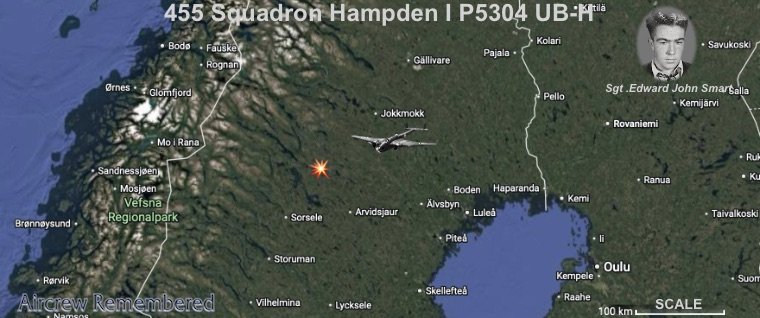
Location: Mount Arvestuottar, north of Arjeplog, Lapland, Sweden
Pilot: Sgt. Edward John Smart, Aus/400842, RAAF, Age 25 - Killed
Nav: Fl/Sgt. Thomas Graham Nicholls, Aus/400331, RAAF, Age 22 - Killed
W/Op/Air/Gnr: Fl/Sgt. Louis Arthur Biggin, 1358006, RAFVR, Age 27 - Killed
Air/Gnr: Sgt. John Mackenzie Oberlin Harris, Aus/408129, RAAF, Age 20 - Killed
Fl/Mech: Cpl. Donald Henry Nelson, Aus/6707, RAAF, Age 21 - Killed
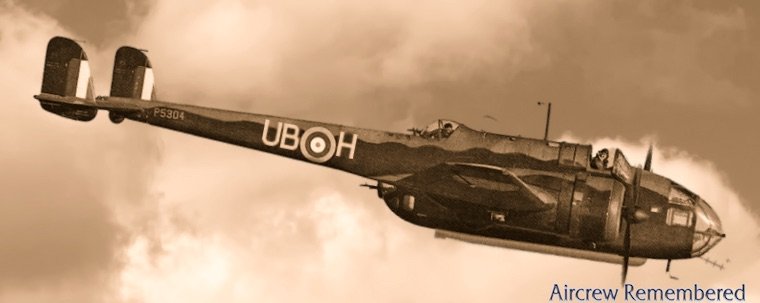
Hampden P5304 photographed with 16 OTU as JS-L, digitally altered to show her 455 Squadron codes UB-H, a torpedo and ASV aerials as she would have appeared in 1942 (artist's impression).
Reason for Loss
Handley Page HP.52 Hampden P5304 was built in Canada by the Quebec Group of the Canadian Associated Aircraft consortium at Saint-Hubert, Quebec, to Air Ministry Specification B.30/36 under Contract No. B.965794/38. She was completed in about October 1940, the seventh of 40 aircraft in the first Canadian production batch, serials P5298 to P5337.
She was powered by two Bristol Pegasus XVIII nine-cylinder radial engines of 965hp, each driving a three-bladed de Havilland constant-speed propeller. Defensive armament was six .303 inch machine guns: a fixed Browning in the nose fired by the pilot, a single Vickers K gun for the navigator, and twin Vickers K guns in each of the upper and lower rear positions. In 1941 two rectangular openings were cut in the fuselage just aft of the wing spar so that the navigator could also fire to either beam. She was finished in the standard RAF night scheme of matt Dark Green and Dark Earth upper surfaces with black undersides.
 After acceptance flights, P5304 was dismantled for shipment in January 1941. The fuselage and wing centre section, with the undercarriage, travelled as protected deck cargo, while the tail unit, outer wings and smaller items were crated in the hold. She sailed from Montreal to Birkenhead and went by road to No. 7 Aircraft Assembly Unit at RAF Hooton Park, Cheshire, where she arrived on 28th March 1941 to be assembled and tested.
On 25th May 1941 she was delivered to No. 44 Maintenance Unit at RAF Edzell, Angus, and on 27th July 1941 she was taken on charge by No. 16 Operational Training Unit at RAF Upper Heyford, coded JS-L. On 16th December 1941 she suffered Category B damage in a flying accident. She was taken to the London Midland & Scottish Railway workshops on 25th December 1941, then to Handley Page at Radlett on 30th December, and returned to the LMS workshops on 8th January 1942 for repair and conversion to torpedo-bomber standard. She then passed through Tollerton Air Services at RAF Tollerton on 4th March 1942, No. 24 Maintenance Unit at RAF Tern Hill on 22nd March and No. 34 Maintenance Unit at RAF Montford Bridge on 8th April.
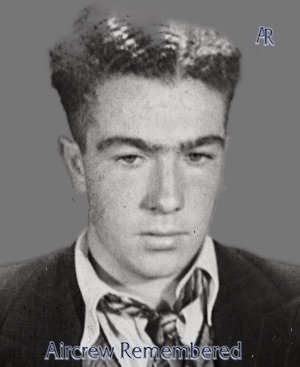
Left: Sgt. Edward John Smart,
On 16th May 1942 P5304 was taken on charge by No. 455 Squadron RAAF at RAF Leuchars, Fife, and coded UB-H. Four days later, on 20th May, P/O. J.N. Davenport and crew overshot on landing at RAF Inverness during a familiarisation flight. The aircraft suffered minor (Category A) damage, nobody was hurt, and she was repaired on site and returned to Leuchars on 22nd May.
On 1st July 1942 P/O. M.S. Humphrey and crew flew her from Leuchars to RAF Wick with eleven other Hampdens for torpedo exercises with the Royal Navy. On 5th July the squadron flew its first torpedo operation, which was also P5304's first operational sortie. P/O. Humphrey and crew left Wick at 16:00 with five other Hampdens, each carrying a single torpedo, to attack German naval vessels moving along the Norwegian coast. At 20:15 the formation was attacked by two Me 109s, and after twenty minutes of inconclusive combat the Hampdens broke off and returned to base.
On 8th July P/O. Humphrey flew P5304 from Wick to RAF Sumburgh to prepare for another attempt on the same ships. The next evening, 9th July, Sqn/Ldr. James Catanach and crew took her off from Sumburgh at 21:25 with twelve other Hampdens to search for the German warships. No ships were found and the aircraft landed back at Wick as planned.
On 3rd August 1942 the squadron's aircraft were withdrawn from operations to prepare for a detachment to North Russia. Following the destruction of convoy PQ 17 in July, the Admiralty feared that the battleship Tirpitz and other German heavy units based in northern Norway would attack the next convoy, PQ 18. Under Operation Orator, the torpedo Hampdens of 144 Squadron RAF and 455 Squadron RAAF would be based at Vaenga, near Murmansk, ready to strike at any surface force that put to sea. On 29th August P5304 was named as one of 18 Hampdens selected for the detachment, and Sgt. Smart and his crew spent the next three days flying air tests in preparation for the long ferry flight.
On 2nd September 1942 Sgt. Smart, Sgt. Nicholls, Sgt. Biggin and Sgt. Harris, with the squadron fitter Cpl. Donald Nelson travelling as a passenger, left Leuchars at 10:15 on the first 514km leg to Sumburgh, landing safely at 12:10.
On the evening of 4th September 16 of the squadron's Hampdens took off from Sumburgh between 19:55 and 21:00 for Afrikanda, in the Murmansk Oblast, on their way to Vaenga (later renamed Severomorsk). Sgt. Smart and crew departed at 20:40 on the 3,100km second leg. The route, flown at night and at the limit of the Hampden's range, crossed occupied Norway, neutral Sweden and enemy-held Finland, and the weather was poor.
Eleven of the 455 Squadron aircraft landed safely at Afrikanda between 03:15 and 04:50. P5323 (UB-L) could not find the airfield and, short of fuel, force-landed 8km west of Kandalaksha; her crew were unhurt and were picked up by Russian troops, but the aircraft was written off. P1287 was intercepted by Russian Hurricanes and escorted to Monchegorsk, and X3131 was intercepted by Russian Airacobras and escorted to Murmashi. Both later joined the rest of the squadron at Vaenga. AT109 (UB-C), flown by Sqn/Ldr. Catanach, came down on the shore of the Varangerfjord near Vardø in Norway and her crew were taken prisoner. Catanach was later one of the fifty officers murdered after the Great Escape. Across 144 and 455 Squadrons, eight of the 32 Hampdens were lost on the way, mostly to the weather and navigational errors.
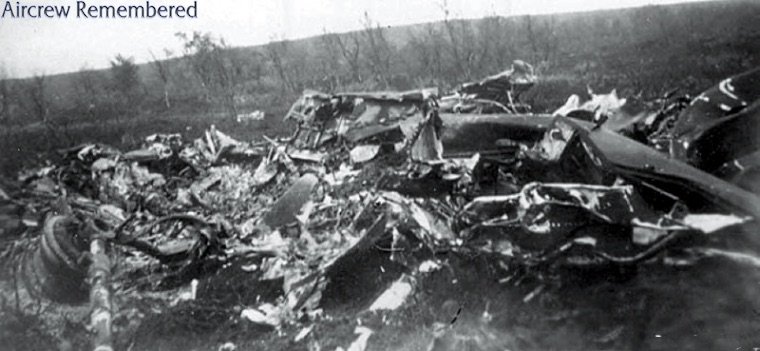 P5304 failed to arrive and was posted missing. Some weeks later it was learned that she had crashed into Mount Arvestuottar, north of Arjeplog in Swedish Lapland. At the time it was thought that she had either iced up and been unable to climb over the mountain, or had been shot down by Swedish anti-aircraft fire.
The Swedish investigation found that the aircraft had struck the ground in a very steep dive, nose and right wing first. The rear fuselage broke away to the right, and the explosion that followed destroyed the aircraft and left a large crater. The aircraft clock, recovered in 1983, had stopped at 01:04. One of the propellers showed that its engine was not running at the moment of impact. The investigators concluded that heavy icing on the wings and tailplane, and possibly in the carburettors of the Pegasus engines, which were known to be vulnerable to it, had probably caused the Hampden to stall and dive into the mountain.
Local accounts later claimed that a German fighter had shot the aircraft down, pointing to bullet holes in a propeller and spent cartridge cases in the wreckage. However, research has found no German night fighters at any of the possible bases in northern Norway in 1942. The holes may have been made by hunters or passers-by long before the propeller was recovered, and the cases are more likely to have come from the usual test firing of the guns after take-off.
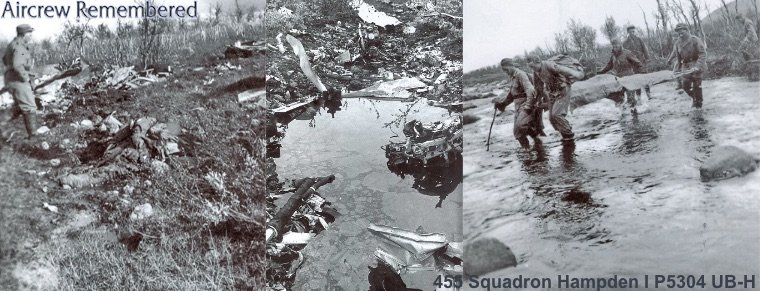 The crash was seen by a Sámi reindeer herder, Juho Grufvisare, who was so shaken that he did not report it to the police for three days. The local Home Guard commander, Harald Jörgensen, was alerted on the night of 9th/10th September and began searching the fells with two companions. On 14th September, with their food gone, they spotted something white moving in a birch tree. It proved to be a large map of the Arctic as far as the Urals, and following the wind direction they soon found wreckage and then the crash site itself.
They found the remains of four men. Jörgensen returned with a platoon of Home Guardsmen, and it took a full day to recover the remains from the water-filled crater before they were flown out. The four were buried at Överluleå, near Boden, on 23rd September 1942. In October 1943, after the recovered items had been compared with British records, the Swedish Air Staff concluded that a fifth man must still be on the mountain. Jörgensen and Ruben Svenonius returned and found his remains in the crater. As they could not be moved without great difficulty, they were left where they lay under a cairn of stones, marked with a cross of birch branches and a steel helmet. In a pocket of his uniform Jörgensen found a photograph of a young woman named Dorothy. Some years later she travelled to Sweden, and Jörgensen guided her and her family to the crash site and the grave.
The remains of the wreck still lie at the crash site today, and the crater is still filled with water. The aircraft clock is held by the Forced Landing Collection in Sweden.
Burial Details
Sgt. Edward John Smart. Kviberg Cemetery, Gothenburg, Sweden. Section 4.A. Collective grave 1-5. Epitaph: 'His Name Liveth For Evermore'. Born on 20th July 1917 in Mildura, Victoria, Australia. Enlisted in the RAAF on 9th November 1940. Son of Alexander Robert (died 1980) and Maria Elyena Smart (née Roberts, died 1967), of Irymple, Victoria, Australia. Also remembered on Panel 106 of the Commemorative Area at the Australian War Memorial, Canberra, and on the Mildura War Memorial Cenotaph.
Fl/Sgt. Thomas Graham Nicholls. Kviberg Cemetery, Gothenburg, Sweden. Section 4.A. Collective grave 1-5. Epitaph: 'At The Rising And Going Down Of The Sun We Will Remember'. Born on 16th August 1920 in Mordialloc, Victoria, Australia. Enlisted in the RAAF on 18th August 1940. Son of Thomas Edward and Mabel May Nicholls, of Mordialloc, Victoria, Australia. Also remembered on Panel 106 at the Australian War Memorial, Canberra, and on the Mordialloc War Memorial.
Fl/Sgt. Louis Arthur Biggin. Kviberg Cemetery, Gothenburg, Sweden. Section 4.A. Collective grave 1-5. Royal Air Force Volunteer Reserve, serving with 455 (RAAF) Squadron. Son of William Thomas and Beatrice Hilda Biggin, of Queen Camel, Somerset, England.
Sgt. John Mackenzie Oberlin Harris. Kviberg Cemetery, Gothenburg, Sweden. Section 4.A. Collective grave 1-5. Epitaph: 'Their Name Liveth For Evermore'. Born on 21st October 1921 in St Leonards, New South Wales, Australia. Enlisted in the RAAF on 3rd January 1941. Son of John Redford Oberlin Harris (died 1960, age 82) and Helen Harris, of Malvern, Victoria, Australia. Also remembered on Panel 106 at the Australian War Memorial, Canberra, and on the Hobart Roll of Honour, Tasmania.
Cpl. Donald Henry Nelson. Kviberg Cemetery, Gothenburg, Sweden. Section 4.A. Collective grave 1-5. Fitter IIA. Born on 5th November 1922 in Queensland, Australia. Enlisted in the RAAF in Brisbane on 8th January 1940. Son of George (died 1960, age 74) and Ruby Maud Nelson (née Moore, died 1961, age 74), of Norman Park, Queensland, Australia. Also remembered on Panel 106 at the Australian War Memorial, Canberra.
Sgt John Smart and Fl/Sgt. Louis Biggin are shown in 455 Squadron image below.
Sources and Acknowledgements
- Paul McGuiness RAAF Archive - history of P5304
- Forced Landing Collection, Sweden - Hampden P5304 (compiled by Bengt Hermansson from research by Magnus Löwenstein and Norrlands Historiska Förening)
- Magnus Löwenstein - crash site images
- 'RAAF in Russia' (book), as cited by Paul McGuiness
- Commonwealth War Graves Commission
- Australian War Memorial - Commemorative Roll of Honour
- Aviation Safety Network - P5304
- Aircrew Remembered - Sqn/Ldr. James Catanach, Hampden AT109
- Flyvrak.info - Tsatsa and Arvestuottar wrecks
- Aeropedia - Handley Page Hampden
- WIX Archives - Operation Orator losses
- Aircrew Remembered Archives
Supplement - Additional Information and Notes
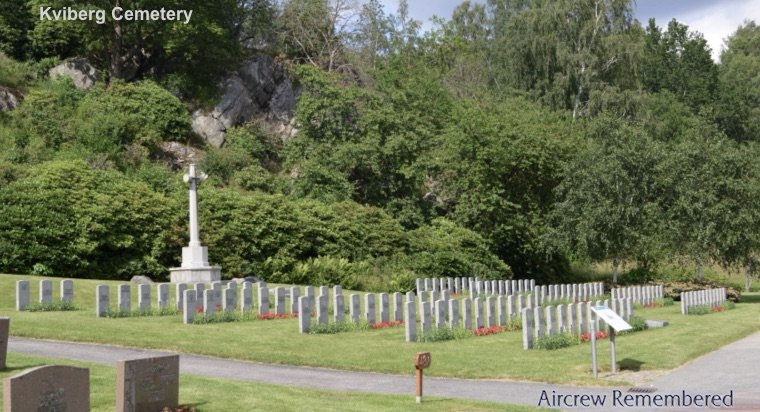 Kviberg Cemetery
the Although Sweden remained neutral throughout both world wars, a number of Commonwealth servicemen lie buried in her cemeteries and churchyards.
Most of the First World War burials are of Naval casualties from the Battle of Jutland in 1916, or from the hired drifter 'Catspaw', wrecked on the south-east coast in December 1919. The Second World War graves are mostly those of airmen who failed to return from bombing raids over Germany or German occupied territories.
The three killed, all Royal Canadian Air Force:
F/O. William Henry Bowler, J/7210, observer. Born 4th November 1912. Son of William and Annie Bowler of Kettleby, Ontario, and husband of Constance Bowler of London.
Fl/Sgt. John Parker Campbell, R/69686, wireless operator/air gunner. Born 25th January 1915 in Vancouver. Son of John Gregor and Edna Parker Campbell of Vancouver. He enlisted in Toronto on 2nd July 1940.
Fl/Sgt. James Steven Jewett, R/56296, wireless operator/air gunner, aged 21, from Montreal.
The two survivors were P/O. D.I. Evans and Cpl. B.J. Sowerby, both RAF. Sowerby was a ground crewman travelling with the crew, like Cpl. Nelson in P5304. They walked about 20 miles through the mountains over three days. To hide the fact that they had broken Swedish neutrality, they claimed to be evaders from an aircraft shot down over Norway. They were then interned in Sweden for a time.
Many casualties of both wars were buried in isolated and inaccessible locations and in 1961, the Gothenburg Church Commission made land available for a war graves plot in Kviberg Cemetery, which allowed these graves to be relocated. Three further burials were made in the plot in 1976, when a crashed aircraft, buried in snow in Lapland since 1942 was discovered during a thaw.
The Commonwealth plot in Kviberg Cemetery now contains 68 burials of the First World War, 30 of which are unidentified. Second World War burials number 46, 11 of them unidentified.
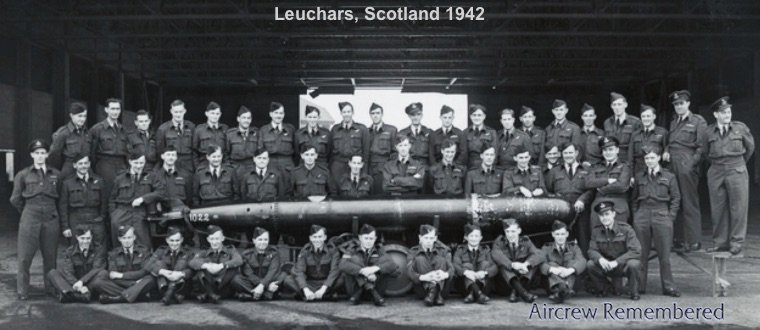
Leuchars, Scotland. C. 1942-04. A group portrait of the aircrew members of No. 455 Squadron RAAF, at an RAF Station. Front row, left to right: Sergeant (Sgt) E. Smith, Wireless operator/air gunner (WOP/AG), RAF; Sgt L. A. Biggin, WOP/AG, RAF; 404395 Sgt R. J. Booth, WOP/AG; 402616 Sgt S. V. L. Sheedy, WOP/AG; 404632 Flight Sergeant (Flt Sgt) C. W. Cameron, WOP/AG; 400842 Sgt Edward John Smart, pilot (lost on operations over Sweden on 5 September 1942); 88803 Sgt E. L. L. Rowe, Navigator (Nav) "B"; 404814 Pilot Officer (PO) T. A. Edgoose, Nav "B"; Sgt D. W. Elliott, WOP/AG, RAF; 404728 Sgt C. G. Storry, pilot; 403403 Acting Flight Lieutenant (A/Flt Lt) J. N. Davenport, pilot. Middle row: 402583 PO G. I. Gunton; 400316 Flying Officer (FO) G. R. Anderson, Nav "B"; 402575 A/Flt Lt L. P. Oliver DFC, Nav "B"; 403615 Sgt S. W. Wilson, pilot; Flt Sgt D. W. Parkhouse, Royal New Zealand Air Force, WOP/AG; 402627 Sgt H. H. Willis, WOP/AG; 402779 Sgt D. F. Thomas, WOP/AG; 404633 Sgt A. E. Crossley, WOP/AG; 37302 Wing Commander G. M. Lindeman, pilot; Sgt L. R. Lord, RAF, pilot; 402586 Sgt W. K. Bremner, WOP/AG; 403468 PO R. Patrick, pilot; 402762 PO R. N. Lindeman, Nav "B"; 404835 A/Flt Lt B. R. D. O'Connor, pilot; 400610 PO W. W. Wilson, Nav "B"; Sgt P. H. Baker, RAF, pilot. Back row: 404707 Sgt E. J. Gleeson, pilot; Sgt C. Harrison, WOP/AG; 403612 Sgt S. A. Vincent, pilot; 402871 Sgt W. H. S. Martin, pilot; 404599 Sgt D. Collins, WOP/AG; 402568 Sgt G. S. Dun, Nav "B"; 407829 Sgt F. L. Penhall, WOP/AG; 407681 Sgt Douglas Thorne Martin (lost on operations over Scotland on 11 January 1943), WOP/AG; 402467 Sgt J. A. L. Miller, WOP/AG; 400473 PO M. S. Humphrey, pilot; 404314 FO L. M. Jeffreys, Nav "B"; 404768 PO A. F. G. Broughton, pilot; 400349 Sgt V. W. Miller, WOP/AG; 402296 Sgt C. W. Richards, WOP/AG; 404578 F Sgt G. W. Carter; 400650 PO F. G. Dick, Nav "B"; 406501 Sgt L. Clohessy, WOP/AG; 400964 PO A. H. G. Clarke, pilot; 400364 Acting Squadron Leader (A/Sqn Ldr) J. Catanach DFC, pilot; 406356 A/Sqn Ldr R. Holmes, pilot; Flight Lieutenant A. Findlay Fleming, gunnery officer, RAF. (courtesy Australian War Memorial)


