




Operation: Training - radar homing and Leigh Light exercise
Date: 11th/12th February 1945 (Sunday/Monday)
Unit: No. 458 Squadron RAAF (motto: 'We find and destroy')
Type: Wellington GR XIV
Serial: HF402
Code:?
Base: RAF North Front, Gibraltar
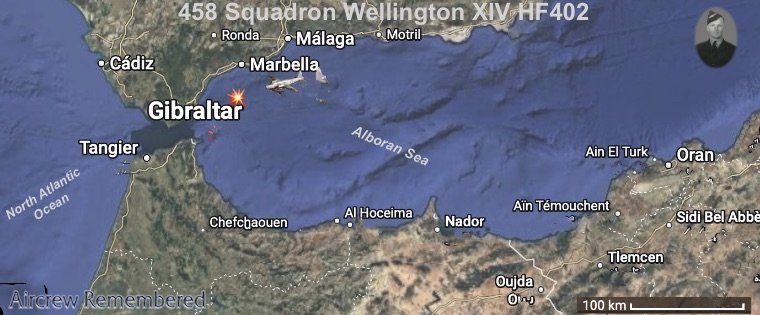
Location: Alboran Sea, 18 miles on 055 degrees from Europa Point, Gibraltar (36°16'48"N 5°02'24"W)
Pilot: Fl/Sgt. William John Fox Aus/428682 RAAF Age 30 - Killed
2nd Pilot: Fl/Sgt. Norman Leslie Taylor Aus/419777 RAAF Age 25 - Injured (1)
Nav: W/O. Keith Hamilton Watts Aus/429839 RAAF Age 23 - Missing, believed killed
W/Op/Air/Gnr: Fl/Sgt. Bernard Leslie Reid Conolan Aus/428070 RAAF Age 20 - Missing, believed killed
Radar/Op: Fl/Sgt. Maxwell George Egan Aus/423682 RAAF Age 21 - Injured (1)
W/Op/Air/Gnr: W/O. Mervyn Thomas Lee Aus/410993 RAAF Age 27 - Missing, believed killed
(1) After rescue both were admitted to the Military Hospital, Gibraltar.
 REASON FOR LOSS:
The squadron Operations Record Book records: "Wellington HF402 was engaged on a training exercise off Gibraltar on the night of 11/12 February 1945 when the aircraft ditched in the sea, and four of those on board were killed and there were two survivors."
The aircraft was on a radar homing and Leigh Light exercise with RAF Pinnace 1272 in the early hours of the 12th February. After what appeared to be a normal run onto the pinnace, at 02:10 hrs she hit the water, caught fire either before or after the impact, and sank almost immediately in position 055 degrees, 18 miles from Europa Point.
The court of inquiry concluded that the aircraft was flying too low and hit the water in a shallow dive.
 Statement of Fl/Sgt. Norman Leslie Taylor:
"We were on radar homing and Leigh Light training at low level. We had made about twelve runs and used the light about eight times, and this was the last run before heading for base. I was setting the elevation of the Leigh Light and not looking at the sea when the aircraft hit the water. The next thing I knew, I was under water.
When I surfaced the wreck was about 50 yards away, with the tail standing out of the sea and burning. The fabric had burnt off, exposing the geodetic framework. It sank within about eight seconds. I swam to the dinghy, which had inflated. Egan was already hanging on to it and we helped each other in. The pinnace arrived about five minutes later.
I believe the Leigh Light struck the water first and that the aircraft was straight and level. I know of no engine or airframe trouble and heard none reported over the intercom. We were not using the radio altimeter. We had tried it before the first run but switched it off because its indicator lights were too bright."
Statement of Fl/Sgt. Maxwell George Egan:
"I was at the radar operator's position giving the pilot homing directions, and had just called 'on course - half mile'. I then heard the second pilot ask the captain to switch on the Leigh Light, and the captain told him to wait. Moments later the aircraft hit the water.
I opened the astrodome and found myself in the sea. I looked around but could not see anyone else. The aircraft was on fire and the dinghy was just off the starboard wingtip. It had deployed automatically, as I had not pulled the release. I thought the aircraft was flying straight and level and had no impression of a dive."
 BURIAL DETAILS:
Fl/Sgt. William John Fox. Gibraltar Memorial. Born on the 3rd July 1914 at Junee, New South Wales. Enlisted on the 10th October 1942. Son of William Charles (c/o Commonwealth Bank, Albert Park, Melbourne) and Annie Etheline Fox, of 'Tala Heina', Henty, New South Wales, Australia.
W/O. Keith Hamilton Watts. Malta Memorial. Panel 19, Column 2. Born on the 11th February 1922 at Hyde Park, South Australia. Enlisted in the Army on the 12th December 1941 and in the RAAF on the 12th September 1942. Son of Raymond Arthur and Dorothy Agnes Watts, of Albert Park, Victoria, Australia.
Fl/Sgt. Bernard Leslie Reid Conolan. Malta Memorial. Panel 19, Column 2. Born on the 6th June 1924 at Hobart, Tasmania. Enlisted in the Army on the 7th July 1942 and in the RAAF on the 9th October 1942. Son of Bernard Arthur and Doris Emma Conolan, of 17 Manning Avenue, Sandy Bay, Hobart, Tasmania, Australia.
W/O. Mervyn Thomas Lee. Malta Memorial. Panel 19, Column 2. Born on the 12th May 1917 at Bendigo, Victoria. Enlisted on the 24th April 1942. Son of Lionel Wilton Lee and Teresa Agnes Lee; husband of Doreen Ella Lee, of Windsor, Victoria, Australia.
THE SURVIVORS:
Fl/Sgt. Norman Leslie Taylor. Born on the 5th October 1919 at Melbourne, Victoria. Son of Mr H.L. Taylor, 14 Langdon Street, Westgarth North, Melbourne.
He began his service in the Army, enlisting in the Australian Military Forces as a Private on the 28th August 1940 (V78216), a Militia number from Victoria. He was discharged from the Army on the 28th October 1942 and enlisted in the RAAF the next day, the 29th October 1942. By early 1945 he was flying as second pilot with 458 Squadron. He was discharged from the RAAF as a Warrant Officer on the 30th January 1946.
He appears to have rejoined the RAAF after the war. The same veterans' record shows a Flight Lieutenant with service number O18975 and RAAF involvement in Vietnam on the 24th August and 4th September 1967. His post-war airman's number on discharge was A18975, and with the same name and date of birth this is very likely the same man, re-enlisted, later commissioned and still flying in his late forties. A short stay in Vietnam such as this usually meant transport aircrew flying into the country rather than a full posting. This is not confirmed.
Fl/Sgt. Maxwell George Egan. Born on the 17th November 1923 at Dubbo, New South Wales. Enlisted on the 6th January 1942. Son of Winifred Egan. His RAAF will also named a Miss J. Clowes, 24 Seddon Avenue, Dumers Lane, Manchester, England, to be informed - very likely a girlfriend or fiancée he had met in Britain.
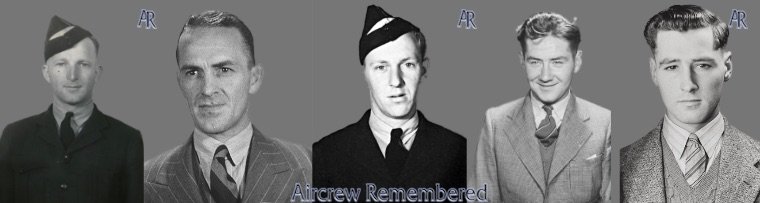
Above: Crew LR: l/Sgt. William Fox, Fl/Sgt. Leslie Taylor, W/O. Keith Watts, Fl/Sgt. Bernard Conolan, Fl/Sgt. Maxwell Egan, W/O. Mervyn Le and W/O. Mervyn Lee
THE 458 SQUADRON STORY:
458 Squadron was one of the Australian squadrons raised under the Empire Air Training Scheme, which trained Australian aircrew at home to serve alongside the RAF in squadrons carrying an RAAF number. On paper it was formed in Australia in July 1941. In practice it came together that summer at RAF Holme-on-Spalding-Moor in Yorkshire, flying Wellingtons with No. 1 Group, Bomber Command. Most of the aircrew were Australian, while the ground staff were largely RAF, as was common for these units.
Its time with Bomber Command was short. The squadron flew its first raid in October 1941, against Emden, and spent the winter attacking targets in Germany and occupied France. Early in 1942 it was ordered to the Middle East. The move went badly: the aircraft and crews flown out were taken over by other units on arrival in Malta and Egypt, and for several months the squadron existed in name only.
It was rebuilt in Egypt later in 1942 with a new role. Instead of bombing cities it became a maritime squadron working over the Mediterranean, hunting submarines and attacking Axis shipping, at first partly with torpedoes.
 For the next two years the squadron moved constantly as the war in the Mediterranean shifted, operating from North Africa, Malta, Sardinia and Corsica, and from the Foggia airfields in southern Italy, where HF402 joined it in 1944. The crews became specialists in night anti-submarine work with the Leigh Light, a powerful searchlight fitted under the Wellington. The radar operator guided the aircraft towards a contact in the dark, and in the last moments of a low approach the light was switched on to catch a surfaced U-boat before it could dive. It was exacting flying, very close to the sea at night, and as Bill Fox's crew found in February 1945 a small misjudgement of height could be fatal even on a training exercise.
In January 1945 the squadron moved to Gibraltar to cover the western approaches to the Mediterranean, by which time the U-boat threat there was fading. With the war in Europe over, the squadron was disbanded at Gibraltar in June 1945 and its Australian crews were sent home or posted elsewhere, as Taylor and Egan were.
The squadron never had the public profile of the big Australian bomber squadrons in England. It spent most of its life far from home, scattered across the Mediterranean, flying long and often uneventful patrols that occasionally turned deadly. Many of its losses, like those of HF402, were men lost at sea with no grave, which is why their names appear on the memorials at Malta, Alamein and Gibraltar.
THE LEIGH LIGHT:

The Leigh Light was a large searchlight carried under an aircraft to find and attack submarines at night. It was the idea of Sqn/Ldr. Humphrey de Verd Leigh, a Coastal Command officer who was neither an engineer nor a scientist. He had talked to aircrew about their problem, was convinced he could solve it, and pressed ahead largely on his own initiative and against some official resistance.
U-boats had to spend time on the surface to run their diesel engines and recharge their batteries, and preferred to do so at night when aircraft could not see them. By 1941 Coastal Command aircraft carried ASV radar, which could pick up a surfaced submarine in the dark from several miles away. In the final stretch, though, the echo from the submarine was lost among the returns from the waves, so the crew lost the target at the very moment they needed it. Dropping flares only warned the U-boat and gave it time to dive.
Leigh's answer was to fit a searchlight into the space left by the Wellington's retractable belly turret. The light was lowered beneath the fuselage and aimed by an operator in the nose, powered by batteries charged from the aircraft's own generator. The radar guided the aircraft in, descending all the time, and the light was switched on only in the last mile or so. The U-boat was suddenly lit up with the aircraft already on its attack run and only seconds away, and the depth charges followed before the crew below could dive.

Trials ran through 1941, and the first squadron to use the light on operations was No. 172, flying from Chivenor in Devon in the summer of 1942. Within a few weeks it had its first kill, a U-boat sunk in the Bay of Biscay. The effect on the Germans was greater than the number of boats sunk. Commanders who had felt safe on the surface at night no longer did, and U-boats crossing the Bay began surfacing in daylight instead, where they were easier for patrolling aircraft to find. The Germans fitted radar warning receivers to give boats time to dive, which helped them for a while until the Allies moved to radar sets the receivers could not detect.
The light was later fitted to Catalinas and Liberators, carried in a pod under the wing rather than in the fuselage, but the Wellington remained its best-known carrier, and squadrons like 458 used Leigh Light Wellingtons until the end of the war.
The method demanded a great deal of the crews. An attack meant flying low over the sea at night, often with no horizon, relying on instruments and the radar operator's directions, and then being dazzled by the light itself at the last moment. Training was constant and accidents were not rare. The loss of HF402 off Gibraltar, on what looked like an ordinary practice approach towards a rescue launch, shows how small the margin was.
At the going down of the sun, and in the morning we will remember them. - Laurence Binyon
Dedicated to the relatives of this crew. We seek additional information and photographs of the crew - please contact us.
SOURCES AND ACKNOWLEDGEMENTS:
- Paul McGuiness RAAF Archive
- Commonwealth War Graves Commission
- Australian War Memorial
- Aviation Safety Network
- National Archives of Australia
- Aircrew Remembered Archives
- Department of Veterans' Affairs - WW2 Nominal Roll
- Virtual War Memorial Australia
- Aviation Heritage Museum (WA) - 'Lest We Forget' record for W/O. M.T. Lee
- 458 Squadron Association - roll of fatalities, honour roll and squadron history
- No. 1 Wireless Air Gunners School Ballarat (1WAGS) - Conolan and LeeSUPPLEMENT:
Corrections made to the report
Further details of the loss
The aircraft is recorded as having gone into the sea about two miles from the pinnace (Aviation Heritage Museum, WA).
The 458 Squadron Association roll of fatalities records Fl/Sgt. Fox as buried at sea. This suggests his body was recovered and later committed to the sea, which explains why he is commemorated on the Gibraltar Memorial while the three men never found are on the Malta Memorial.
The squadron used the codes FU (September 1941 to March 1942) and MD (October 1942 to April 1943) (458 Squadron Association). HF402 joined the squadron in 1944, so it may not have carried MD codes at all. The code is left as 'MD-?' pending a photograph or the Operations Record Book.
Further details of the crew
Fl/Sgt. William John Fox. A labourer from Henty, New South Wales, before enlisting.
W/O. Keith Hamilton Watts. A former pupil of Pulteney Grammar School, Adelaide. He had his 23rd birthday on the day before the crash.
Fl/Sgt. Bernard Leslie Reid Conolan. Trained at No. 1 Wireless Air Gunners School, Ballarat, on Course 35 from the 4th February 1943.
W/O. Mervyn Thomas Lee. A surgical rubber worker from Windsor, Victoria, who attended Bendigo Elementary High School from 1929 to 1931. He trained at No. 1 Wireless Air Gunners School, Ballarat, on Course 27 from the 25th June to the 14th December 1942, and was then posted to No. 3 Bombing and Air Gunnery School. The 1 WAGS website holds two photographs of him.
Fl/Sgt. Maxwell George Egan. Discharged from the RAAF on the 14th November 1945.
Memorials to the crew
- Gibraltar Memorial, North Front Cemetery, Gibraltar: Fl/Sgt. Fox. The memorial commemorates servicemen who died in the Gibraltar area and have no grave but the sea.
- Malta Memorial, Floriana, Malta - Panel 19, Column 2: W/O. Watts, Fl/Sgt. Conolan and W/O. Lee. The memorial stands outside the City Gate of Valletta and commemorates almost 2,300 Commonwealth airmen who lost their lives serving in the Mediterranean and have no known grave. It was unveiled by HM Queen Elizabeth II in May 1954.
- Australian War Memorial, Canberra: all four men are on the Roll of Honour. W/O. Lee is recorded on Panel 106 of the Commemorative Area.
- Pulteney Grammar School WW2 Honour Roll, Adelaide: W/O. Watts.
- Adelaide WW2 Wall of Remembrance: W/O. Watts.
- 458 Squadron Association Honour Roll: all four men.


