




Operation: Hanover
Date: 22nd/23rd September 1943 (Wednesday/Thursday)
Unit: No. 218 (Gold Coast) Squadron
Type: Stirling III
Serial: EF139 (1)
Code: HA-B
Base: RAF Downham Market, Norfolk
Location: Between Lauenau and Pohle, villages south-west of Hanover
Pilot: Fl/Sgt. Norman Vincent Spencer, R/122306, RCAF, Age 25 - Killed
Fl/Eng: Sgt. William George Morement, 1120513, RAFVR - PoW No. 660, Stalag 357 Kopernikus
Nav: Fl/Sgt. George McCowan King, R/142247, RCAF, Age 21 - Killed
Air/Bmr: Fl/Sgt. (W/O 2 posth.) Douglas McKay Wylie, R/129010, RCAF, Age 23 - Killed
W/Op/Air/Gnr: Sgt. Harold James Hicks, 1316957, RAFVR, Age 22 - Killed
Air/Gnr (M.Up): P/O. Raymond Frederick Eberle, J/27315, RCAF, Age 22 - Killed
Air/Gnr (Rear): Sgt. Arnold William Baker, R/112703, RCAF - PoW No. 250706, Stalag 4B Mühlberg (Elbe)
 Reason for Loss
The force. 711 aircraft took part: 322 Lancasters, 226 Halifaxes, 137 Stirlings and 26 Wellingtons. It was the first major raid on Hanover for two years and the first of a series of four heavy raids on the city. Five American B-17s also joined in, their first night raid on Germany. They came from the 422nd Bombardment Squadron, 305th Bomb Group, and bombed Hanover between 21:43 and 22:09 hours with no losses.
Diversions. 21 Lancasters and 8 Mosquitos of No. 8 Group made a diversionary raid on Oldenburg. They dropped large amounts of "Window" and many flares and target indicators to make it look as though a much bigger force was arriving. Another 12 Mosquitos made a further diversion to Emden, 4 Stirlings laid mines in the Frisians, and there were 7 sorties by training units. None of these aircraft were lost. The losses on the Hanover raid were lower than the recent average, which may mean that the diversions partly worked.
 Conditions and results. The moon was 34% full. Visibility was good, but strong winds made it hard for the Pathfinders to mark the target, and the main force's bombing suffered as a result. According to Middlebrook and Everitt's Bomber Command War Diaries, stronger winds than forecast meant that the marking and bombing were concentrated 2 to 5 miles south-south-east of the city centre. They judged that serious damage was unlikely, and that only the third of the four raids caused extensive damage.
German local history publication - kindly supplied by Kevin Latham:
"The radio programme was interrupted: 'Attention! Attention! We have the following announcement: strong enemy bomber formations approaching the Hanover area! Full alarm!' Soon afterwards we could hear the drone of the enemy bombers here too. Heavy anti-aircraft fire began. The first 'Christmas trees' were dropped. Wave after wave of bombers unloaded their deadly cargo over Hanover.
It was a ghostly sight: the ridge of the Deister in darkness, and behind it the glowing red sky over burning Hanover. One bomber came in low over the Deister, heading west. It had been badly hit by flak and was on fire. It turned in a loop and flew very low over Pohle. Shortly afterwards the aircraft hit the ground and exploded. The next morning (Saturday) we learned that the bomber had crashed by the road between Meinsen and Pohle. It was a Short Stirling (a four-engined bomber) of the British air force..."
(Note: "Christmas trees" (Christbäume) was the German nickname for the Pathfinder flares and target indicators hanging in the sky. The Deister is the wooded ridge between Hanover and Pohle/Lauenau. A bomber crossing it heading west fits the area exactly.)
"Several dead lay in the wreckage. Two crew members saved themselves by parachute. One landed in a cherry tree at August Kracke's in Meinsen. Children found the other in a roadside ditch with broken legs. The bomber had apparently already dropped its bombs over Hanover, but Meinsen still narrowly escaped a catastrophe that night. The same night, several bombs also came down in the fields between Feggendorf and Rodenberg, probably an emergency jettison.
This was the first bomber crash so close by, so the news spread like wildfire. Many people from Meinsen, Messenkamp, Pohle, Lauenau and even Rodenberg made their way to the crash site."
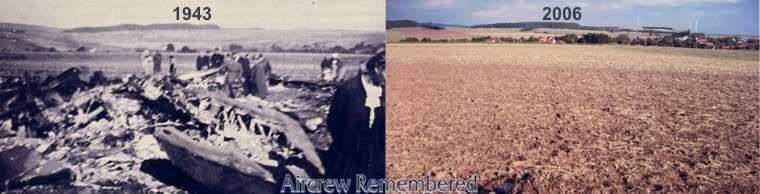 Above: wreckage of Stirling EF139 near Pohle
Note on image: Local people came to look at the wreckage of the crashed bomber. The photo was taken despite a ban, which is probably why it is blurred. (Courtesy Kevin Latham)
Fritz Konerding recalls:
"Herbert Calm was an apprentice at master baker Carl Strube's. His job was to sell bread in the surrounding villages from a horse-drawn bakery cart. The day after the crash he had to drive to Meinsen again with bread, and he took us along.
The bomber lay in the hollow beside the road from Pohle to Meinsen. The fuselage lay where the high-voltage pylon stands today. The wings, with their four radial engines, were completely burnt out. The tail lay near the Weichselland house, on the path leading down. So the bomber had already broken apart in the air. The cockpit lay quite near the front, by the road.
 When we boys got there in the morning to look at the wreck up close, soldiers from Wunstorf airfield were there. An Oberfeldwebel (flight sergeant) established that two of the crew were missing. He assumed both were dead and still in the cockpit. The cockpit had bored deep into the ground and had to be pulled out. A tractor was fetched from the Lauenau estate. Its driver, the dairyman Kowalewski, tied a rope to the cockpit and dragged it out of the earth. The two airmen were indeed inside, dead. I can still see it: the dead coming up out of the earth in the cockpit. The Oberfeldwebel took their pay books and identity discs, and explained that these would be sent to the relatives via Switzerland."
(Translation note: "der Schweizer" here almost certainly means a dairyman or cattle-herder on the estate, which was a common rural job title. It does not mean a Swiss national.)

This account fits the official records closely. A four-engined bomber with radial engines (the Stirling's Hercules) and a Canadian crew came down between Pohle and Meinsen, near Lauenau. Two men parachuted to safety, which matches the two PoWs, Baker and Morement. Five dead were recovered, matching the five buried at Lauenau.
EF139 took off at 19:00 hrs. Some reports state that it was hit by incendiary bombs dropped by an aircraft flying at a higher altitude. A claim was also made by Lt. Ernst-Erich Hirschfeld (sgown right) of 5./JG 300. It was probably a combination of both.
The squadron lost two other crews:
BK700 HA-L, flown by Canadian 21-year-old F/O. Carman Mackenzie Colquhoun, J/17934, RCAF, from Maple Creek, Saskatchewan, Canada - killed with all six of his crew.
EJ105 HA-N, flown by Australian 23-year-old Fl/Sgt. (P/O. posth.) Rodney Ernest Duffy, Aus/413838, RAAF, from Rose Bay, New South Wales, Australia - killed on return at Bury St Edmunds, Suffolk, with three other crew. Three of the crew had baled out over Germany: one was killed and two were taken PoW.
218 Squadron Stirling III EF139.pdf
 Burial Details
The five crew killed were initially buried in Lauenau parish cemetery. The graves were carried out by 85 Graves Concentration Unit. The five were first registered at Hanover in a collective grave; in 1951 the Graves Registration Service registered graves 1-3 individually (letter to Wylie's widow, 2nd June 1951).
Fl/Sgt. Norman Vincent Spencer. Hanover War Cemetery, Grave 2.H.1. Born on 18th September 1918 in Vancouver, British Columbia, Canada. Enlisted on 30th July 1941. Trained at 30 Operational Training Unit; crews formed up here and flew Wellingtons 11th May 1943. Final training with 1651 Heavy Conversion Unit 23rd July 1943. Joined 218 Squadron on the 18th August 1943. Son of Ernest (died 1949, age 58) and Minnie Beatrice Spencer (née Vincent, died 1971, age 81), later of 525 Seymour Street, Vancouver, , British Columbia.. Husband of Kathryn (née Davidson - later Miller). They married on on the 14th November 1942 in Vancouver and lived at 3963 West 12th Avenue, Vancouver
Fl/Sgt. George McCowan King. Hanover War Cemetery, Grave 2.H.2. Born on 19th April 1922 in Summerberry, Saskatchewan, Canada. Enlisted on 29th November 1941. Trained at 30 Operational Training Unit; crews formed up here and flew Wellingtons 11th May 1943. Final training with 1651 Heavy Conversion Unit, 23rd July 1943. Joined 218 Squadron on the 18th August. Son of William King (died 1950, age 77) and Agnes King (née McCowan, died 1974, age 93), He had two brothers, William and James (R/155809 RCAF), and a sister, Jeanie Ellen of Summerberry, Saskatchewan, Canada.
W/O 2. Douglas McKay Wylie. Hanover War Cemetery, Grave 2.H.3. Born on 17th July 1920 in New York City, USA. Enlisted on 27th August 1941. Trained at 30 Operational Training Unit; crews formed up here and flew Wellingtons 11th May 1943. Final training with 1651 Heavy Conversion Unit 23rd July 1943. Joined 218 Squadron on the 18th August 1943. Son of Thomas Newton Wylie (died 1938, age 45) and Judith Newton Wylie (née Pole, died 1958, age 58), who later married Mr. Willmot (died 1945, age 64) and then Nathaniel Young (died 1961, age 78). Brother of Newton Wylie, who served in the RCAF (died 1992, age 69), Bradley Claybrook Wylie, who served in the US Navy, Judith Newton Wylie (Jones) and Mary Willoughby Wylie, of New York, USA. Husband of Vera Mae Wylie (née Huston - later Glen - died 2007, age 86n); they married on 15th September 1942 in Toronto. Epitaph: "The Readiness Is All".

Above: Th Hick brothers
Sgt. Harold James Hicks. Hanover War Cemetery, Grave 2.H.4. Born on 9th January 1921 in Cardiff, Wales. Trained at 3 30 Operational Training Unit; crews formed up here and flew Wellingtons 11th May 1943. Final training with 1651 Heavy Conversion Unit 23rd July 1943. Joined 218 Squadron on the 18th August 1943. Son of Frank and Florence Amelia Hicks, of Roath, Cardiff.
His brothers, 18-year-old Sgt. Reginald George Hicks, 652673 (254 Squadron, Blenheim IV T1953, 28th February 1941), and 23-year-old Fl/Sgt. Francis John Hicks, 534619 (27 Squadron, Blenheim I L1258, 15th February 1942), both serving as W/Op/Air/Gnrs, also died on service. Epitaph: "In God's Own Time We'll Meet Again".
P/O. Raymond Frederick Eberle. Hanover War Cemetery, Grave 2.H.5. Born on 16th August 1921 in Toronto, Canada. Enlisted in September 1942. Trained at 30 Operational Training Unit; crews formed up here and flew Wellingtons 11th May 1943. Final training with 1651 Heavy Conversion Unit 23rd July 1943. Joined 218 Squadron on the 18th August 1943.. The only son of Frederick (died 1985, age 95) and Mabel Eberle (née Hallett, died 1987, age 94), of 127 Eastwood Road, Toronto, Canada - later of Manitoba, Canada. Brother of Geraldine (Grabowsky, died 2008, age 82), and Ruth. Epitaph: 'Lovingly remembered by Mother and Dad, Ruth and Geraldine'.
 (1) Aircraft history. EF139 came to 218 Squadron from No. 623 Squadron, which had been formed at Downham Market on 10th August 1943 from 218 Squadron's "C" Flight. This could go in a numbered footnote, as on the Ferguson page.
Memorials. A Norfolk flint pillar memorial at the eastern threshold of the old main runway at the former Downham Market airfield is dedicated to those killed in EF139. The squadrons are also remembered at St. Mary's Church, Bexwell. The five are named on the IBCC Spire, Lincoln (Spencer panel 245, King 194, Wylie 270, Hicks 181, Eberle 159); the Canadians are also on the Bomber Command Memorial Wall, Nanton, Alberta.
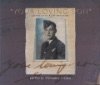
'Your Loving Son' Letters of an RCAF Navigator is a collection of George King's wartime letters to his family in Summerberry, Saskatchewan. These letters--humorous, heartwarming, poignant--offer a glimpse of the war and of Prairie life from the pers8pective of one young man who journeyed far from home to serve his country. Your Loving Son also includes the telegrams, government documents, and letters of condolence received by the King family after George's death. These provide a rare insight into the impact of the death of this young airman on his friends and family, the other and often forgotten casualties of war.
Author Dr. Stephen L.V King, nephew of the navigator
Canadian Plains Research Center, Regina, Saskatchewan
ISBN 13 9780889771499
Sources and Acknowledgements
- Kevin Latham (grandson of Sgt. William Morement)
- Rudolf Dehne and Fritz Konerding, local history accounts (via Kevin Latham)
- Paradie-Dutil RCAF Archive
- RCAF Personnel Service Records
- Steliana Translation Service (German newspaper)
- National Archives, Kew
- National Archives of Australia
- Kracker Luftwaffe Archive
- Roath Virtual War Memorial
- Aircrew Remembered Archives
- Aviation Safety Network
- Find a Grave
- Commonwealth War Graves Commission (CWGC)
- International Bomber Command Centre
- 218 Squadron Association
Supplement - Editor's Notes and Additional Information
Additional information found
How EF139 was lost. The IBCC biographies of the crew give a fuller account. While over the target, EF139 was coned by searchlights and attacked by Lt. Robert Wolf of 3./NJG 5, flying a Bf 110 from Stendal, who damaged the Stirling. The rear gunner (Baker), who survived as a PoW, reported that the aircraft was finally brought down when it was hit by incendiaries dropped from above, just after bombing. At 22:50 the aircraft broke up over Lauenau and crashed at Pohle, about 15 miles south-west of Hanover. This gives two different fighter claims (Wolf, NJG 5; Hirschfeld, JG 300). You may wish to mention both. Fifteen 218 Squadron crews took part in the raid.


