





Operation: Köln, Germany
Date: 16th/17th June 1943 (Wednesday/Thursday)
Unit No: 61 Sqn, 5 Group, Bomber Command
Type: Lancaster I
Serial: W4789
Code: QR:W
Base: RAF Syerston, Nottinghamshire
Location: Pattern, 3 Miles (5 km) SW of Jülich, Germany
Pilot: Plt Off. Alan William Pullan 145859 RAFVR Age 20. MiA
Flt Eng: Sgt. Bernard Stanley Bridge 570570 RAF Age 21. MiA
Nav: Sgt. Cecil Thomas Oswald Dudley 569983 RAFVR Age 23. KiA
2nd Nav: Plt Off. Jean Paul Laurin J22363 RCAF Age 23. MiA (1)
Bomb Aimer: Fg Off. James Rutherford Hutton Bell 131959 RAFVR Age 26. MiA (2)
WOp/Air Gnr: Sgt. Johnathan ‘John or Jack’ Nuttall 1132714 RAFVR Age 20. MiA
Air Gnr (Mid Upp): Sgt. Percy Frederick Cottle 1381859 RAFVR PoW Age 22. PoW No: 260472 * (3)
Air Gnr (Rear): Sgt. Robert Stinson Morley R136408 RCAF Age 21. MiA
* Stalag Luft 6, Heydekrug, Memelland now Šilutė in Lithuania
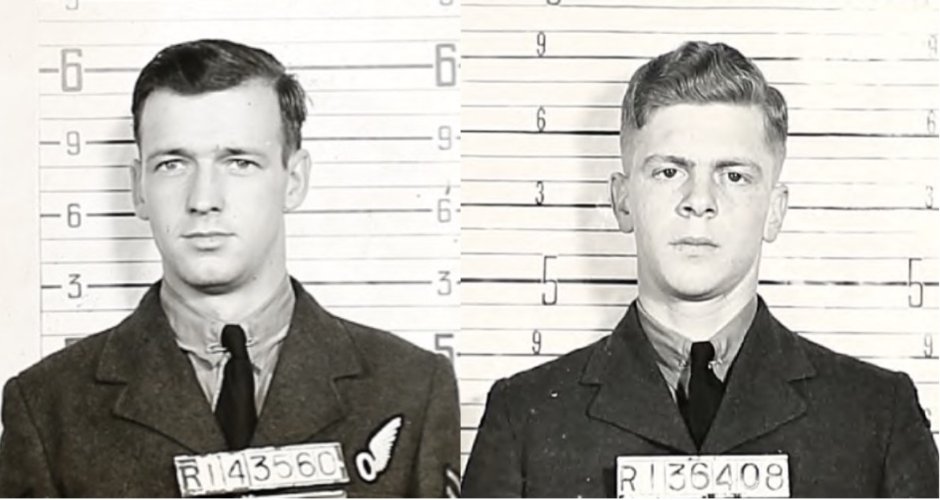
Above left to right: Plt Off. Jean Paul Laurin, Sgt. Robert Stinson Morley (From their service records)
REASON FOR LOSS:
On the night of the 13th/14th April 1943 61 Sqn detailed fifteen (15) aircraft on an operation to bomb the Battleships in the harbour at La Spezia south of Gerona, Italy.
This crew were flying 61 Sqn Lancaster I W4137 and departed from RAF Syerston at 20:35 hrs. The then Sgt. Pullen located Lake Bourget, east of Lyon and Savoua in Italy but was unable to find the target despite a ‘Square search’ after the ETA. They were unable to maintain height due to an engine issue therefore could not climb over the Alps to return so they jettison their bombs and set course for North Africa. Their R/T was also ineffective and eventually had to land in a ploughed field near an Arab village. They were helped by the villagers to obtain assistance from an American airbase who provided petrol to refuel the Lancaster. They then made a successful 3-engine take off and landed at RAF Maison Blanche in Algeria for repairs, after which the aircraft returned to base via Gibraltar.
On the night of the 16th/17th June 1943 the Sqn detailed twelve (12) aircraft to join a force of two-hundred and twelve (212) Lancasters and Halifaxes on an operation to bomb Köln in Germany.
Since the departure of Lancaster I W4798 at 22:26 hours no communications from the aircraft was received and it failed to return.
Pilots of other aircraft from this Unit engaged on the operation reported 8/10 to 10/10 cloud with tops at about 15,000 ft. above this the visibility was good. Searchlights were not in evidence but Flak was very intense, both barrage and predicted, night fighters were also in the vicinity. No observations were made by anyone that could reasonably have been connected with the failure of W4798 to return.
Lancaster I W4798 was claimed by Maj. Walter Ehle from Stab II./NJG1, his 27th Abschuss over Pattern, 3 miles (5 km) SW of Jülich at 5.000m at 01:18 hrs.
- Note: Also claimed by Flak of 1.-4./schw. Flak Abt. 514, schw. Flakbattr. z.b.V. 5701 (Lancaster near Pattern 5.600-600 m. 01:35 hrs). The victory for Maj. Ehle was confirmed on the 20.12.1944 (Ref 1, p124).
- Maj. Ehle and his crew were killed on the night of the 17th/18th November 1943. On final approach in bad weather to St. Trond airfield his Bf110 G-4 G9-AC was seen to dive vertically into the ground at Horpmaal at 20:30 hrs. He was credited with thirty (30) Abschüsse, three (3) of which were during the day time (Ref 2, p22).
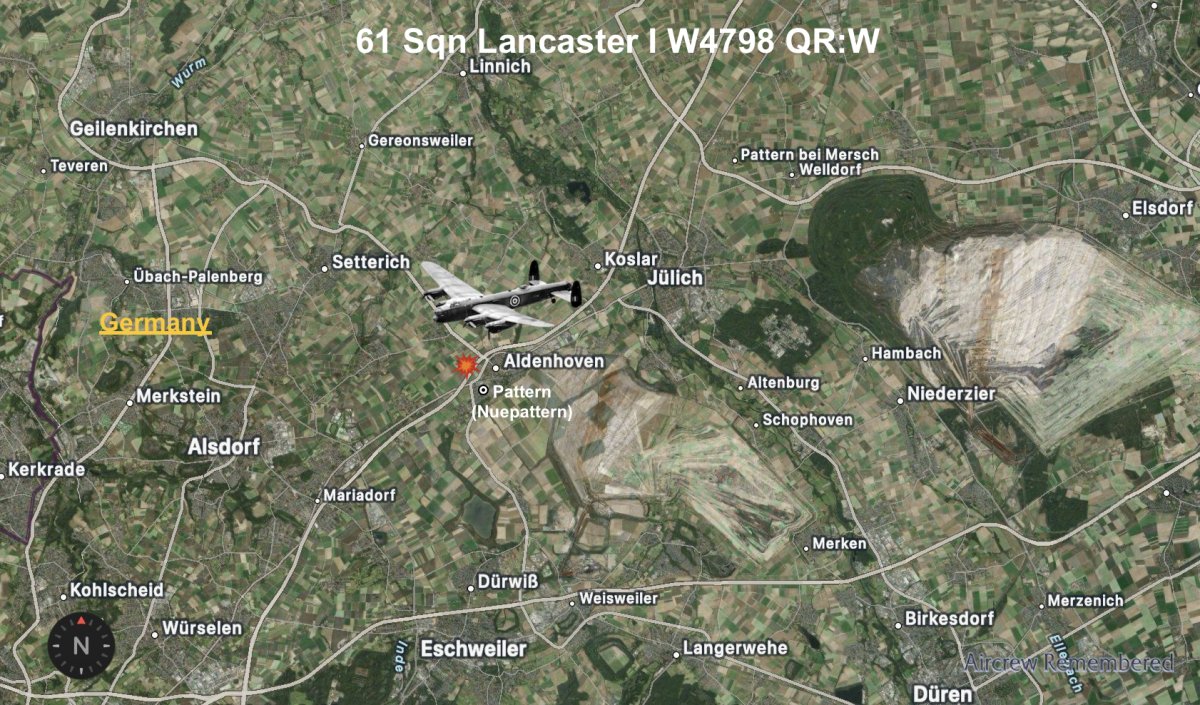
(1) Plt Off. Jean Paul Laurin was on the strength of No. 1654 Heavy Conversion Unit (HCU) and was flying as the 2nd Navigator on his first operation.
(2) Fg Off. James Rutherford Hutton Bell.
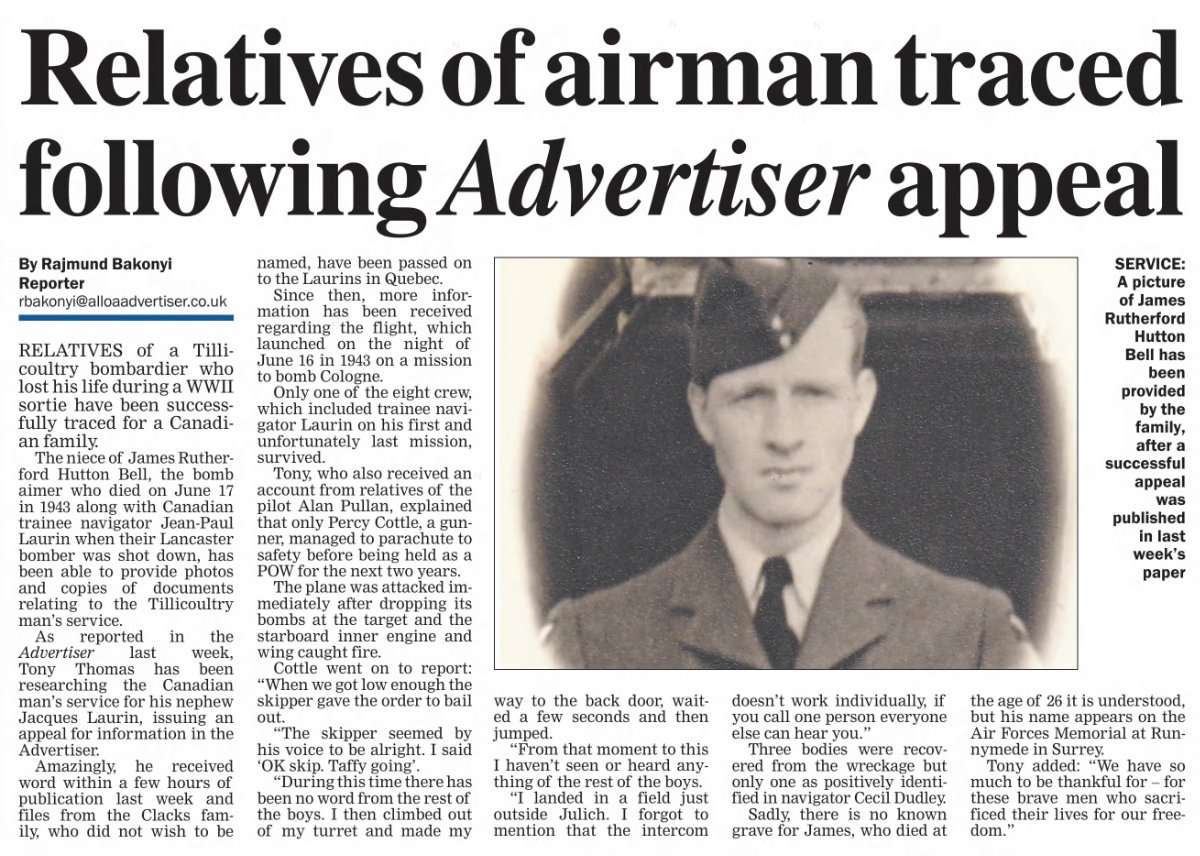
Above: Courtesy of the Alloa and Hillfoots Advertiser, dated 27th July 2022
(3) Sgt. Cottle successfully baled out and landed uninjured. He tried to get to Belgium and managed to evade for the next eight (8) days but was apprehended about 6 miles (9½ km) west of Jülich by a local farmer and the locals villagers from Aldenhoven on the 24th June. By this time he was in bad shape because of the lack of food and suffering from a slight touch of dysentery. He had lost his escape kit during his bale out.
He was transferred to Stalag Luft 6 at Heydekrug in Memelland arriving there on the 1st July. In early 1944 the Russian Army were advancing into the Baltic States from the North and the East preparation for evacuating the camp was being made. PoWs from Stalag Luft 6, the camp closest to the Russian advance, were in the "northern route" of the force-marches, and were transported to Stalag 20A by train in July 1944, and from there took part in the forced-march.
It was estimated that 100,000 PoWs took the northern route. It went to Stalag Luft 4 at Groß-Tychow, Pomerania then via Stettin and Stalag 11B to Stalag 357, Kopernikus at Thorn (Toruń) in Poland.
On the 1st September 1944 the PoWs were force-marched from Thorn (Toruń) in Poland to the site of the former Stalag 11D, with construction being carried out by the Italian PoWs from Stalag 11B. The camp was commonly known as Stalag 357, Fallingbostal but officially the designation was Stalag 357, Oerbke.
In early April 1945 the PoWs were informed by the Commandant Oberst (Col) Hermann Ostmann that the about 10/12,000 Allied PoWs were being evacuated from the camp in the face of the Allied advance. On the 7th April 1945 the men marched from the camp in columns of 2,000 in the general direction of Lauenburg on the Elbe River. After about ten (10) days they arrived at the village of Ludersburg, north of Luneburg on the west side of the Elbe river where they stayed overnight. Early the next morning, on the 19th April at about 10:00 hrs the column crossed the Elbe via a pontoon bridge and passed through the small town of Lauenburg before crossing the frontier into Mecklenburg. The column then turned east along a raised road to the village of Horst where they were afforded a short rest before arriving at Gresse, some 15 km NE of Lauenburg. Here they were issued with Red Cross parcels.
At around 10:30 hrs whilst the column was on a narrow country road amidst open fields they heard aircraft flying nearby which turned out to be a flight of seven (7) or eight (8) RAF Typhoons which dived in line-astern and strafed the column with rockets and dropped anti-personnel bombs all except the last aircraft which wheeled away at the last moment perhaps realising that they had mistaken the columns as retreating German troops. It was reported that upwards of sixty (60) allied PoW’s were killed and many were wounded.
- It was established that a total of forty-two (42) named Allied PoWs died either on the 19th April or in the following days. In addition there was one (1) unnamed American killed who was has yet to be identified;
- Six (6) German guards were also killed and a number were wounded. None have been identified;
- A total of forty-five (45) named and one unnamed wounded were admitted to the Boizenberg-on-Elbe Cottage Hospital. Twenty-seven (27) were seriously injured, seven (7) of whom succumbed to their injuries in the following days.
The then Warrant Officer (WO) Deans confronted Oberst (Col) Ostmann and bluntly gave him a choice, to be captured by the Russians or the British. Oberst Ostman provided WO. Deans with a pass and a German guard, and they headed west to contact the advancing British troops. On the 1st May WO. Deans and his guard were sheltering in a house east of Lauenberg when they heard over the radio the news of the death of Adolf Hitler. The next morning the house was overrun by troops of the British 6th Airborne. WO. Deans was taken to the commander of VIII Corpswhere he explained the situation. He was provided with a captured Mercedes car and drove back to Gresse. Two (2) days later the PoW column marched back across to the British lines.
- A number of so far unidentified Allied PoWs were killed in escape attempts but a large number of the men finished the march.
Meanwhile Stalag 357, was liberated on the 16th April 1945 by British troops from B Squadron 11th Hussars and the Reconnaissance Troop of the 8th Hussars. They were met at the main gate of Stalag 357 by a guard of Airborne troops, impeccably attired and led by RSM Lord.
Based upon his interview on the 26th April 1945 the then promoted Warrant Officer (WO) Cottle it appeared that he was not on the forced march and was liberated from the camp.
In his General Questionnaire for British/American Ex-PoW he added:
- “I would like to state, that if it had not been for WO ‘Dixie’ Dean things would have been a lot worse all round. I cannot find words to express my thanks to him. If anyone has any praise to give, you could never find a more deserving man”.
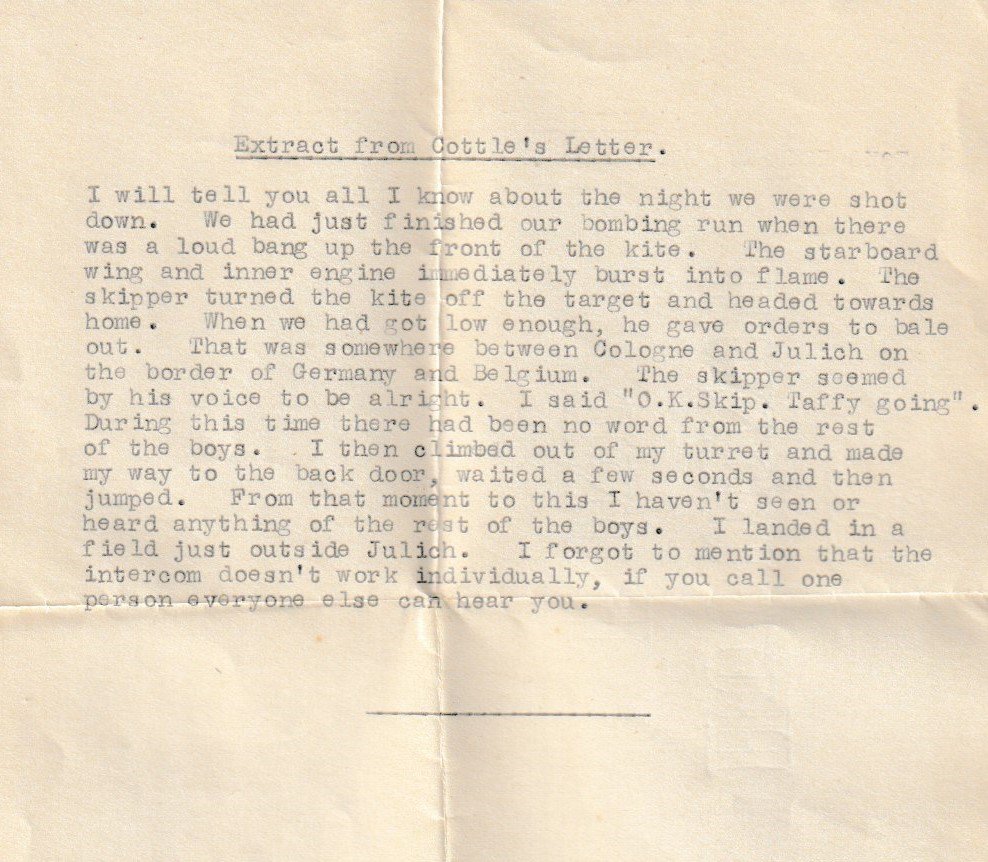
The following is an extract from a letter written by Sgt. Percy Frederick Cottle after his return to the UK which describes the circumstances of the loss of W4789 and his bale out of the stricken aircraft. (Courtesy of Ken Stone)
Percy Frederick Cottle was born on the 21st July 1920 in Grangetown, Cardiff, Glamorganshire. He was working as an Upholsterer prior to enlisting in the RAFVR on the 11th November 1940. Percey passed away on the 30th September 1992 in Penarth, Wales.
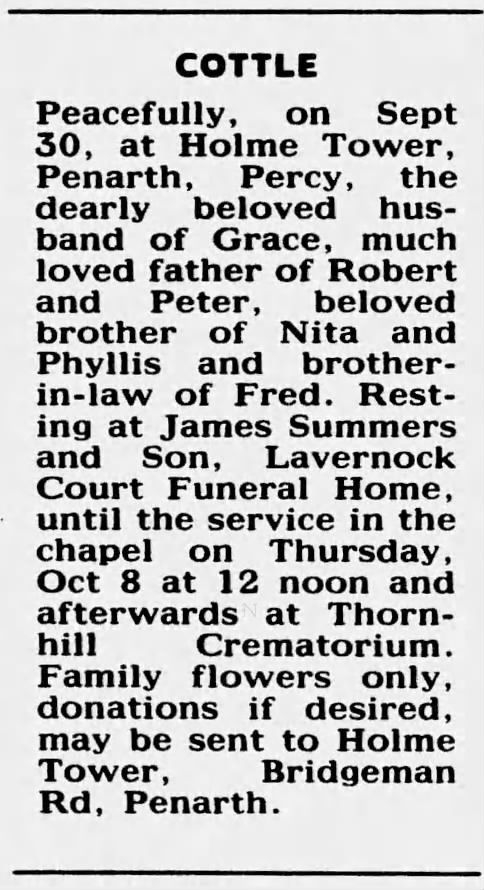
Above: Courtesy of the South Wales Echo, dated 2nd October 1992
BURIAL DETAILS:
Sgt. Cecil Thomas Oswald Dudley was initially buried in the Cologne Southern Cemetery and was finally laid to rest at the Rheinberg War Cemetery on the 17th May 1946.
Note: Apart from Sgt. Dudley, whose identity was established by his identity discs, the graves at the Cologne Southern Cemetery which, had previously believed to contain the remains of the six (6) other crew members, only contained two (2) bodies and could not be identified. The graves for these two (2) airmen are laid to rest in Plot 2, Row C, Graves 22 and 23 at the Rheinberg War Cemetery.
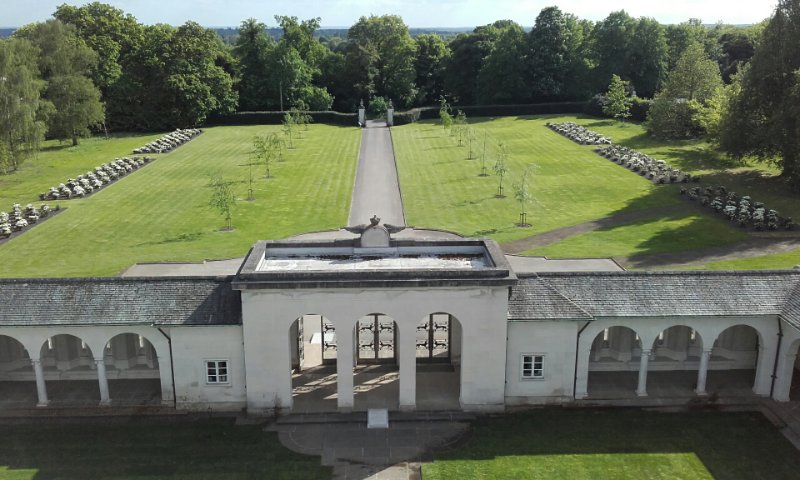
Above: The Runnymede Memorial (Courtesy of the CWGC)
Plt Off. Alan William Pullan. Runnymede Memorial Panel 133. Born on the 16th April 1923 in Southwark, London. Son of Arthur William and Dara Helen Pullan of London, England
Sgt. Bernard Stanley Bridge. Runnymede Memorial Panel 143. Born on the 9th October 1921 in Manor Park, Essex. Son of William Stanley and Amelia Alice (née Jones) Bridge of West Ham, Essex, England.
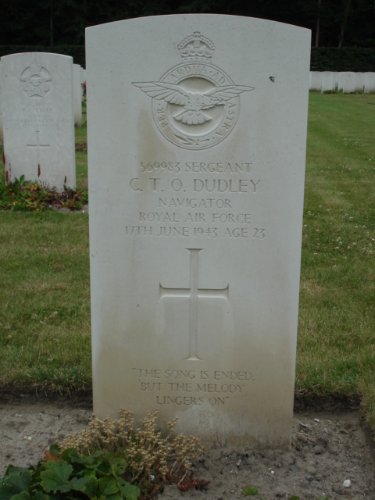
Above: Grave marker for Sgt. Cecil Thomas Oswald Dudley (Courtesy of Fred-FindAGrave)
Sgt. Cecil Thomas Oswald Dudley. Rheinberg War Cemetery, Plot 1, Row B, Grave 25. Grave Inscription: "THE SONG IS ENDED, BUT THE MELODY LINGERS ON". Birth registered in the 3rd Qtr of 1919 in Bicester, Oxfordshire. Son of Thomas William and Elsie Elizabeth (née Buckle) Dudley. Husband of Thelma (née Todd) Dudley of Scotstoun, Glasgow, Scotland.
Plt Off. Jean Paul Laurin. Runnymede Memorial Panel 174. Born on the 13th August 1919 in Shawinigan Falls, Province of Quebec. Son of Jean and Rose Albina (née Boisvert) Laurin of Shawinigan Falls, Province of Quebec, Canada.
Fg Off. James Rutherford Hutton Bell. Runnymede Memorial Panel 123. Son of James Hutton and Jane McConnell Rutherford Bell of Tillicoultry, Clackmannanshire, Scotland
Sgt. Johnathan ‘John or Jack’ Nuttall. Runnymede Memorial Panel 160. Born on the 7th September in Pontypridd, Glamorgan, Wales. Son of Daniel and Fanny (née Gwyther) Nuttall of Bootle, Lancashire, England
Sgt. Robert Stinson Morley. Runnymede Memorial Panel 185. Born on the 9th May 1922 in Toronto, Ontario. Son of Albert James and Irene Ambler (née Stinson) Morley of Highland Creek, Ontario, Canada.
Researched by Ralph Snape for Aircrew Remembered and dedicated to the crew and their relatives with thankd to Ken Stone for the letter extract (23rd Nov 2026).
Other sources listed below:
REFERENCES:
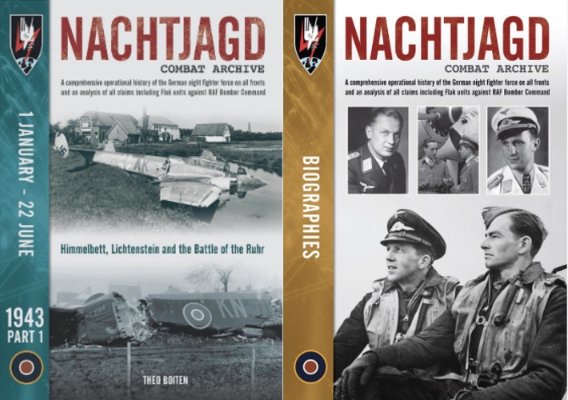
1. Nachtjagd Combat Archive (1 January - 22 June) 1943 Part 1 - Theo Boiten
2. Nachtjagd Combat Archive - Biographies - Theo Boiten


