




Operation: Chemnitz, Germany
Date: 14/15 February 1945 (Wednesday/Thursday)
Unit: 427 Squadron
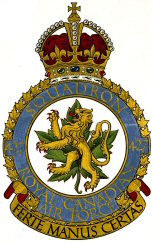
Squadron Badge: Argent a maple leaf Vert overall a lion rampant Or;
Symbolism (The lion represents England and the maple leaf Canada. Together, they indicate that this Canadian squadron was formed in England during the Second World War.)
Motto: Ferte manus certas (Latin 'Strike with a sure hand')
Type: Halifax III
Serial: MZ422
Code: ZL-N
Base: RAF Leeming, North Riding of Yorkshire
Location: Scheibe-Alsbach, Thuringia, Germany.
Pilot: F/O. Vernon Shillington Roy J86214 RCAF Age 26 -Killed
Fl/Eng: Sgt. Herbert Lee Gisborne (Mike) Mayer R225219 RCAF Age 27 - PoW
Nav: F/Sgt. Albin Robert (Mick) Williams R196508 RCAF Age 25 - PoW
Air/Bmr: Sgt. Andrew Lawrie Morrison R198441 RCAF Age 20 - PoW
W/Op/Air/Gnr: F/Sgt. Alden Norman Scorah R187219 RCAF Age 22 - Died from wounds
Air/Gnr (MU): Sgt. Adolph Joseph (Cy) Cybulskie R279178 - RCAF Age 19 - Killed
Air/Gnr (R): Sgt. Harold Gallagher R274861 RCAF Age 31 - Killed
INTRODUCTION
The air gunners, Adolf (Cy) Cybulskie and Harold Gallagher had first crossed paths at 10 Bombing and Gunnery School where they had both joined Course 76 on Valentine's Day 1944. Graduating on 5 May they each received Air Gunner Badges and promotions to Sergeant. From there on in their service records are a mirror image of each other, 3 AGTS at RCAF Three Rivers until 18 June, Y depot and embarkation from Halifax on 25 June 1944, 3 PRC at Bournemouth on 4 July and now on 1 August 1944 Course 28 at 82 Operational Training Unit at RAF Ossington, Nottinghamshire. On the face of it the pair had little in common, Cy was 19 years old and single while Harold was 30 years old, married with two sons. Admittedly they were both Ontarians albeit born and raised 165 miles apart and had both been employed in the Brewery industry, but that was where any similarity ended. They had however clearly formed a friendship and came as a pair when crewing up - though having two gunners working in sync was surely beneficial to any crew.
They had found themselves crewing up with pilot, F/O. Vernon Roy, from Ottawa and thus another Ontarian. A Sheet Metal Worker prior to joining the air force, Vernon was 26 and had initially enlisted as a ground crew Radio Mechanic before volunteering for air crew. Also joining the crew was Navigator, Sgt. Albin 'Mick' Williams aged 24 and Australian by birth. He had emigrated to England with his parents when he was 4 and then to Newfoundland when he was 8 before eventually settling on a farm at Colleston Saskatchewan along with his four siblings.
The role of Air Bomber was filled by Sgt. Andrew Morrison from Toronto and yet another Ontarian. He was 19, the same age as Cy and thus the youngest members of the crew.
Completing the line up was Wireless Operator Sgt. Alden Scorah age 21 from Clive, Alberta where his father was a farmer. Alden had been a Farm Labourer before enlisting and in April 1944 had married AW1 Jean Marie Hutton at Regina Saskatchewan. Jean was based at 5 Bombing and Gunnery School at RCAF Dafoe and romance had clearly blossomed when Alden had been posted there for 10 weeks from February to May 1944.
At 82 OTU crews were trained to fly Wellington bombers specifically for night bomber operations. Courses lasted about 10 weeks and Course 28 was duly completed on 15 October. Following 8 days leave Vernon Roy and his crew reconvened at RAF Dalton, a satellite station of nearby RAF Topcliffe in the North Riding of Yorkshire and where Group 6 Aircrew School was based. Apart from specialised courses the School provided a short two-week survival, escape, and evasion training program for aircrew prior to them joining heavy conversion units. Aircrew were schooled in hiding or disposing of parachutes, use of micro compasses, rations, emergency escape kits and how to safely approach potential local help in
enemy territory.
The crew spent a month at Dalton from 25 October to 24 November 1944 after which, on 4 December, it was off to 1664 Heavy Conversion Unit at RAF Dishforth in the North Riding of Yorkshire for conversion training on the Handley Page Halifax. Conversion courses typically ran for 4 to 5 weeks but with a severe, disruptive winter spell in Yorkshire during December 1944 and January 1945 the crew were to spend over 8 weeks at Dishforth and thus not completing training until 31 January 1945.
Whilst here the six became seven as a Flight Engineer was now a necessary requirement when flying four engine heavies. To fulfil the role the crew acquired the services of Sgt. Herbert Lee Gisborne Mayer who, it seems also answered to the name of Mike - at least there was no confusion with Albin Williams who was Mick. 'Mike' Mayer was also Canadian, originally from Alberni, British Columbia he was 26 and had already led an interesting life. Educated in Australia he sailed to England in 1936 when he was just 18 where he became an Insurance Agent until the outbreak of war when he joined the British Army and became a driver. Stranded with the army at Dunkirk he was one of the 200,000 British that were rescued.
He later transferred to the RCAF and returned to Canada where he trained as a flight engineer before returning to England in 1944, where, on 28 October 1944 he married English girl, Pamela Patricia Taunton at Kensington, London.
With effect from 31 January 1945 and now deemed ready for operational flying, Vernon and the crew were posted to 427 Squadron at RAF Leeming a mere 10 miles north of Dishforth. RAF Leeming was also home to 429 (Bison) Squadron (RCAF), the two squadrons regularly taking part in the same operations.
Vernon Roy had barely time to unpack before his name appeared on the Battle Order for 4 February 1945, a raid on the coking and benzol plant at Osterfeld, Germany. He was to fly the 6½ hour round trip
as 2nd Dicky with the crew of F/Lt Edward Chester Stewart DFM DFC J17000 RCAF.
12 aircraft were despatched by the Squadron on this operation and all returned safely.
(F/Lt. E.C. Stewart was killed in a flying accident on 15 September 1946 and lies in Holden Cemetery, Alberta)
OPERATION THUNDERCLAP
First proposed in 1944, the initial plan to carry out massive air raids on Berlin causing an estimated 220000 casualties, was shelved in August 1944 as military planners viewed it as unrealistic and lacking accurate target data.
Following the Yalta conference in February 1945 and a Russian request to assist the advancing Soviet Red Army on the Eastern Front the emphasis was shifted from attacks on Berlin to coordinated attacks on eastern transport and communication hubs the most infamous of which were the attacks on Dresden between 13 and 15 February carried out by the RAF and USAAF that devastated the city leaving a death toll of between 22700 and 25000 people.
Similar scaled-down strikes were made against other eastern German cities serving as military transit points, including Chemnitz, Leipzig, and Berlin.
It was to be 10 days later on 14 February before Vernon Roy appeared on the Battle Order again but not as 2nd Dickey - this time he was to take his own crew into war!
As the operation planned for that night involved the both the Leeming based Squadrons, a joint briefing was to be held in the 429 Squadron crew room at 1315 hours when detailed crews from the two squadrons duly gathered to learn their fate.
The two Squadrons were to contribute to two distinct operations that night. On being drawn back the curtain revealed the routes to be taken. One route was from Leeming to Chemnitz and the other from Leeming to aerial minelaying area codenamed 'Willow' which ran from Cape Arcona on Rügen Island to the River Dievenow in North East Germany. A total 54 Halifaxes and Lancasters was to be despatched on the minelaying operation
427 Squadron was to provide 3 aircraft for the raid on Chemitz and 6 for 'Willow' (in the event only 5 took off) while 429 Squadron was to provide 3 for Chemnitz and 4 for 'Willow'.
After Dresden, Chemnitz had been selected as second target in the Operation Thunderclap series while a secondary/subsidiary strike force was to bomb the Rositz oil refinery near Leipzig. H was also set for 2100 hours and controlled by Master Bomber with emergency H2S skymarking and carried out by 224 Lancaster and 8 Mosquitoes of 5 Group.
In addition to the 'Willow' minelaying operation RAF Bomber Command was to employ a further elaborate series of diversions to confuse German night-fighter defences and radar tracking. A force of 95 aircraft was to enter the Heligoland Bight, dropping large amounts of 'Window' to simulate a massive attack heading toward northern Germany. A raid on Berlin by a separate force of 46 Mosquitoes as well as 19 to Mainz 14 to Dresden, 12 to Duisburg, 11 to Nuremberg and 8 to Frankfurt were to be made to draw off fighter opposition and spread German command confusion whilst a further 87 Mosquitoes were to conduct offensive patrols.
The raid on the urban/industrial areas of Chemnitz was to be made in two waves, for the first attack H-Hour was set at 2100 hours and the second at 0030 hours. Both waves were to be controlled by a Master Bomber with emergency H2S skymarking.
Mandrel screening was to be provided for both phases of the attack by 21 aircraft. Mandrel was a radar noise-jamming transmitter designed to blind and overwhelm German coastal early warning and tracking radars.
The 6 Halifaxes of 427 and 429 Squadron were to attack in the first wave, the bomb load for each being 1 x 2000 lb HC bomb and 8 No. 14 Mk. 1 Clusters.
329 aircraft were in the first wave and 388 in the second.
And away...
At 16.45 hours the first of the 6 Halifaxes destined for Chemnitz led off and by 16.52 all were airborne. Vernon Roy and his crew in MZ422 were fourth away at 16.49. The round trip was estimated to be 9 hours.
Along with hundreds of others from various airfields across East Anglia, Yorkshire and the Midlands they headed southwest converging directly over Reading where they established formation, timing and altitude stacking. Once established the main bomber stream of 329 Lancasters and Halifaxes destined to attack Chemnitz in the first wave turned south east and shortly after crossing the English Coast at Beachy Head entered France near Abbeville.
Flying eastwards across France and Belgium and avoiding major German fighter bases the bomber stream continued the long eastbound route to give the impression that the target was Berlin or Leipzig. In central Germany the force turned southward towards Chemnitz.
There was little cloud en route until 11-1200°E (i.e. about 50 miles west of Chemnitz when the weather changed to 8-10/10ths thin layers to 15-18000'. Wind at 18000': 320°/60 mph and which remained the situation over the target area.
The other two 427 Squadron Halifaxes, ME755 and MZ423, later reported bombing the target at 2107.4 hours and 2111 hours respectively so it would seem likely that Vernon Roy and his crew in MZ422 bombed about the same time before turning for home. About 70 miles into the homebound leg at about 21.50 hours, near Saalfeld and totally without warning, a night fighter flown by Ofw. Helmut Bunje of 4./NJG 6, wrought a most devastating attack on MZ422.
Theo Boiten recounts Bunje's combat report.
During the course of the 14/15 February night raid on Chemnitz, Ofw. Bunje established visual contact with a ‘Lancaster’ that dived for cover into thick cloud. Unfazed, he followed suit homing on his SN-2* contact to within 200 metres. Inching forward to the point of near collision, established visual contact and raked the ‘Lancaster’ with a devastating salvo. During his evading manoeuvre, a crewman from the now blazing bomber flashed past above them.
*FuG 220 Lichtenstein SN-2 airborne interception radar
The crew of 427 Squadron Halifax, MZ422, had no idea what had hit them - in the dark of night, cloaked in a protective cloud! Incredibly, this interception was witnessed on radar by Ofw. Bunje’s squadron mate Peter Spoden, who was stalking the same target 200 metres behind him when he saw flames and suddenly two returns on the radar screen, one dropping vertically and the other maintaining level flight!
What Peter Spoden Witnessed
According to Luftwaffe night fighter archives preserved by military historians, Peter Spoden was flying his night fighter directly behind Bunje's aircraft:
Spoden was tracking the same Halifax (MZ422) from a position just 200 metres behind Bunje when Bunje opened fire. Spoden did not just see the visual explosion of flames through the cloud layer; he watched the tragedy unfold digitally on his Lichtenstein radar scope. As Bunje's cannon fire tore into the bomber, Spoden saw the single target blip on his radar screen suddenly split into two distinct returns. One radar signature plummeted straight down vertically (the detached wing or heavy wreckage), while the other section initially maintained level flight before disappearing.
Historical records document unnamed German civilian eyewitnesses from the Saalfeld and Katzhütte area, whose testimonies are preserved in regional archives and research compilations (such as those by military historians Jörg Helbig, Rene Siegert, and Arthur W. Arculus).
Local witnesses recalled seeing the blazing four-engine bomber descending over the Thuringian forest before crashing violently along the River Schwarza.
Halifax MZ422 crashed at Scheibe-Alsbach some 28 kms south west of Saalfeld with wreckage strewn over a wide area
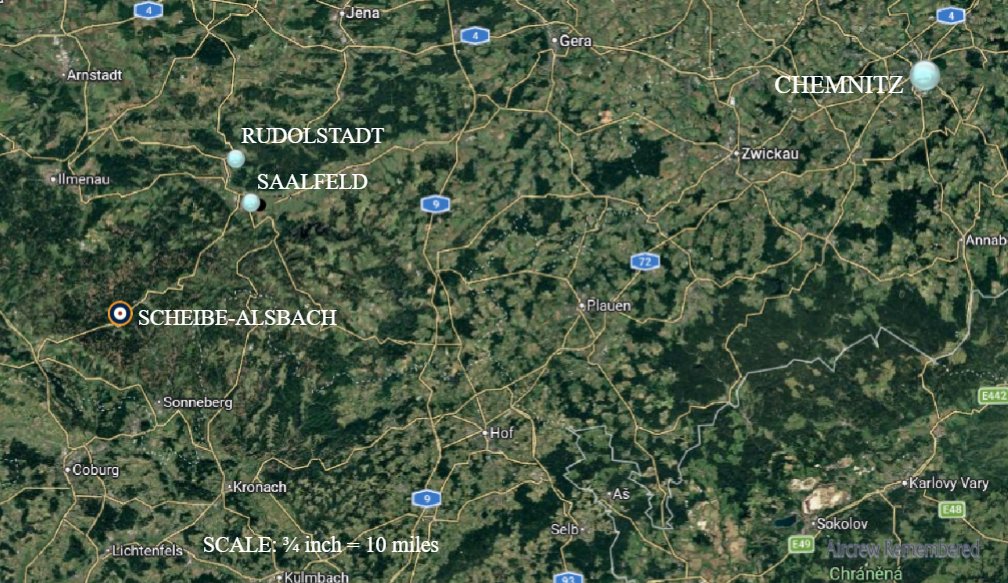
Three of the crew miraculously survived and it is to the Liberation Questionnaires completed by each of them that we turn in order to discover more of the situation during and following the attack. The statements necessarily relate to their personal recollection of events and should be treated for what they are. However, the over-riding facts common to all their statements would seem to be that following the initial catastrophic attack an explosion occurred that blew off the nose section of the Halifax. At the time of the explosion pilot Vernon Roy, flight engineer Mike Mayer, navigator Mick Williams, air bomber Andrew Morrison and wireless operator Alden Scorah were in the nose section. Mayer and Williams were blown out in the explosion but were able to deploy their parachutes and land comparatively unharmed. Williams, in his statement contends that Morrison landed in the nose section alive and able to walk with the aid of a stick. Morrison does not say in his statement what happened to himself except that he suffered a wrenched back and leg and spent a week in hospital.
Morrison and Williams both reported having been captured 'near Weimar on 15 February'. Mayer however, managed to evade until 16 February before he was 'captured 100 miles NE of Frankfurt'
The bodies of Pilot Vernon Roy and the two air gunners Cy Cybulskie and Harold Gallagher were recovered from the wreckage. According to air bomber Andrew Morrison, Gallagher was believed to have been killed by machine gun fire from the night fighter, this would seem logical given that Harold in the rear turret faced the initial onslaught as Bunje attacked from behind. By sad coincidence, the two air gunners had died together on St Valentine's day 1945, precisely one year after they first met at Bombing and Gunnery School.
Alden Scorah was found in the nose section alive but badly burned.
Andrew Morrison stated that 'W/Op Sgt. Scorah A.N. RCAF was put on rear of truck, on a stretcher, next to myself. It was dark and I could not see him, but I could hear him talking deliriously. Reported by Germans [later] to be in hospital with severe burns.' Mick William also stated 'Scorah reported to be in hospital condition bad.'
Mike Mayer, who had reported that he was not captured until 16 February 1945, stated that 'I heard the voice of the W/Op Sgt. Scorah when held in a prison, he sounded delirious. I was told that he would be taken to hospital but was not allowed to see him.'
The importance of Mayer's recollection of events that occurred at least two days after the crash will become clear later.
Mike Mayer, Andrew Morrison and Mick Williams were first sent to the interrogation centre, Dulag Luft at Oberursel near Frankfurt where Morrison was also hospitalised for a week before being moved to Stalag 3a Luckenwalde and later Stalag 7a at Mooseburg. They were all liberated on 29 April 1945 and eventually repatriated to Canada.
POST WAR INVESTIGATIONS BY MISSING RESEARCH AND ENQUIRY UNIT
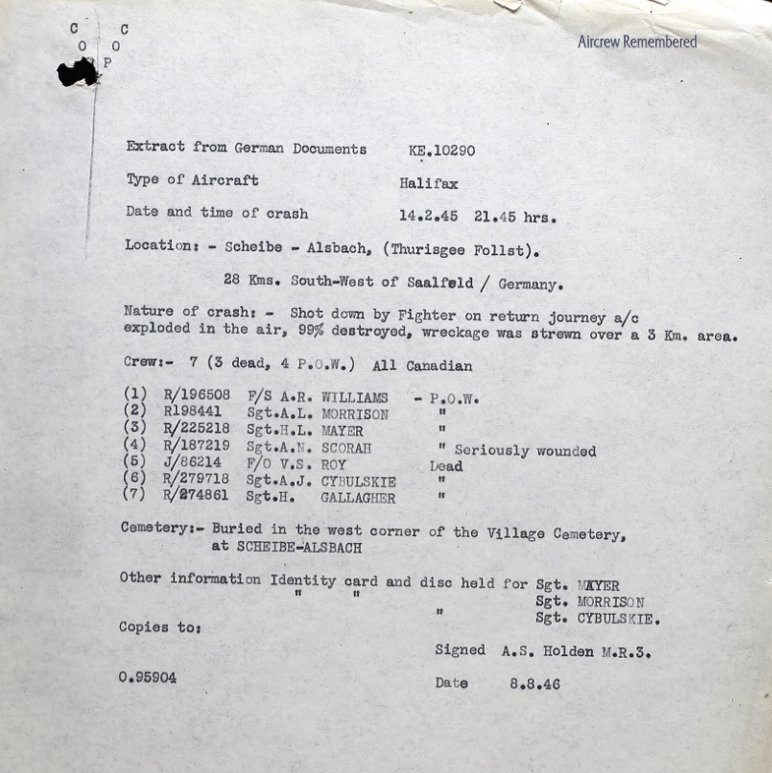
On 6 September 1946, in response to ongoing requests from next of kin and based on the information contained in the above document the RCAF requested that 'an investigation be made to locate the burial place of F/S Scorah and to have the graves located and registered for F/O. Roy and F/Sgts. Cybulskie and Gallagher.'
On 24 November 1947 the results of an Investigation and Findings of the Berlin Detachment No. 4 MR and EU were as follows:
'An interim report on CE1231 is submitted as information has now been received giving the whereabouts of the grave of F/Sgt. Scorah.
Documents produced by the German Grave Service, Berlin show that an airman is buried in Rudolstadt M51/J54 Thuringen under the following inscription: Arl Scorah Fliegersergeant Canada 20/2/1945
Rudolstadt Cemetery Sec. IIIc.
Obviously as Rudolstadt is quite near Scheibe-Alsbach, the place of the crash, this must be the grave of F/Sgt. A.N. Scorah Wop/AG, Can R.187219
The date of death 20/2/1945, 5 days after the crash, fits quite well with the story of Sgt Mayer who heard F/Sgt. Scorah's voice when they were taken to prison, F/Sgt. Scorah must have died of his wounds in the hospital at Rudolstadt a few days after this incident.
As soon as the Russian authorities permit, both Scheibe-Alsbach and Rudolstadt will be visited and this crew concentrated at Heerstrasse Cemetery.'
It was 1950 before the Russian authorities permitted access to the four graves and on 27 June 1950 the remains of the four airmen were re-interred at the Berlin 1939-1945 War Cemetery. Details of the grave references can be found in the Burial Details Section below.
The temporary grave markers pictured below were placed on the respective graves pending permanent headstones being made and fixed.
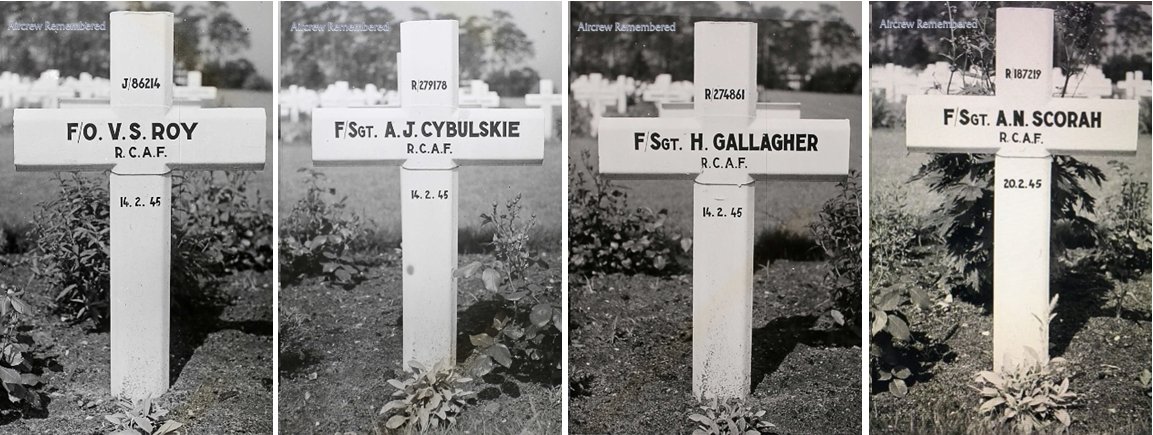
These temporary markers were replaced between 1955 and 1957 by permanent traditional upright steles carved from British Portland stone, maintained by the Commonwealth War Graves Commission.
DISCREPANCY REGARDING THE DATE OF DEATH OF ALDEN NORMAN SCORAH
The following is a summary of events leading up to the remains of the four airmen being transferred to the Berlin 1939-1945 War Cemetery in 1950.
On 5 December 1945 and with no further information forthcoming Alden Scorah was presumed to have lost his life on the day of the crash of MZ422, 14 February 1945.
With the loss of MZ422 having taken place within the post war Russian Sector it had been impossible to obtain any details of his place of burial and indeed those of his crew mates, Vernon Roy, Harold Gallagher or Cy Cybulskie, until August 1946 when burial details for these latter three became known via German documents (an image of extracts from the German documents appears earlier in the text).
However, it was to be November 1947 before similar details for Alden Scorah became known following investigations by the Missing Research and Enquiry Service in Berlin.
The German Grave Service provided documents showing that Scorah was buried in Rudolstadt Cemetery SecIIIc, Thuringen under the inscription 'Arl Scorah Fliegersergeant Canada 20/2/1945.' As Rudolstadt is quite near Scheibe-Alsbach where MX422 crashed it was concluded that this must be the grave of F/Sgt. A. N. Scorah Wop/AG Can R.187219, but with access to the graves still not permitted by Russian authorities nothing further could be ascertained.
Permission to access all four graves was finally granted by the Russians in 1950 when the remains of the four airmen were exhumed and re-interred at the British Military Cemetery in Berlin Heerstrasse. The following Final Graves Registration Report Form was produced by the Missing Research and Enquiry Service which details 20 February 1945 as the date of death for Alden Scorah.
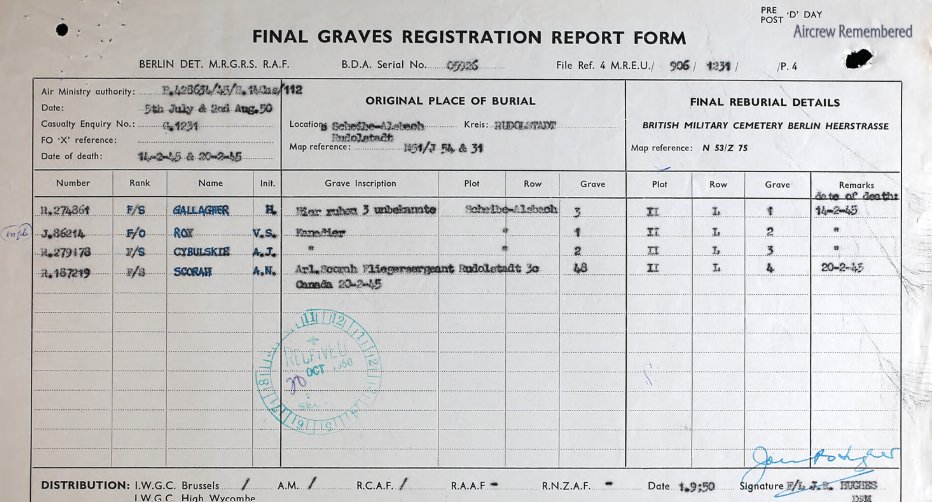
However when the temporary markers were replaced by the permanent traditional Portland stone headstones between 1955 and 1957, Alden Scorah's date of death had been changed to 14 February 1945.
In 2021 during the compilation of the Archive Report for Lancaster ME789 of 106 Sqn captained by FO Gorden Stanley Mather Jack Albrecht queried the discrepancy with the Commonwealth Graves Commission. They confirmed that the date of death was in fact 14 February 1945, the date on the temporary grave marker being the date of burial but offered no evidence or explanation as to how they had arrived at this conclusion.
The following would seem to be relevant
1. If Scorah died on 14 February 1945 why did he remain unburied for an inordinately long 6 days until 20 February the date of burial as quoted by the Commonwealth Graves Commission?
2. Morrison states that he was captured on 15 February and was transported by truck along with Scorah. He states that 'W/Op Sgt. Scorah A.N. RCAF was put on rear of truck, on a stretcher, next to myself. It was dark and I could not see him, but I could hear him talking deliriously. Reported by Germans [later] to be in hospital with severe burns.'
And as stated earlier, Mike Mayer, who had reported that he was not captured until 16 February 1945, 'I heard the voice of the W/Op Sgt. Scorah when held in a prison, he sounded delirious. I was told that he would be taken to hospital but was not allowed to see him.'
The statements given by both Morrison and Mayer confirm that Scorah could not have died on 14 February 1945 but at least 2 days later.
3. Rudolstadt is located about 32 miles north east of the crash site at Scheibe-Alsbach. The only reason for burying Alden Scorah at Rudolstadt must be that he had died there thus indicating that he had been taken to Thüringer Landeskrankenhau, the hospital at Rudolstadt, a journey today of one hour in modern times but in 1945 much longer, the route being through the steep, winding, and mountainous terrain of the Thuringian Forest and the Schwarza Valley in a vehicle of much lower speeds and inferior performance.
4. Considering all the evidence Alden Norman Scorah clearly lived beyond the 14 February 1945 and thus indicating a date of death of 20 February 1945 or at best a day or two earlier if the 20 February 1945 is accepted as his burial date rather than date of death.
5. One can only conclude that, since a precise date of death was not known, the Commonwealth Graves Commission chose 14 February 1945 as a safe option and a neat fit with the dates of death of the other three crew members.
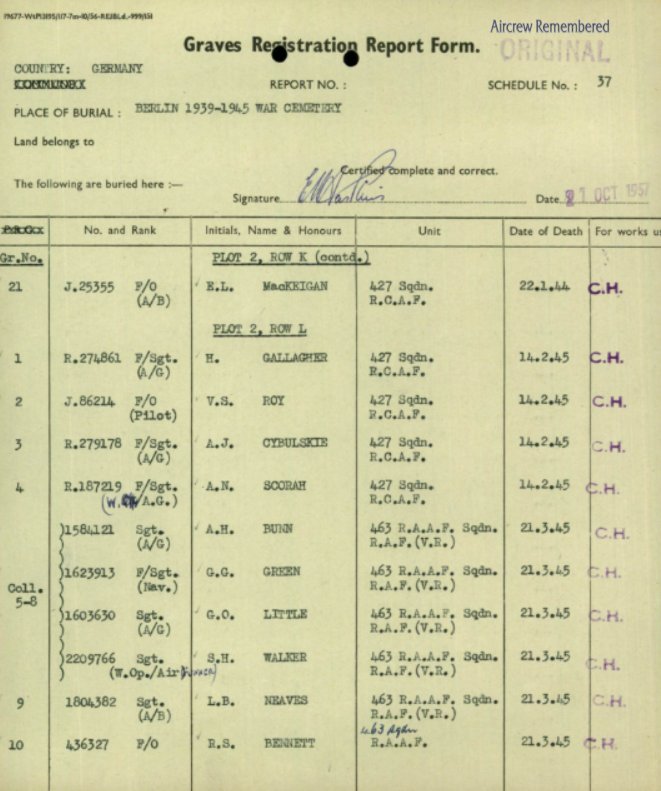
BIOGRAPHICAL DETAILS OF THE CREW
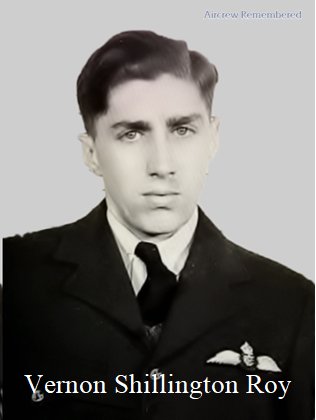
(1) F/O. Vernon Shillington Roy was born on 25 February 1918 at Ottawa, Ontario, Canada the son of Arthur Vernon Roy, a Signal Maintainer for the Canadian National Railway Co and Laura Rider Roy née Ellacott. His mother died in 1920 and in 1926 his father married Olive Mathilda Boyd. Vernon Roy is not believed to have had any siblings and he lived with his parents in Napanee, Ontario where he attended the Napanee Public School 1926-1933) and the Napanee Collegiate Institute (1933-1938). After leaving school he was employed as a Sheet Metal Worker from 1939 to 1941 during which time he took evening classes at Kingston Collegiate Institute studying and a correspondence course with Utilities Engineering Institute in Air Conditioning. He played piano by ear and played baseball, basketball, tennis and hockey all moderately.
When he enlisted at Ottawa on 4 April 1941 he was 5' 8" tall and weighing 123 lbs with blue eyes, dark brown hair and a medium complexion.
He initially trained for Ground Duties as a Radio Mechanic at the University of Toronto but in November 1941 volunteered for aircrew and was subsequently posted to 1 Initial Training School at RCAF Toronto, Ontario on 16 February 1942.
After training 20 Elementary Flying Training School at RCAF Oshawa, Ontario and 16 Service Flying Training School at RCAF Hagersville Ontario he was awarded his Flying Badge and promoted to Sergeant on 6 November 1942.
Following 14 days embarkation leave he was posted to 1 Y Depot, Halifax, Nova Scotia and on 11 December embarked for the UK where he arrived on 18 December. The following day he was posted to 3 Personnel Reception Centre at Bournemouth and on 16 February 1943 was posted to 3 (Pilot) Advanced Flying Unit at RAF South Cerney near Cirencester in Gloucestershire for training on the Airspeed Oxford twin engine trainer.
He was posted to 50 Group Pool on 3 March 1943 attached to 3 Empire Air Training Scheme (EATS) from 19 May 1943 to 26 January 1944 during which time he was promoted to WO2 on 6 October 1943. He was again attached to 3 EATS from 22 February to 9 May 1944 and commissioned as a Pilot Officer on 27 April 1944.
He joined Course 89 at 14 (Pilot) Advanced Flying Unit at RAF Banff and RAF Fraserburgh Aberdeenshire, Scotland from 9 May to 1 August 1944.
He was next posted to 82 Operational Training Unit at RAF Ossington in Nottinghamshire where he joined Course 28 from 1 August to 15 October. Attached to Aircrew School at RAF Dalton North Riding of Yorkshire from 25 October to 24 November he was then posted to 1666 Conversion Unit at RAF Wombleton and on 4 December to 1664 Conversion Unit at RAF Dishforth, these two stations also located in the North Riding.
On 31 January 1945 he was posted to 427 Squadron at RAF Leeming in the North Riding.
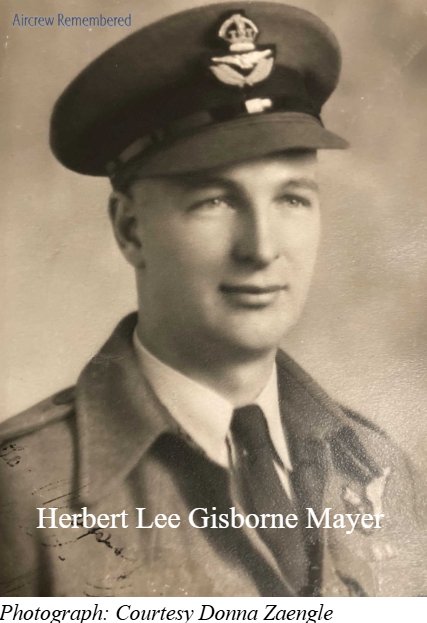
(2) Sgt. Herbert Lee Gisborne (Mike) Mayer was born on 9 February 1918 at Alberni, British Columbia, Canada the son of Herbert Edward Mayer (a Clerk) and Kate Isabel Mayer née Guillod. He had 2 siblings: Kathleen Mary Ruth Mayer (1914-2010) and Harry Edward Mayer (1921-1943)*
The family lived at 129 River Road, Alberni and later at 2180 Pentland Road, Victoria, British Columbia
Mike Mayer was educated in Australia and in 1936, aged 18, sailed from Brisbane for England on board the SS Mongolia arriving at Tilbury on 26 June 1936. His proposed address in England was c/o Wychwood, Nightingale Road, East Horsley and his occupation was stated as a Mechanic.
In 1939 he was living at 61 Shernall Street Walthamstow, London and was employed as an Insurance Agent.
Following the outbreak of war Mike enlisted in the army in London on 20 October 1939 and in 1940 as a driver in the RASC he was one of the servicemen evacuated from Dunkirk. He later applied for transfer to the RAF for flying duties but since such transfers had been suspended he was advised to apply to the RCAF. He was successful and after enlisting on 22 September 1942 returned to Canada where he spent a year training as a Flight Engineer before returning to the UK.
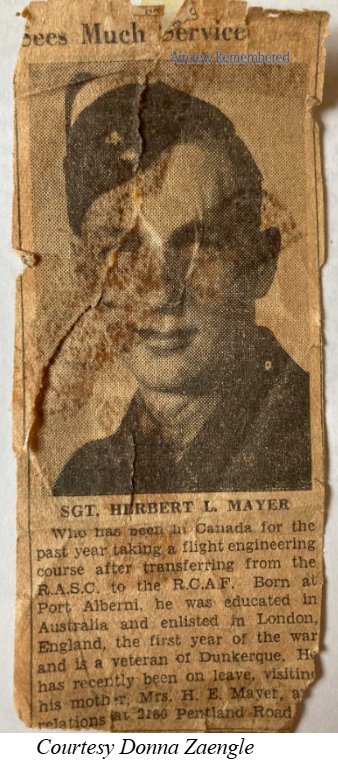
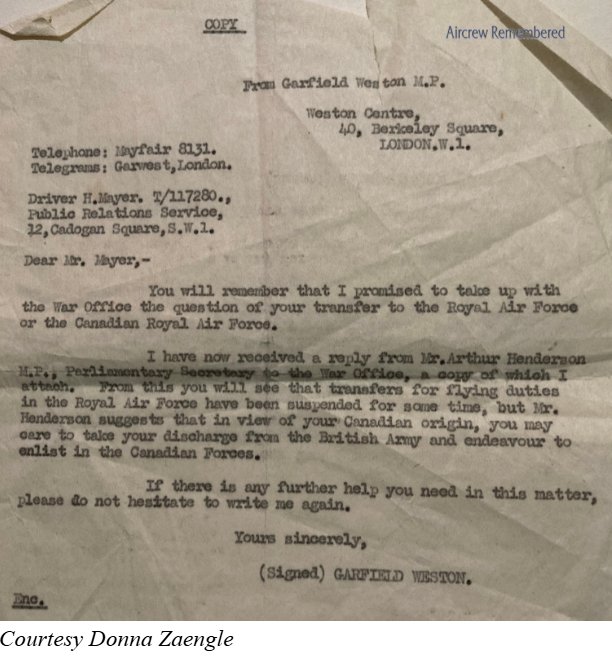
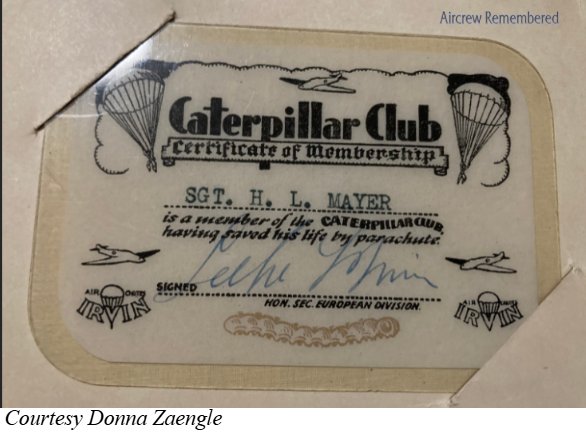
Mike's father, Herbert Edward Mayer, died on 15 May 1944 at Parksville, British Columbia and later that year on 28 October Mike married Pamela Patricia Taunton (1924-2009) at Kensington, London, England.
In October 1944 he also joined the crew of F/O. Roy at 1666 Conversion Unit at RAF Wombleton in the North Riding of Yorkshire.
After the war Mike Mayer and his wife Pamela lived at 113 Coleherne Court London SW5 and Mike was employed as a Salesman. A son, Harry Frederick Gisborne Mayer, was born in 1947 and later that year Mike, Pamela and baby son Harry, sailed for Canada on the SS Aquitania.
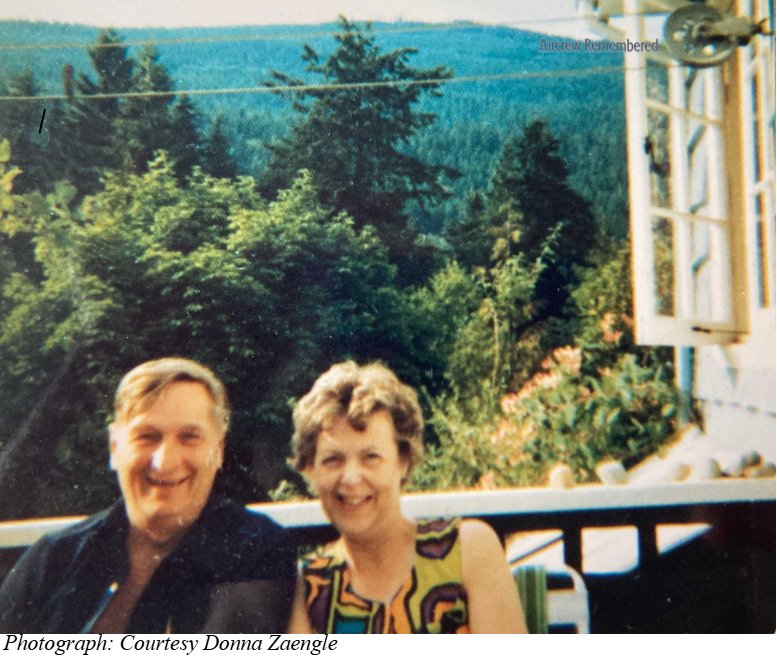
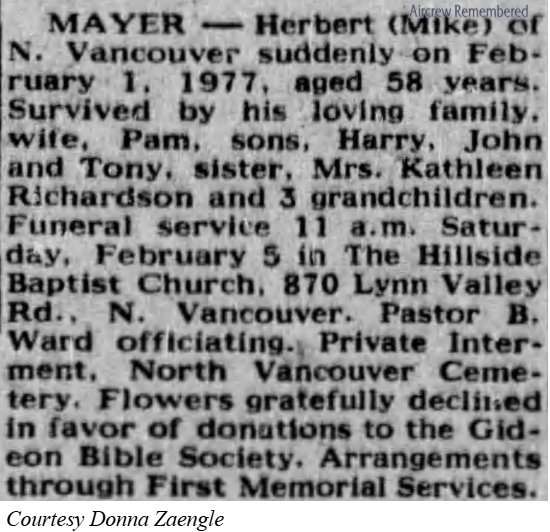
Herbert Lee Gisborne Mayer died suddenly at Vancouver, British Columbia on 1 February 1977 aged 58. His funeral service was held at the Hillside Baptist Church in North Vancouver on 5 February 1977 and he was later interred at North Vancouver Cemetery.
*WO1 Pilot Harry Edward Mayer (R/92088) aged 22 of 424 Squadron RCAF was missing believed killed with all his crew when their Wellington HE272 failed to return from a raid on Messina on 29 June 1943. Having no known grave is commemorated on the Malta Memorial Panel 10 Column 2.
(3) Albin Robert (Mick) Williams was born on 18 January 1920 at Ballarat, Victoria, Australia the son of Robert Baird Williams (a Bricklayer) and Ethel Williams née Mullins.
He had 4 siblings: Ethel Doreen Williams 1921–2001, Myrtle Joan Williams 1922–2018, Sydney Jack Williams born c.1925 and Evelyn May Williams 1930–2015.
In 1924 the family emigrated to England and lived at 49 Hatherley Road, reading, Berkshire. On 17 March 1928 they emigrated to Canada arriving at St John's, Newfoundland on 26 March. Robert Williams now stated his occupation as a Farmer. They later settled on a farm at Colleston, Saskatchewan.
Mick joined the RCAF in 1942
Following his repatriation to Canada he married Elsie Mae Gill (1923-2012) on 23 July 1945. They later had two children: Brian Williams and Marian Williams.
He worked for the Solicitor General's Department (Penitentiary) Service for 27 years, first at Prince Albert, Saskatchewan and then in Drumheller, Alberta. Whilst at Prince Albert he was the Adjutant of Air Cadets No. 38 Squadron for many years.
In 1984 he retired and with Elsie moved to Calgary where they belonged to Southwood Seniors.
In 1995 Mick made his first and last trip back to his birthplace in Australia and it was not long after this that ill health began to afflict him.
Albin Robert (Mick) Williams died at home on 26 September 2004 aged 84.
A Memorial Service was held at Parkdale United Church, Calgary on 30 September 2004.
He was buried at Eden Brook Memorial Gardens, Calgary, Calgary Census Division, Alberta, Canada
(4) Sgt. Andrew Lawrie Morrison was born on 1 October 1924 at Toronto, Ontario Canada, the son of James William Morrison and Janet Watson Banks Morrison née Lawrie. He had 4 siblings: Mary Anne Morrison (1914–2004), James Lawrie Morrison born 1916, Margaret Morrison born 1920, Robert Lawrie Morrison (1935–2005).
On 6 April 1946 he married Bertha May Coupland with whom he later had two children, Donald Andrew Morrison born 1948 and Richard Morrison.
He died on 14 August 2010 aged 85 at Scarborough, Ontario of pneumonia following a major ischemic stroke.
He was cremated and his remains were interred at Saint Margaret's in the Pines Cemetery, Scarborough, Toronto, Ontario.
A celebration of his life was held at the Olde Stone Cottage Pub & Patio in Scarborough at on Saturday 28 August 2010
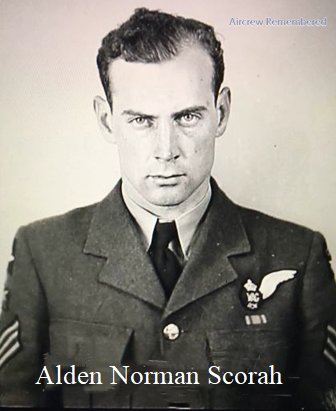
(5) F/Sgt. Alden Norman Scorah was born on 22 November 1922 at Clive, Alberta the son of American parents, Lewis De Lisle Scorah (a Farmer) and Hazel Scorah née Hyslop. He had four siblings: Velma Virginia Scorah (1915-1992), Glen De Lisle Scorah born c. 1916, Ruby Mae Scorah (1919-1977) and Harland George Scorah born c. 1923.
Alden attended Sargent School School from 1928 to 1938 and Clive School from 1938 to 1940. After leaving school he worked mainly as a farm labourer and played Baseball and Hockey.
When he enlisted at Edmonton Alberta on 28 September 1942 he was 5'6½" tall weighing 138 lbs with blue grey eyes, brown hair and a medium complexion.
He was required to attend the Pre-Aircrew Education at Seaview School Vancouver which he passed on 11 May 1943
After training at 3 Repair Depot at RCAF Vancouver, British Columbia during which time he attended Pre-Aircrew Education Department and received a pass on 11 May 1943 he went on to train at 7 Initial Training School at RCAF Saskatoon, Saskatchewan, 3 Wireless School at RCAF Winnipeg, Manitoba, 5 Bombing and Gunnery School at RCAF Dafoe, Saskatchewan he was awarded his Air Gunner Badge and promoted to Sergeant on 10 April 1944.
On 26 April 1944 he was married to Jean Marie Hutton by RCAF Padre Rev. H. C. Smith (UC) at Regina Saskatchewan
His wife was W314939 AW1 Scorah J.M. 5 B & G School at RCAF Dafoe.
He embarked for the UK on 25 May 1944 and the day after arrival, 3 June 1944, was posted to 3 Personnel and Reception Centre at Bournemouth. On 13 June he was posted to 3 (Observer) Advanced Flying Unit at RAF Halfpenny Green in Staffordshire and to 82 Operational Training Unit at RAF Ossington in Nottinghamshire where he joined Course 28 from 1 August to 15 October. Attached to Aircrew School at RAF Dalton North Riding of Yorkshire from 25 October to 24 November he was then posted to 1666 Conversion Unit at RAF Wombleton and on 4 December to 1664 Conversion Unit at RAF Dishforth, these two stations also located in the North Riding.
On 10 January he was promoted to Flight Sergeant and on 31 January 1945 he was posted to 427 Squadron at RAF Leeming in the North Riding.
His father died aged 60 on 14 January 1945 just over a month before Alden also lost his life.
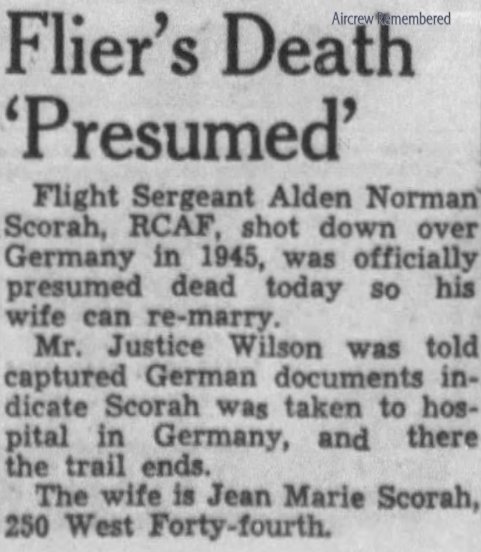
Presumption of death on 14 Feb 1945 notified to Mrs L D Scorah in letter of 19 December 1945
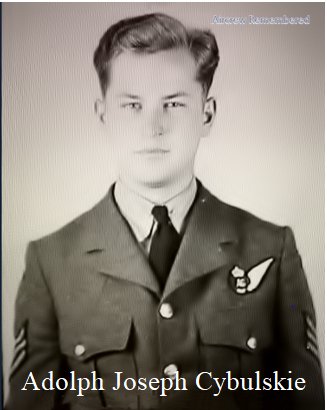
(6) F/Sgt. Adolph Joseph Cybulskie was born on 14 April 1925 at Wilno Ontario the son of a Blacksmith, Victor Cybulskie and Roseann Rosalie Agnes Cybulskie née Prince. He had 5 siblings: Benedict Adam Cybulskie (1920–1980), Rita M Cybulskie (1923-1998), Doris Ann Cybulskie (1927-2015)Lawrence Michael Cybulski (1928-2015) and Adam Dominic Cybulski (1934–1934).
He was educated at Wilno Separate School (1932 -1938) and Wilno Public School (1938-1940).
After leaving School he was employed in the Post Office of Alex P. Prince in Wilno until 1941 when he became employed in Shoe Making at Goodrich Rubber in Kitchener, Ontario until 1942 when he left to work in the bottling room of Carlings Brewery at Waterloo, Ontario.
He played softball and hockey moderately.
When he enlisted at Kitchener on 23 October 1943 he was 5'10" tall weighing 167 lbs with grey eyes, brown hair and a fair complexion.
He was required to attend Pre Aircrew Education from 20 December 1943 to 30 January 1944 Montreal prior to commencing aircrew training with the RCAF.
After a posting to RCAF Mountain View, Ontario he commenced training at 10 Bombing and Gunnery School at RCAF Mount Pleasant, Prince Edward Island he was awarded his Air Gunner Badge and promoted to Sergeant on 5 May 1944.
He was posted to 3 Air Gunner Training School at RCAF Three Rivers Manitoba on 20 May until 18 June when he was posted to 1Y Depot at Halifax, Nova Scotia, to await embarkation to the UK
He duly embarked on 25 June arriving in the UK on 3 July and was posted to 3 Personnel and Reception Centre at Bournemouth the following day.
He was next posted to 82 Operational Training Unit at RAF Ossington in Nottinghamshire where he joined Course 28 from 1 August to 15 October. Attached to Aircrew School at RAF Dalton North Riding of Yorkshire from 25 October to 24 November he was then posted to 1666 Conversion Unit at RAF Wombleton and on 4 December to 1664 Conversion Unit at RAF Dishforth, these two stations also located in the North Riding.
On 31 January 1945 he was posted to 427 Squadron at RAF Leeming in the North Riding.
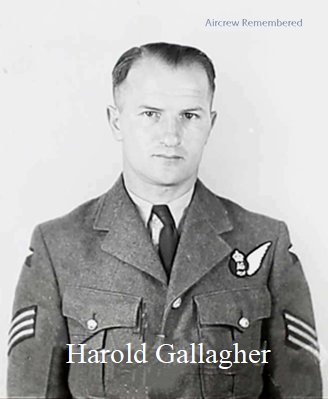
(7) F/Sgt. Harold Gallagher was born on 14 September 1913 at Brockville, Ontario, Canada the son of Painter and Decorator William Henry Gallagher and Mary Gallagher née McCaffery
He was educated at St Francis Xavier School Brockville (1918-1925) and Brockville Collegiate Institute (1925-1929). After leaving school he worked as a Bookkeeper at Brewery Warehouse in Brockville. His sporting interests were softball, bowling, skating and swimming
Siblings: Alice Marguerite Gallagher (1909 -1996), Gerald Gallgher born 1911, Edgar Gallagher born 1916, Charles Gallagher, Eva Gallagher born 1921
On 3 June 1935 he married Mrs Eleanor Grace Hewitt and later lived at 10 Apple Street Brockville. They went on to have 2 children: Harold Garry Gallagher born 23 December 1935 and William Gerald Gallagher born 19 August 1937
When Harold Gallagher enlisted on 25 October 1943 at Kingston Ontario he was 5'6" weighing 120 lbs with brown eyes, dark brown hair and a medium complexion. He was required to attend Pre Aircrew Education from 6 December 1943 to 12 January 1944 at Kingston Ontario prior to commencing aircrew training with the RCAF.
After a posting to 8 Manning Depot at RCAF Trenton from 14 January 1944 he commenced training at 10 Bombing and Gunnery School at RCAF Mount Pleasant, Prince Edward Island on 12 February and on 5 May 1944 was awarded his Air Gunner Badge and promoted to Sergeant.
He was then posted to 3 Air Gunner Training School at RCAF Three Rivers Manitoba on 20 May until 18 June when he was posted to 1Y Depot at Halifax, Nova Scotia, to await embarkation to the UK
He duly embarked on 25 June arriving in the UK on 3 July and was posted to 3 Personnel and Reception Centre at Bournemouth the following day.
He was later posted to 82 Operational Training Unit at RAF Ossington in Nottinghamshire where he joined Course 28 from 1 August to 15 October. Attached to Aircrew School at RAF Dalton North Riding of Yorkshire from 25 October to 24 November he was then posted to 1666 Conversion Unit at RAF Wombleton and on 4 December to 1664 Conversion Unit at RAF Dishforth, these two stations also located in the North Riding.
On 31 January 1945 he was posted to 427 Squadron at RAF Leeming in the North Riding.
(8) Lt. Helmut Bunje of 4./NJG6, a Luftwaffe nightfighter ‘ace’ survived the war with 11 victories. Born 5 November 1921 in Bremen the son of Alfred Heinrich Bunje and Adeline Wilhelmine Bunje née Brandhorst. He had one sibling: Reinhard Bunje Maler (1928-2009). Helmut Bunje died 6 July 2000 at Hamburg aged 78. (Details courtesy Ancestry)
BURIAL DETAILS, MEMORIALS AND EPITAPHS
(1) F/O. Vernon Shillington Roy was originally buried at Scheibe-Alsbach and reinterred in the Berlin 1939-1945 War Cemetery - Grave 2.L.2 on 27 June 1950.
His epitaph reads:
Greater love
Hath no man than this,
That a man lay down
His life for his friends
(5) F/Sgt. Alden Norman Scorah was originally buried at Rudelstadt and reinterred in the Berlin 1939-1945 War Cemetery - Grave 2.L.4 on 27 June 1950.
No epitaph
(6) Sgt. Adolph Joseph Cybulski was originally buried at Scheibe-Alsbach and reinterred in the Berlin 1939-1945 War Cemetery - Grave 2.L.3 on 27 June 1950.
His epitaph reads:
Eternal rest
Grant unto him, O Lard,
And let perpetual light
Shine upon him
(7) Sgt. Harold Gallagher was originally buried at Scheibe-Alsbach and reinterred in the Berlin 1939-1945 War Cemetery - Grave 2.L.1 on 27 June 1950.
No epitaph
Researched by Aircrew Remembered researcher Roy Wilcock for all the relatives and friends of the members of this crew - October 2026


