
- Home
- Maps▾
- FAQ▾
- About/Donate▾
- News▾
- Obits
- Contact/Help▾
- PersonalHistories▾
- Cross Reference Research Lists ▶
- Recent Archive Reports
- Profiles in Courage
- 1914 -1918 WW1 Material
- Royal Air Force + RAFVR ▶
- WAAF/WRAF
- Australia
- Belgium
- Canada
- Site honouring Czechoslovak RAF
- Holland: LOST Rob Philips Memorial Archive
- New Zealand
- Norway, Denmark, Sweden, Finland
- Poland
- South Africa
- Archiwum Mielnika: Polish Air Force Archive
- USAAF & USAF
- USA WASP Flygirls
- USA - Co de Swart Gallery: Baker Crew 95th BG
- USA - Co de Swart Gallery: Geyer Crew 98th BG
- Axis Powers
- Russia/Soviet Union
- RCAF 409 The Nighthawks
- Hore-Kennard RCAF
- Zenon Bartkowiak PAF
- Charles Dills USAAC
- Gerald Schwartz USAAC
- Ralph Malan Memoirs
- Soviet Women 'Night Witches'
- Full Story of Lancaster Z-Zebra
- First Air Raid Victim
- 1914 -1918 WW1 Material
- Databases▾
- Databases Master List
- Consolidated Names: includes 500K+ names from all our databases
- Cross Reference Research Lists
- Research Sources
- MULTI-NATIONAL DATABASES
- Aces and Aviators International WW1 - 3000+
- Vitz Memorial Archive: War Crimes Victims of Axis
- USAAF & Allies Non Combat Incidents and Losses
- War Crimes Victims of the Japanese
- ALLIED DATABASES
- Allied Losses and Incidents: all Commands
- Aircrew Deaths & Resting Places Worldwide 1939 - 47 120,000+
- Alamein Allied Air Forces Memorial 3000+
- Allied Non-British Graves in Europe managed by CWGC
- Battle of Britain: Enhanced and Extended
- Glider Pilot Regiment Casualties
- Korean War UN Forces Database
- LOST Rob Philips Memorial Archive Dutch/2TAF Losses
- Malta Memorial Database
- Nordic Allied Database
- Ottawa Allied Air Forces Memorial Database
- Paradie-Dutil RCAF Archive
- Archiwum: Polish Air Force Archive
- Polish Honour Roll
- RAAF Honour Roll
- RCAF Notes - 9000+
- Royal Navy Fleet Air Arm
- Runnymede Memorial Database
- Soviet Aces Database 1941 - 1945
- US Aces and Aviators WW2
- US Air Service Victories WW1
- USAAF Allies NonCombat Losses
- USAAF Operations WWll
- US Marine Corps Squadrons WWll
- AXIS DATABASES
- Kracker Luftwaffe Archive
- Deutsches Kreuz in Gold
- German Graves in UK
- German WW2 Aces
- Luftwaffe Graves Managed by CWGC
- Luftwaffe Victories by Name/Date
- Archives ▾
- Archiwum: Polish Air Force Archive: Data on 17,000
- Kracker Luftwaffe Archive
- LOST Rob Philips Memorial Archive: Holland
- Paradie-Dutil RCAF Archive
- Paul McGuiness RAAF Archive WW1 & WW2
- Profiles in Courage
- Vitz Memorial Archive: War Crimes Victims of Axis
- USAAF Combat Operations 1941-45 Worldwide
- 409 RCAF: The Nighthawks
- Detailed Personal Archive RCAF Officer
- Charles Dills Archive
- Gerald Schwartz Archive
- Ralph Malan Memoirs
- RAF Coastal Command Patrol Areas
- US Intelligence Analysis German Anti Aircraft
- Allied Mine Laying Map (Gardening)
- Airborne Forces - a short history
- More ▾
- de Swart Gallery: Baker Crew, Geyer Crew
- Guide to Complete Site
- Helpdesk
- Donate
- Lay a Wreath
- Your relative's CWGC grave explained
- CWGC War Graves in USA
- Doing Your Own Research
- Research Sources
- US Assistance to Warsaw Uprising
- Our support for charities
- Axis Awards Descriptions
- Stolperstein: Permanent Remembrance
- Who fought for Britain 1939 - 1945
- Aerotoxic Syndrome
- Bermuda Triangle Mystery
- Cross Reference Research Lists
- Not Many People Know That
- Image Acknowledgements
- Abbreviations Used by Forces
- Poetry of Direct Personal Experience
- Staggering Cost in Lives of WWll
- Animated Map All Allied Bombing WW2
- USAAF Combat Operations 1941-45 Worldwide
- Polish Airmen Fighting (Video)
- Important Links
- Canada Memorial Project
- Remembering Banica
- Book Reviews
- 1 BFTS Texas
- Veterans Appeals
- Korean Conflict
- Vietnam Conflict
- Other Conflicts
- Commercial Aviation
- Bush Flying
- Nose Art
- Military Humour
- Airborne Forces - a short history
-

RAF Battle of Britain Consolidated Database
3094+ Entries in Database
Search Tips •
DatabasesAll databases on site •
Names in databaseCheck spelling of names in the database •
Accredited SquadronsOnly members of these units eligible for Battle of Britain Clasp
Check the Databases Menu for the extensive list of our databases which represent decades of original research by our Editors
THIS DATABASE IS CURRENTLY UNDER DEVELOPMENT
Read Search Tips. Corrections and Additions via Helpdesk please
NOTE: KIA = Killed In Action. WIA = Wounded In Action. KIFA = Killed in Flying Accident. = Jewish as per jewishvirtuallibrary.orgFate In Battle is date of incident between July 10 1940 and October 31 1940. Fate After Battle is date of death after the Battle
3-character searches are now supported.
If you need help, EMAIL us with name and database to search and we will perform the search manually for you.
To search on squadron, append 'Sqn'. Examples: '72Sqn' or '416Sqn'
Read Search Tips. Corrections and Additions via Helpdesk please
NOTE: KIA = Killed In Action. WIA = Wounded In Action. KIFA = Killed in Flying Accident.
= Jewish as per jewishvirtuallibrary.orgFate In Battle is date of incident between July 10 1940 and October 31 1940. Fate After Battle is date of death after the Battle
The Battle of Britain clasp (worn on the 1939-45 Star – or a silver gilt rosette if medal ribbons only are worn) is restricted to aircrew from 71 defined units
of RAF Fighter Command, Coastal Command or the Fleet Air Arm, who flew at least one operational sortie between 00:01 July 10 1940 and 23:59 October 31 1940.
To see a larger database covering the entirety of WWll, refer to our Allied Losses and Incidents database. This database is the result of research into all known sources of information on the crews which fought the Battle of Britain on the Allied side. It is surprising that for the most significant air battle of WW2, and even after 80+ years, there remains any uncertainty at all about who took part and in some cases, what they did. We have made it our objective to develop this database into a most comprehensive and accurate record which brings to life those heroic deeds. You can help: send corrections and additional information via our Helpdesk.
We believe this database to be among the most useful records extant in terms of its searchability: for example, it is easy to determine all Blenheim crews, or losses on a specific date or the members of a particular squadron.
Readers are referred to the following sites which we have used to cross-check information and we acknowledge and thank them as respected sources for some of the material in this database:
VintageWings.ca: comprehensive listing of artworks
bbm.org: Comprehensive listing of RAF personnel and service records
Wikipedia: Life stories of leading pilots and crew
AircrewRemembered Paradie Canadian Archive Database: 45,000 Service Records of RCAF personnel
AircrewRemembered Allied Losses and Incidents Database: Covering 120,000+ Allied aircrew 1939 - 1945
AircrewRemembered Archiwum: specialist database with details of Polish personnel (in Polish)
AircrewRemembered Kracker Luftwaffe Archive: 31,000 Luftwaffe pilot and crew details
AircrewRemembered LOST: Rob Philips Memorial Archive: Dutch losses in Europe
bel-memorial.org: Comprehensive site on Belgian aircrew
of RAF Fighter Command, Coastal Command or the Fleet Air Arm, who flew at least one operational sortie between 00:01 July 10 1940 and 23:59 October 31 1940.
To see a larger database covering the entirety of WWll, refer to our Allied Losses and Incidents database. This database is the result of research into all known sources of information on the crews which fought the Battle of Britain on the Allied side. It is surprising that for the most significant air battle of WW2, and even after 80+ years, there remains any uncertainty at all about who took part and in some cases, what they did. We have made it our objective to develop this database into a most comprehensive and accurate record which brings to life those heroic deeds. You can help: send corrections and additional information via our Helpdesk.
We believe this database to be among the most useful records extant in terms of its searchability: for example, it is easy to determine all Blenheim crews, or losses on a specific date or the members of a particular squadron.
Readers are referred to the following sites which we have used to cross-check information and we acknowledge and thank them as respected sources for some of the material in this database:
VintageWings.ca: comprehensive listing of artworks
bbm.org: Comprehensive listing of RAF personnel and service records
Wikipedia: Life stories of leading pilots and crew
AircrewRemembered Paradie Canadian Archive Database: 45,000 Service Records of RCAF personnel
AircrewRemembered Allied Losses and Incidents Database: Covering 120,000+ Allied aircrew 1939 - 1945
AircrewRemembered Archiwum: specialist database with details of Polish personnel (in Polish)
AircrewRemembered Kracker Luftwaffe Archive: 31,000 Luftwaffe pilot and crew details
AircrewRemembered LOST: Rob Philips Memorial Archive: Dutch losses in Europe
bel-memorial.org: Comprehensive site on Belgian aircrew
3-character searches are now supported.
If you need help, EMAIL us with name and database to search and we will perform the search manually for you.
To search on squadron, append 'Sqn'. Examples: '72Sqn' or '416Sqn'
These are the results of your search:
You searched for: “"south african"”
| # | Name SORT (↑) | First Names | Rank | Service No. | Photo | Air Force | Country of Origin* | Squadrons | Awards | Aircraft | Victories | Fate in Battle | Fate After Battle | DateOfDeath | **************Notes************** |
|---|---|---|---|---|---|---|---|---|---|---|---|---|---|---|---|
| 1 | Hill | Michael Rowland | Plt Off (later Sqd Ldr) | 72467 |  | RAFVR | South African | 266Sqn Spitfire | KIA | 1945-03-12 | Runnymede |
| |||
| 2 | Weber | Jack | Sgt | 115547 754595 | RAFVR | South African | 1Sqn | Hurricane | WIA Died | 1988-05-05 | Son of Joseph Weber of 521 Finchley Rd., NW3. Born in Hove on October 12, 1917. from a family of shoe manufacturer, Weber & Phillips Footwear based in Tottenham. Joined RAFVR in July 1939. Sgt. Pilot/Flt. Lt. with 1 Sqd and 145 Sqd. Fighting from Tangmere throughout the Battle, he was shot down in his Hurricane by a Bf 109 in the afternoon 6 November 1940 - but survived - over the Isle of Wight. Commissioned in 1942 he was Mentioned in Despatches whilst fighting in the Middle East. Whilst protecting Kittyhawk bombers on July 15th he was shot down and again wounded. He died in Brockenhurst, Hampshire on 5 May 1988 aged 70. |
||||
| 3 | Watkinson | Arthur Basil | Plt Off | South African | 66Sqn | Spitfire | WIA | Died | Wounded 28 September 1940. Baled out of damaged Spitfire I (X4322) after combat over Mayfield in Sussex. | ||||||
| 4 | Wallace | Thomas Young | Sgt (later Sqd Ldr) | 149635 |  | South African | 610Sqn 111Sqn  | DFM | Hurricane | WIA | KIA | Wounded 7 September 1940 at 18:30hrs. Baled out Hurricane I (P3025) near Ashford in Kent after combat with Bf 109s. Pihen les Guines War Cemetery France Age 28 | |||
| 5 | Van Mentz | Brian | F/Off (later Flt Lt) | 708926 (70826 ?) | 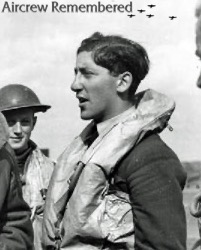 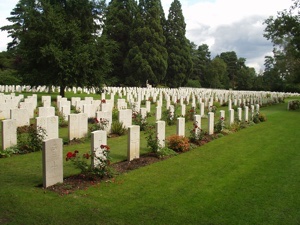 | RAF | South African | 222Sqn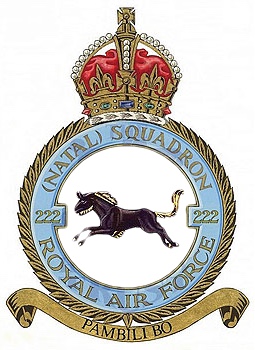 | DFC | Spitfire | 10 | KIA | 1941-04-26 | Son of Sidney and Rosine and nephew of Samuel Mence of Burghclere, Hants. (One report him as the son of Major van Mentz, adjudant of the Witwatersrand Rifles, killed in action in WW1) .Born in Johannesburg, South Africa in 1916. Commissioned in the South African RAF Reserve in 1937 and the RAF in 1938. Flying Officer with 222 Sqd. In France he shot down a Ju 88 on May 14 1940, Ju 87 and He 126 on 15 May, damaged two Bf109s on 16 May. From Hornchurch he shot down a Bf109 on 31 August 1940, a Bf 110 and damaged another on September 3 1940, a Bf109 and shared a Do 17 on September 7 1940, a Ju 88 and damaged a Bf 109 on 11 September 1940, damaged a Ju 88 on 15 September, shot down a Bf 109 on 23 September, and damaged a Bf110 on Oct 12 1940. DFC on 1940-10-25. Citation: 'This officer led his section with great skill and courage, and showed great determination in pressing home his attacks against large enemy formations. He has been engaged in flying operations against the enemy since the outbreak of war'. On October 30 1940 he damaged a Bf109 and on November 30 1940 shot down a Do 17. Decorated by the King at Bircham Newton on 1941-01-28 together with Stanford Tuck. On February 2 1941 he shot down a Ju 88 , damaged an He 111 and on March 18 1941 shared a Do 17. Having flown 75 sorties, he was killed on April 26 1941 aged 24 years when a bomb hit the Ferry Inn pub, Coltishall, not half an hour after Robert Tuck had left him to go to Norwich for a drive. He is buried at Brookwood cemetery, Woking, Grave 25.A.9 Age 24 Archive Report |
|
| 6 | Stapleton | Basil Gerald 'Stapme' | Plt Off | 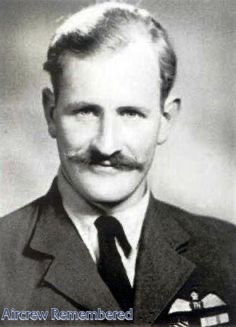 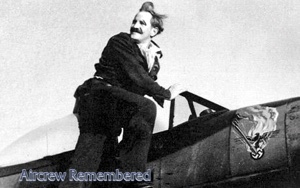 | South African | 603Sqn | DFC Vliegerkruis (Netherlands)  | Spitfire | 6 | Survived war | 13 April 2010 | Born on 12 May 1920 in Durban, South Africa. Educated in England, at King Edward VI School at Totnes, Devon. In January 1939 he signed up for a short service commission with the RAF. Short period on Blenheim night fighters, transferred to 603 (City of Edinburgh) Squadron at RAF Montrose, Scotland, in October 1939. On 16 October 1939, Stapleton's squadron intercepted the first German air raid on the British Isles, during which the first enemy aircraft over Britain were shot down. Stapleton shared two German bombers shot down in the estuary of the Firth of Forth. For the first period of the Battle of Britain, 603 Squadron remained in Scotland. On 27 August 1940, 603 were sent south to join 11 Group based at RAF Hornchurch in Essex. This was during the critical phase of the battle, when the fighter airfields were being attacked. Pilot attrition was high, as 603 found out the next day. Stapleton wrote: '603 Squadron arrived at Hornchurch from Scotland on 27 August and were embroiled in the action the very next day, losing three pilots killed. Pilot Officer Don Macdonald and Flight Lieutenant Laurie Cunningham died when we were bounced by 109s whilst still trying to gain a height advantage. Macdonald was on his first patrol and had only fifteen hours on Spitfires while Laurie Cunningham was experienced with over 160 hours. Neither knew what hit them. On our last patrol of the day we were bounced again and Pilot Officer Noel Benson was shot down. Almost certainly killed instantly by cannon fire, 'Broody' had over 160 hours on type. He had been so eager to get at the Germans but never had the chance. Experience didn't really count for much when you were bounced.' Stapleton left 603 Squadron in April 1941 and served in various units, including flying 'Hurricats' (Hurricane fighters converted as catapult-launched convoy escorts) with the Merchant Ship Fighter Unit, as a Flight Commander with 257 Squadron, and as an instructor at Central Gunnery School before taking over Command of No. 247 (China-British) Squadron, part of 124 Wing, 2nd Tactical Air Force, flying Typhoons from beachhead code B.6, northern France in August 1944. Initially the Squadron helped close the Falaise Gap but as the Allied forces moved inland, so they followed: from B.6 – Coulombs to B.68 (Amiens/Glisy), B.58 (Melsbroek) and B.78 (Eindhoven). 247 Squadron provided aerial support throughout the Arnhem campaign during Operation Market Garden. On 23 December 1944 Stapleton was forced to land behind enemy lines and became a prisoner of war. Luck finally ran out for me on 23 December 1944. As part of a force of 16 Typhoons from 247 and 137 Squadrons at Eindhoven, led by Wing Commander Kit North-Lewis, we were ordered to seek out 15-plus German tanks forcing their way into the American sector. The weather was awful and we were lucky to avoid collisions. Unable to locate the tanks we were ordered split into our individual squadrons and continue the armed reconnaissance. I spotted a train and led the attack. One of my rockets must have entered the firebox as there was a terrific explosion and my radiator was punctured as I flew through the debris. I tried to nurse my aircraft back at low level but simply ran out of height. I force-landed about 2 miles inside the German lines and was taken prisoner. I was initially taken to a rear echelon platoon HQ and from there, ironically by train, to the interrogation centre at Oberursel, near Frankfurt. I was then taken to Stalag Luft I, Barth, on the Baltic Coast where I remained until May 1945 when I was repatriated as part of Operation Exodus. | |||
| 7 | Smythe | Derek Myles Altamont | Fg Off | 79196 |   | South African | 98Sqn 264Sqn  223Sqn  515Sqn  | Defiant Wikipedia discussion of Defiant tactics | Survived war | December 1999 Sleaford England | DFC London Gazette 14 November 1944.
The original recommendation for the non-immediate award of the DFC. - by Acting Wing Commander Kenneth Frederick Mackie, DFC. & Bar, Officer Commanding, 223 Squadron - states:
‘Flight Lieutenant Smythe has now completed 160 operational sorties, totalling 334 operational hours during two operational tours of flying. In practice, this has been over one long operational tour, instead of two, as he has had no rest period since he started operational flying in November, 1940.
Between November, 1940 and December, 1943, Flight Lieutenant Smythe carried out 113 operational sorties on Defiant night fighters with Fighter Command in the United Kingdom, and in January of this year flew out to Italy, joining No. 223 Squadron as my own gunner on Baltimore aircraft on 20 January, 1944.
During the six months he has flown with me he had continual stomach trouble of varying intensity, but, in spite of this, he refused to go into hospital or to miss a single raid. He has flown with me as Leading Gunner of Squadron formations on 33 occasions and of Second boxes on seven, during a long period of strain and a change-over of Observer and W/Op. Air members of my crew.
He has been Gunnery Leader of this Squadron during this period and by his drive, sound knowledge and experience with Fighter Command, has commanded the respect of the other Gunners and had contributed to a marked degree towards their efficiency and high morale.
Although we have not encountered any enemy fighter opposition, as Leading Gunner he has directed me in evasive action against often severe Ack-Ack fire with such coolness and skill that no aircraft has been lost when he has been Leading. By his personal example and continuous strict supervision of the gunnery side of this Unit, he has been an inspiration and asset to all the aircrew.
Strongly recommended for the award of the Distinguished Flying Cross for determination and devotion to duty over a very long period of operational flying.’ The covering remarks by the Air Officer Commanding, No. 3 Wing, S.A.A.F., Lieutenant-Colonel O. Galgut, state: ‘Although Flight Lieutenant Smythe has only completed 47 sorties whilst with No. 223 Squadron, he previously completed 113 sorties in the United Kingdom. During his period of service with No. 223 Squadron he flew as Leading Gunner on 33 occasions. He showed keenness, enthusiasm and devotion to duty far beyond average and the award of the Distinguished Flying Cross is strongly recommended.’ Derek Myles Altamont Smythe was born on 26 June 1914 at Pretoria, Gauteng, South Africa, the son of John James Robert Smythe and Ethel Mary Sophy Grayson; he was the husband of Julia J. O’Sullivan whom he married in June 1935 at Battersea, London. Smythe joined the Royal Air Force Volunteer Reserve on a direct-entry commission as an Air Gunner on 20 April 1940 and carried out his gunnery training at No. 1 Air Armament School at Manby, completing the Air Gunner’s Course there on 12 June 1940. Having been graded a ‘proficient Air Gunner’ on Battles, Demon and Blenheim aircraft, Smythe was appointed Acting Pilot Officer and posted on 20 May 1940 to ‘B’ Flight of No. 98 Squadron, equipped with the single-engine Fairey Battle light bomber. His first operational flight took place that same day, when acting as rear gunner to Pilot Officer Shuttleworth flying out of Nantes Aerodrome. That afternoon he flew in Battle K9219 piloted by Sergeant Leslie Charles Allton, a pilot who died over Maidstone during the Battle of Britain, not through enemy action but most likely through oxygen failure - his Spitfire being seen to fall out of formation and enter a spiral dive. Smythe flew on six more occasions from the training establishment at Nantes, but the success of the German Blitzkrieg and rapid retreat of the British Army towards the beaches of Dunkirk led to the evacuation of the Squadron. On 1 June 1940 Smythe flew across the Channel and likely witnessed the stream of Royal Navy, Merchant Navy and ‘little ships’ craft engaged in Operation Dynamo; among those who would never return home were 75 men of No. 98 Squadron, R.A.F., who died when H.M.T. Lancastria was bombed and sunk off the French port of St. Nazaire by Ju. 88s of Kampfgeschwader 30 on the afternoon of 17 June 1940. Many of those who weren’t drowned within the holds when the ship went down were killed when ‘German aircraft began strafing survivors in the water and dropped flares into the floating oil’ (The Sinking of the “Lancastria”: Britain’s greatest maritime disaster and Churchill’s cover-up, refers). On 18 June 1940, Smythe was posted to No. 5 O.T.U. at Ashton Down. It was here that he received further trainning as an Air Gunner, firstly on Blenheims and latterly, from 30 June 1940 on the Boulton Paul Defiant interceptor aircraft. Known affectionately by its aircrew as ‘The Daffy’, the Defiant looked similar to a Hurricane and used the same Rolls Royce Merlin engine, but there the similarities ended. With an air speed more than 100 miles per hour slower than a Me. 109, and with no forward firing guns, rather a reliance upon an an electrically operated ‘ball turret’ located behind the pilot, it was exceptionally vulnerable in daylight to enemy fighters. Furthermore, the Defiant had a blind spot beneath the tail – from where enemy fighters could deliver the coup de grace. Such weaknesses had been made clear in February 1940 when the Commanding Officer of No. 264 Squadron flew a Defiant on combat manoeuvres against Robert Stanford Tuck in a Spitfire; it soon became clear that against experienced opposition, the Defiant could only defend itself by circling and keeping its speed up, its abilities suited only to performing bomber-destroyer duties (Raymond Bowyer, refers). Nevertheless, Smythe was posted to No. 264 Squadron at R.A.F. Duxford under the command of Squadron Leader Philip Hunter on 6 July 1940. He joined ‘B’ Flight on a sortie with Pilot Officer Hugh Percy on 13 July 1940, and flew an interception patrol in low cloud and heavy rain over Orford Ness two days later. On 19 July 1940, Percy and Smyth patrolled over Harwich; at about noon, just a few days after the commencement of the Battle of Britain, nine Defiants of No. 141 Squadron took off from Hawkinge on a routine patrol, most of them crewed by crewed by New Zealanders. Flying at 5,000 feet, they were ‘bounced’ by a vastly superior force of Me. 109s who came out of the sun. Of the nine Defiants, four crashed into the Channel killing their eight crew, a fifth crashed into the White Cliffs of Dover and a sixth crashed trying to return to base. The scale of the mauling led to media coverage being hushed-up for the sake of national security and morale, but secret reports described it as a ‘massacre’. As a result, all 1,000 Defiant aircraft were later transferred from day to night-flying duty. This may explain No. 141 Squadron’s Latin motto ‘Caedimus Noctu’ (We Slay by Night), which gained relevance not at formation on 1 January 1918 and during home service in the latter stages of the Great War, but following the events that day. On 23 July 1940, the Squadron moved to Kirton Lindsey where they received a visit by Winston Churchill and Marshal of the R.A.F, Sir Cyril Newall. The experienced aircrews furthermore used this time as an opportunity to perfect a technique called the ‘Luftberry’, which enabled them to repel the faster enemy fighters by conducting a complicated manoevre involving forming quickly into a circle and descending, so that the Messerchmitt’s could not fly in front or beneath them. On 6 and 7 August 1940, Percy and Smythe conducted convoy patrols. On 11 August 1940 they were scrambled to intercept a Ju. 88 over Ringway, but could not catch up with the enemy bomber. Further convoy patrols followed, but with no contacts being made. Transferred to Hornchurch on 21 August 1940, Smythe flew on a patrol over R.A.F. Manston three days later, just 30 minutes after the airfield had been on the receiving end of a substantial raid by Ju, 88s and Me 109s. A series of individual combats were taking place overhead, but despite their eagerness Smythe was made to remark in his log book, ‘Numerous He 113s attacked but they would not engage’. That morning No. 264 Squadron claimed three Ju. 88s destroyed, one damaged and one He. 113 destroyed, for the loss of four Defiants in action and a further two lost in a collision on take-off. After a hurried lunch the Squadron were ordered up to meet another attack, and it was on this occasion that the Commanding Officer, Squadron Leader Philip Hunter, D.S.O., was last seen chasing an enemy bomber out to sea (The Few: The Story of the Battle of Britain in the Words of the Pilots, refers). Exactly why the Defiants of No. 264 Squadron were sent up in force on this day has never been fully explained, as it was only a month previously that No. 141 Squadron had been decimated, and by the end of the day No. 264 had lost six aircraft. Similar heavy losses sustained whilst engaged on patrol duties forced Fighter Command to allocate No. 264 Squadron a purely night-fighter role from 27 August 1940, with the occasional cover of convoys in the Channel. Percy and Smythe flew their first operational night patrol on 7 September, being engaged for a number of days in patrolling the skies above Northolt at 15,000 feet. On 20 September, Percy and Smythe lost R/T contact 30 minutes into their patrol and became lost, only finding their way back to base ‘by absolute fluke’ (his Log Book, refers); they continued regular patrols, before Smythe was posted to the Central Gunner School at Warmwell from 12 December 1940-5 January 1941. On 17 January 1941 Smythe returned to ‘B’ Flight with No. 264 Squadron, now operating out of Biggin Hill. Seving on his first night patrol in Defiant P 3313 with Flying Officer Percy on 15 February 1941, Smythe noted in his logbook ‘chased invisible bandit half way across Channel’. On 23 February he added on a similar patrol, ‘sat over Boulogne at 22,000 feet, getting pasted by our bombers’. In March and April, Smythe and Percy flew regular night patrols from Biggin Hill and West Malling, Smythe noting in his log the ‘bad Blitz on London’. In July 1941 they conducted a ‘Turbinlite-Havoc’ operation, where a Douglas Havoc night-fighter equipped with a searchlight in its nose attempted to illuminate the enemy bombers, hopefully to be shot down by the Defiants. Five more similar patrols were conducted in August. It was whilst flying over Dungeness in Kent that Smythe experienced a close shave when his aircraft was mistakenly attacked by Spitfires on 5 April 1942. Promoted Flight Lieutenant on 14 May 1942, he transferred to No. 515 Squadron and was ordered on 26 September 1942 to R.A.F. Zeals in order to participate in any future attacks on the Scharnhorst and Gneisenau capital ships which were being repaired in the Baltic ports. Between January and July 1943 Smythe completed over 30 ‘Ops’ with No. 515 Squadron and was then posted to No. 307 Ferry Training Unit at R.A.F. Finmere, Buckinghamshire. Transferred to No. 223 Squadron on 20 January 1944, he later acted as Gunnery Leader operating Baltimore’s from Celone, Italy. His logbook details 47 operations, the majority of them involving missions to bomb factories, railheads, a railway tunnel to the west of Praetola and road junctions. On 31 March 1944 he bombed the San Benedetto railway and on 7 April 1944 he attacked the Papigno hydro-electric plant. Later targets included gun positions near Ponte Corvino and the Wharves at Ravenna – where his aircraft met heavy flak. On 12 August 1944, Smythe returned home from Pescara to Cairo and on to England via Malta, for a well-earned rest. Smythe saw out the end of the War attached to No. 45 Group Transport Command at Dorval, Canada, where he served as Group Accidents’ Investigator. He was released from the RAF in March 1946, his log book recording a total of 1055 hours’ flying time. He married for a second time in April 1952, living with his wife Patricia Day at 59 Ladbroke Grove, London, W.11 |
||||
| 8 | Smyth | Ronald Henry | Sgt | 103514 | 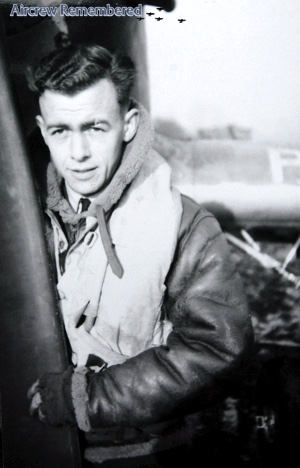 | British | 25Sqn 111Sqn 249Sqn  | AFC | Hurricane | Survived war | October 26 2017 Shrewsbury England | Born 1922 Fought as a 19-year-old in the closing stages of the Battle of Britain and later in the war was awarded the Distinguished Flying Cross for his work in a photo reconnaissance Spitfire.He also ferried communications between London and Winston Churchill at Biarritz and Clement Attlee in Berlin for the Potsdam Conference in 1945. Born near Croydon airport, he was fascinated by the comings and goings of the Imperial Airways flights, and with war clouds gathering, applied to join the RAF Volunteer Reserve.He did his training in Tiger Moths and Hawker Hart biplanes, finishing around August 1, 1940, when the Battle of Britain was in full swing. Initially he converted onto twin-engined Blenheims, but volunteered to go onto single-seat fighters and within two days joined 111 Squadron at Debden. He was to recall: '111 Squadron had Hurricanes. The CO there was rather shattered when I arrived at Debden and had never flown a Hurricane. I had to go on a Hurricane course.' By the time the then Sergeant Smyth rejoined his squadron in the climactic period of the Battle of Britain in September 1940, it was at Drem in Scotland, recovering from its losses, reforming and gaining new pilots.But at the end of September he was pitched into the heart of the Battle of Britain, being posted to join another Hurricane squadron - 249 - at North Weald. 'We saw a bit of action from there, being in London, mainly pursuing bombers. I was 19. I helped shoot two or three down. There was a 109, and a Heinkel 59, and something else. Other people claimed them as well. You will often find that two or three people claimed the same aircraft.' There were however no feelings of triumph. 'I don’t like shooting people,' he said. 'At the so-called end of the battle at the end of October, what I remember best was Armistice Day. I flew over London at 11 o’clock on November 11. I looked down on London and thought here we are, 20 years after the Armistice, trying to defend our capital. Where do we go from here? At the time people had no idea what future they might have. Every day might be their last. That applied to civilians on the ground just as much.' With the Battle of Britain over, he then flew with 615 squadron, where he recalled there were seven Free French pilots, three Poles, two Czechoslovakias, and a South African, as well as British. Later he became a flying instructor, and then was teaching people how to fly gliders.'In spring 1943 I packed up that and I volunteered to do a second tour of operations.' Now he was at RAF Benson flying unarmed photo reconnaissance Spitfire XIs and XIXs. 'I flew all over Europe - France, the Low Countries, Germany,' he said. 'I went to Berlin once. Quite a lot of it was looking at the bombing and looking out for flying bomb sites and rocket sites, other times looking at ports and mysterious places on the ground that the intelligence people wanted to check up on. I was usually flying at about 27,000 to 30,000ft. It was nice being alone and high up and nobody else in sight.' It was during this period that he won his DFC, and also had his closest shave, when his path crossed that of an armada of Flying Fortress bombers. 'Their Mustang escorts saw me and luckily I saw them in time. They were firing at me. I just took evasive action.' Leaving the RAF in January 1946 with the rank of Flight Lieutenant, he was not to fly again until about 1980, when he flew on a holiday jet, and by special arrangement was allowed onto the flight deck. 'I felt very much at home looking down on the Mediterranean from 30,000ft.'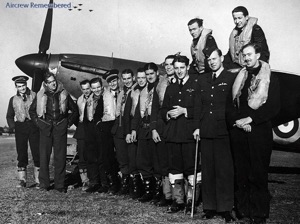 Smyth (on left on wing) with sqauadron colleagues  Plate from 'Men Of The Battle Of Britain' by Ken Wynne |
|||
| 9 | Posener | Frederick Hyam | Plt Off | 41735 | | RAF | South African | 152Sqn | Spitfire | MIA | 1940-07-20 | Son of J. Posener, POB 504, East London, South Africa. Shot down and killed in Spitfire I (K9880) 20 July 1940 by Bf 109 of III Gruppe of JG 27 flown by Oberleutnant Homuth off Swanage at 16:35hrs. Runnymede Panel 9 |
|||
| 10 | Oelofse | Johannes Roelof Stephanus | Plt Off | 13606 |  | RAF | South African | 43Sqn | Hurricane | KIA | 1940-08-08 | Joined 43 Squadron February 1940. KIA in combat ten miles south of the Isle of Wight on 8 August 1940 in Hurricane I (P3468). Tangmere St Andrew Churchyard Age 23 | |||
| 11 | Morris | Edward James | Plt Off | 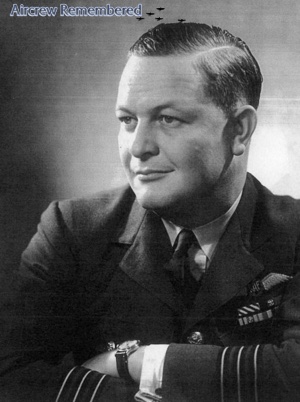 | South African | 79Sqn | DSO DFC | Hurricane | WIA | Wounded 31 August 1940 at 18:50hrs. Crash landed his Hurricane I (P3877) after combat with a Do 17. | |||||
| 12 | Malan | Adolph 'Sailor' | Flt Lt (later Grp Cpt) | 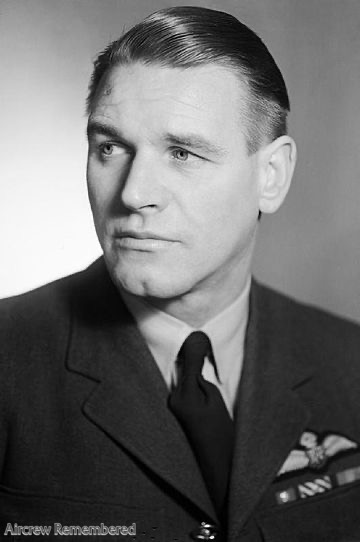 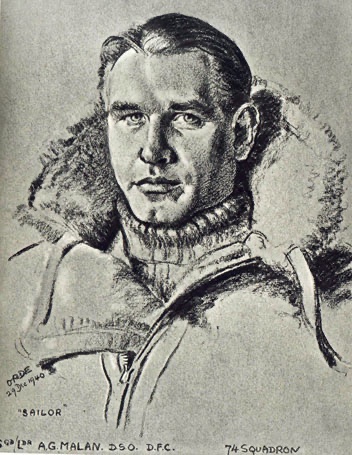 | South African | 74Sqn (CO) | DSO & Bar DFC & Bar Croix de Guerre (Belgium)  War Cross (Czechoslovakia)  Legion d'Honneur 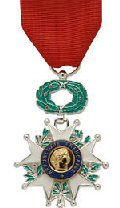 Croix de Guerre (France)  | Spitfire | 32 | Died | 1963-12-17 | Served in Merchant Navy before joining RAF in 1935. Joined 74 Squadron in 1936 on Gauntlets from Hornchurch. Flight commander flying Spitfire September 1939. First victory 21 May 1940 over Dunkirk. Dar to DFC for destroying two Heinkel 111s at night. Stern disciplinarian, his 'Ten Rules of Air Fighting' were circulated within Fighter Command. By end of 1940 he scored 18 victories and received the DSO. Early 1941 became Wing Leader of Biggin Hill squadrons. Undertook sweeps and escort missions over France. June Malan destroyed nine Bf 109s. When his score was 32, taken off flying. Retired from the RAF and returned to South Africa. 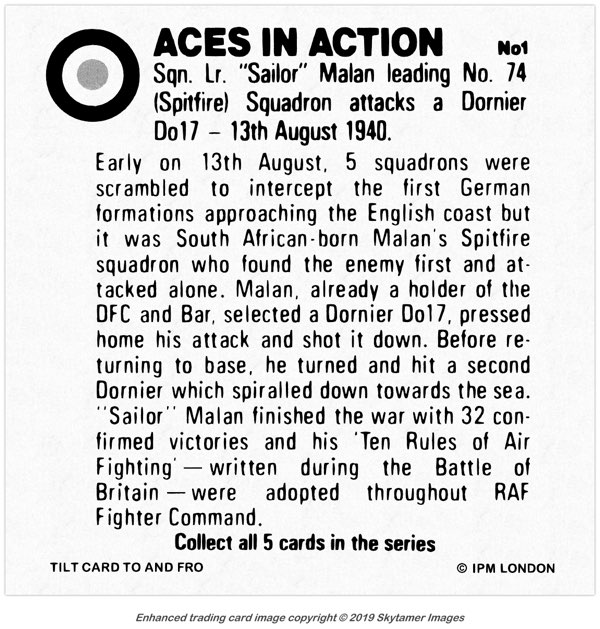 3D Promotional card |
|||
| 13 | MacDonald (post-war Wilson-MacDonald) | Duncan Stuart | Flt Lt | 37451 | 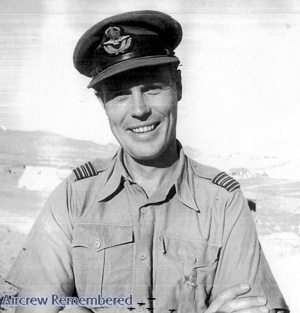 | British | 213Sqn | DSO DFC | 3 | Survived war | March 1996 | Born 15th March 1912 Oban, Scotland. Educated at St. Annes School and Oban High School. September 1935 joined the RAF on a short service commission. Training at 2 E&RFTS Filton. Posted to 4 FTS Abu Sueir 23rd November 1935. Joined 41 Sqd at Sheik Othman, Aden on 24th April 1936. Left for the UK on 11th August 1936. Appointed a Flight Commander in 1938 and in July 1939 he was posted to CFS for a course and then to 8 FTS Montrose as an instructor. 6 OTU Sutton Bridge on 15th August 1940 for a refresher course. Posted to 213 Sqd at Exeter on the 23 August. First flight 29 August and assumed command of the squadron on 2 September. On the 28 September destroyed a Me110, on the 30th destroyed another, on 17th October he damaged a Me109 and on 1st November he destroyed a Me109. DFC (gazetted 17th December 1940), credited with at least three enemy aircraft destroyed. In May 1941 213 Sqd embarked on HMS Furious for the Middle East. Sqd in the ground attack role against Vichy French troops in Syria. Appointed to lead 241 Wing. Formed and then commanded 283 Wing of the Balkan Air Force comprising 213 Sqd, now flying North American Mustangs, and two South African Beaufighter squadrons. In the summer of 1944 he led the wing in support of partisans and guerillas in the Balkans. Awarded the DSO 21st August 1945. In 1947 he changed his name to Wilson-MacDonald, incorporating his wife’s surname. Retired on 6th July 1963 as a Group Captain. | |||
| 14 | Lewis | Albert Gerald 'Zulu' | Plt Off |   Portrait by Eric Kennington | South African | 616Sqn 504Sqn  85Sqn  249Sqn | AFC & Bar | Hurricane | 17 | WIA | 1990 | Radar operator in Blenheims with 25 Sqd in the Battle of Britain. Later rose to the rank of Group Captain. AFC and bar and Polar Medal and had the Lewis Chain of rocky features in Antarctica named in his honour. Born in May 1922, attended Warwick School. Joined the RAFVR as an Aircrafthand in February 1940. Just after the Battle of Britain he was promoted to Sergeant and flew his first Beaufighter sortie. He later served in North Africa and trained as a pilot in Canada. He was granted a permanent commission in 1947. From May 1955 Lewis led the RAF party with the Commonwealth Trans-Antarctic Expedition, under the leadership of Vivian Fuchs, who would receive a Knighthood. Lewis left for the Antarctic in November 1955 and returned to the UK in March 1956. He returned to the Antarctic in November 1956 and finally came home in August 1958. He was responsible for the purchase of aircraft and spares, organising and running air surveys and providing close support for the expedition party in the field. In January 1958 Lewis became the first person to make a Trans-Antarctic flight in a single-engined aircraft. He flew from South Ice to Scott Base on the Ross Sea. Flew with 616 Sqd at the outbreak of hostilities and then moved to 504 Sqd fighting in France. Then moved to 85 Sqd still in France where he claimed 9 kills. Stayed with 85 Sqd until August and shot down two more Germans. Then joined 249 Sqd. 27 September he claimed 6 kills, two probables and one damaged. Baled out of Hurricane I (V6617) badly burned on the 28 September 1940 over Faversham at 14:20hrs.  Dickie Lee and Albert Lewis, good friends on 85 Sqn until Lee went missing during the Battle of Britain. Albert Lewis went on to become a high scoring ace during the war. The drawing by Steve Teasdale has been signed in pencil by the artist and 23 veterans of the Battle of Britain. The signatures are: Roy McGowan, Bob Doe, Wilf Sizer, Len Davies, Bob Foster, Vivian Snell, Terry Clark, Ken Lusty, Ken Wilkinson, Tom Neil, Jack Toombs, Albert Gregory, John Ellacombe, Robert Haylock, Ken Lee, Nigel Rose, Basil Stapleton, Jocelyn Millard, Arthur Piper, CE Smith, Keith Aldridge, Ben Bent and Bill Green. (Courtesy battleofbritainbooks.co.uk |
|||
| 15 | Hugo | Petrus Hendrik 'Dutch' | Plt Off | 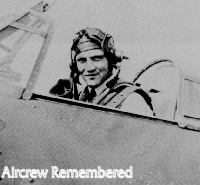 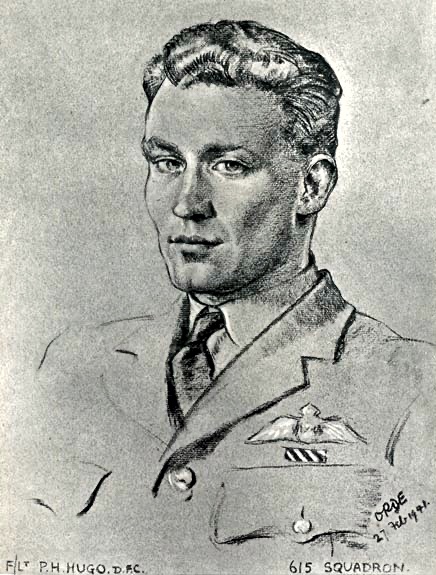 | South African | 615Sqn 41Sqn  | DSO DFC & 2 Bars Croix de Guerre (France) DFC USA  | Hurricane | 17 | Survived war | Died | 6 June 1986 | Born Pampoenpoort, Cape Province, South Africa, 20 December 1917. Served with 615 Sqd during Battle. He, L.M.Gaunce and A.Eyre destroyed 3 Bf 109s over the convoy 'Bosom' mid July 1940. DFC 11 August 1940. 16 August 1940 injured when he force landed Hurricane (P2963) following an attack on a He 111 and a combat with a Bf 110, at 17:30hrs and was shot in the legs. In bandages, on 18 August wounded when he crash landed Hurricane I (R4421) near Orpington, Kent at 13:15hrs after a combat with Bf 109s. Rest of the Battle in Orpington Hospital. Became a flight commander leading 41 Sqd in Spitfires in 1941 and he later became a Group Captain at the age of 24. CO 41 Sqn 20 November 1941-12 April 1942; Sqn Ldr WS, July 1942 Feb 1950.retaining Gp Capt. Died at Victoria West, Karoo. Wikipedia |
||
| 16 | Barry | Nathaniel John Merriman | Fg Off | 72514 | 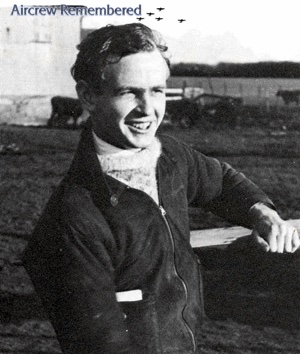 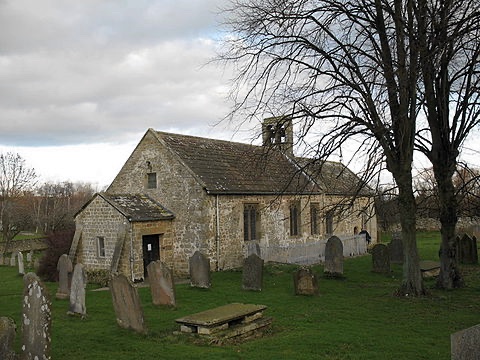 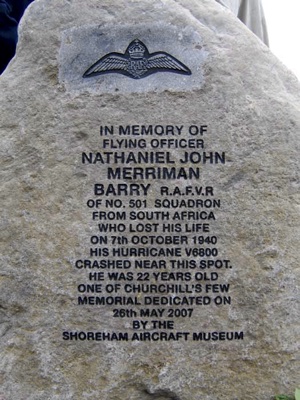 Memorial close to crash site | RAFVR | South African | 3Sqn 501Sqn 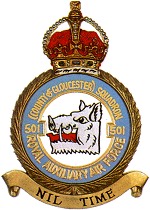 | Hurricane | KIA | 1940-10-07 | Son of Richard and Gladys Barry of Cape Province in South Africa. In 1938 he travelled to England to enrol at Pembroke College, Cambridge to study Mechanical Engineering. Outbreak of war in September 1939 called up as a member of the RAF Volunteer Reserve. Appointed Aide-De-Camp to Air Vice-Marshal Hugh Vivian Champion de Crespigny MC DFC. Barry asked for operational posting. 3 Sqd at Turnhouse Juky 1940. 26th September 1940 posted south to 501 Sqd Auxiliary Air Force Squadron at Kenley. 30th September in combat with Me109’s over Maidstone. Hurricane L1657 was hit in the engine and he force-landed at Pembury, east of Tunbridge Wells. Mid-morning 7th October, forced to take to his parachute when Hurricane V6800 was shot down above Wrotham by Me109’s. He was able to leave the aircraft and deploy his parachute, but was found dead at Wilmington to the south of Dartford. Less than 2 miles to the east, his Hurricane crashed in flames at Lane End in Darenth. Whether he was struck by a shell before baling out or subsequently is not known. Barry was 22 and is buried in Finghall churchyard, Yorkshire.On 26th May 2007 a memorial in honour of F/O Barry was unveiled by the Shoreham Aircraft Museum close to the crash site at Darenth, to the south of Dartford, Kent. Shoreham Account Hurricane V6800 shot down in combat by a BF 109 over Wrotham, crashed at Darenth. Fingall St Andrew Churchyard Age 22 |
|||
| 17 | Hay | BDE | FO | South African | 611Sqn | Spitfire | hayx |
||||||||
| 18 | Haviland | Richard Haviland | PO | 76571 |  | RAFVR | South African | 248Sqn | Blenheim | KIA | 1940-08-28 | Aberdeen Crematorium Age 27 | |||
| 19 | Hancock | Norman Patrick Watkins | Plt Off | 42122 | 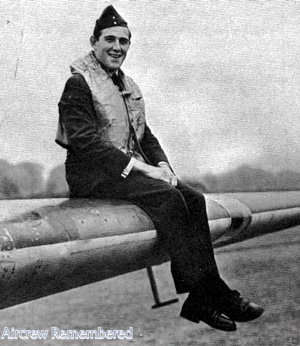 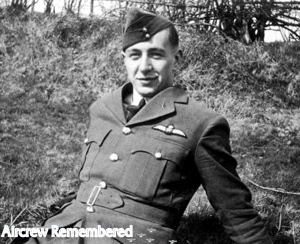 | RAF | British | 1Sqn | OBE DFC MiD  | Hurricane | 3 | Died 2003-02-23 | Born 4 August 1919 in Streatham, south London. Educated at Croydon High School and Wimbledon Technical School. Joined the RAF on a short service commission and began training in February 1939. On 7 November he joined the recently reformed 266 Sqd at Sutton Bridge. Posted to 1 Sqd in France on 12 May 1940. Detached to 501 Sqd but did not fly. Rejoined 1 SQd 18 May. 6 June he probably destroyed a He 111. Withdrawn from Nantes to Northolt. 30 August 1940 30 he damaged a He 111. Posted away to 85 Sqd, moved to 615 Sqd in January 1941 and rejoined 1 Sqd at the end of the month. 14 April he embarked on HMS Argus at Greenock and sailed for Gibraltar, where, on the 24th, pilots and aircraft were moved to HMS Ark Royal. Hancock led seven Hurricanes off to Malta on the 27th, to join 261 Sqd at Hal Far. ‘B’ Flight Commander in 185 Sqd when Flight Lieutenant I B Westmacott, another Battle of Britain veteran, was wounded. Probable He 111 6 June 1941 shared a BR 20 on 25 July and shared a SM 79 on the 27th. Mention in Despatches for a dawn attack on Italian launches that were bringing frogmen to Grand Harbour, Valletta. Posted away to Air HQ, Cairo on 17 September and became an instructor at Gordon’s Tree, Sudan. There were further postings before Hancock did a refresher course and was attached to a South African Air Force Squadron before joining 250 Sqd as a Flight Commander. Damaged a Ju 88, a Bf 110 and a Mc 202 on the ground on 20 July 1942, shot down a SM 79 on the 27th and damaged a Mc 202 on the 31st July 1942. Took command of 250 Sqd. Immediate DFC for an operation where he led 12 Kittyhawks of 250 and six from 405 Sqd to Benina airfield. Intelligence had reported that converted bombers from Crete were delivering petrol for the Afrika Korps. After a flight through bad weather and low cloud, the Kittyhawks arrived as seven enemy bombers were still in the circuit and five others had already landed. 250 Sqd accounted for the bombers still in the air, Hancock destroying a He 111. The Kittyhawks then strafed the airfield, destroying three SM 79s on the ground and also a He 111, destroyed by Hancock. All the Kittyhawks returned safely. Secondments with the Turkish and Egyptian Air Forces. Returned to the UK in January 1946 and became Station Commander at RAF Aberporth and CO of 595 Sqd. Commanded 11 Sqd in Japan from November 16 1946. Born 4 August 1919. Joined RAF on a short service commission 6 February 1939. Joined 266 Sqd at Sutton Bridge 7 November 1939. Sent to Berry-au-Bac in France to 1 Sqd. August 16 1940, flying from Northolt, in combat with an Me 110 over the South Downs. Hurricane damaged but he returned to his base. 30 August Squadron scrambled to intercept a raid over Essex at about 16:30hrs. He claimed a probable He 111. |
||
| 20 | Graham | Leslie William | Plt Off | South African | 56Sqn | Hurricane | WIA | Joined 56 Sqd 1940-07-29. Shot down in flames when bounced by Bf 109s 1940-08-16, at 12:05hrs and baled out of Hurricane I (V7368) slightly injured. Posted away three days later. | |||||||
| 21 | Goldsmith | Claude Waller | Fg Off | 72152 |  | RAFVR | South African | 603Sqn 54Sqn  | Spitfire | WIA KIA | 1940-10-28 | Died of wounds 1940-10-28. Spitfire II (P7439) shot down by a Bf 109 of JG 51 1940-10-27 South of Maidstone, Kent at 14:05hrs. Hornchurch Cemetery England Age 23 | |||
| 22 | Drake | George James | Plt Off | 42398 |  | RAF | South African | 607Sqn | Hurricane | KIA | 1940-09-09 | Killed 1940-09-09 at 17:30hrs. Hurricane I (P2728) shot down by Bf 109s over Guildhurst, Kent. Brookwood Military Cemetery | |||
| 23 | Douglas-Jones | Eric | Sqd Ldr (Later Grp Cpt) | 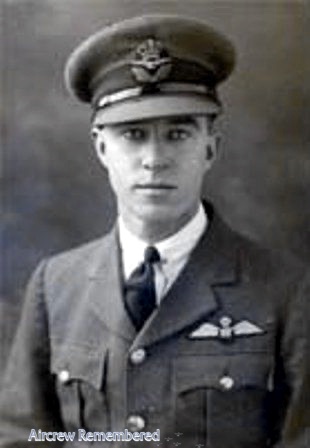 Claimed to be Douglas-Jones on Pinterest, unconfirmed | RAF | South African | 54Sqn (CO) | Spitfire Hurricane | Died | 1984-01-29 | On 3 September 1939, War was declared with Germany and Eric became a Controller in the operations Room with two other officers. They alternated watch over 24 hours a day receiving information, contact with all fighter squadrons on stand by ready to intercept German air attacks. In 1940 large scale enemy air raids took place and later that year Eric took command of 54 Sqd at RAF Hornchurch, Esex. This squadron flew Hurricanes ad Spitfires and at this juncture the first use of VHF radio gave pilots greater range and clearer reception. In May 1940 the Germans outflanked Allied forces at the Maginot Line via Belgium and Holland. The British Expeditionary Force (BEF) of 9 Divisions advanced to meet the attack but could not hold and were pushed back to Dunkirk. RAF squadrons went to meet and intercept enemy aircraft attacking Allied ground forces. Hornchurch was one of the nearest stations to the English Channel coast and Air Marshall Dowding ordered the testing of Spitfire’s ability to cross the Channel and after combat to return with enough fuel. Eric took off with his squadron on 16th May 1940, crossed the Channel and patrolled the French coastline from Ostend to Dunkirk and then returned to Hornchurch. He was able to report that the test was a success and opened the way to further missions to protect British & French Forces at Dunkirk. During this period they regularly engaged with German Stuka, Messerschmitt and Heinkel. On second mission, Flying Officer Al Deere who he had trained at No.6 Fighter School, shot down the first German Bf109. On one flight 24 May 1940, he lost consciousness at 32 000ft due to oxygen failure but regained consciousness again at 5000 ft in time to save himself and the aircraft. After the evacuation of Dunkirk Eric was transferred back to Headquarters No.11 Group as Wing Commander for specific duties as Group Controller in Fighter Group Operations Room and handed over his command of 54 Sqd to Squadron Leader J. Leathart. Died 1984 Age 78 | ||||
| 24 | Difford | Ivor Benison | Fg Off | 39865 | 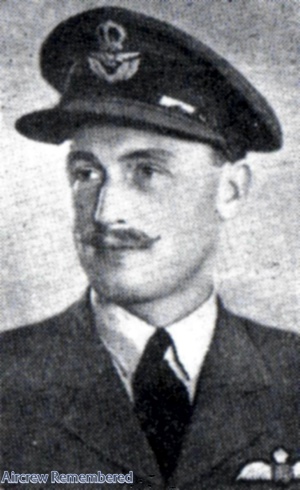 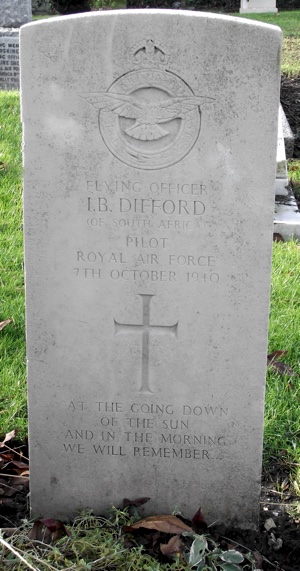  | RAF | South African | 607Sqn | Hurricane | KIA | 1940-10-07 | Killed when Hurricane I (L1728) collided with another Hurricane I (P3860) of his Squadron flown by I.M.W.Scott 1940-10-07 at 16:00hrs. Tangmere St Andrew Churchyard | |||
| 25 | De Keyser | John Lionel | P/O | 79166 | | RAF | South African | 206Sqn | Hudson | 1940-10-25 | 206 Squadron RAFVR Coastal Command. Former member of Stepney Jewish Boys club. He was the son of William and Asneth of Johannesburg, South Africa. Runnymede Panel 8 Age 25 |
||||
| 26 | Clark | Colin Anthony Gordon | Plt Off | 42192 | 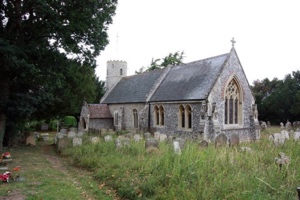 | RAF | South African | FIU | Blenheim | KIA | 1941-10-30 | Geldeston St Michael Churchyard Age 28 | |||
| 27 | Chater | George Frederick | Sqd Ldr | South African | 247Sqn (CO) 3Sqn | DFC | Hurricane | ||||||||
| 28 | Burton | Percival Ross-Frames | Fg Off | 74348 | 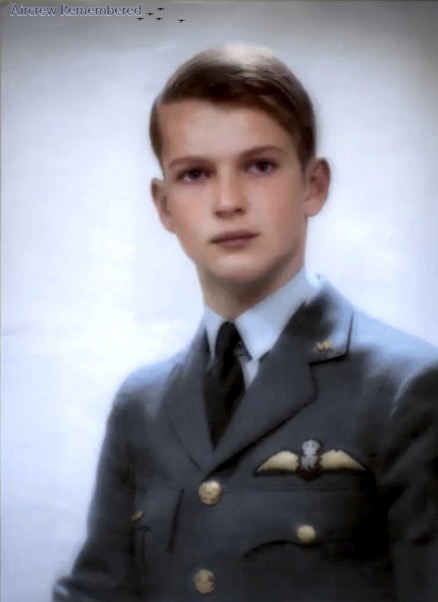 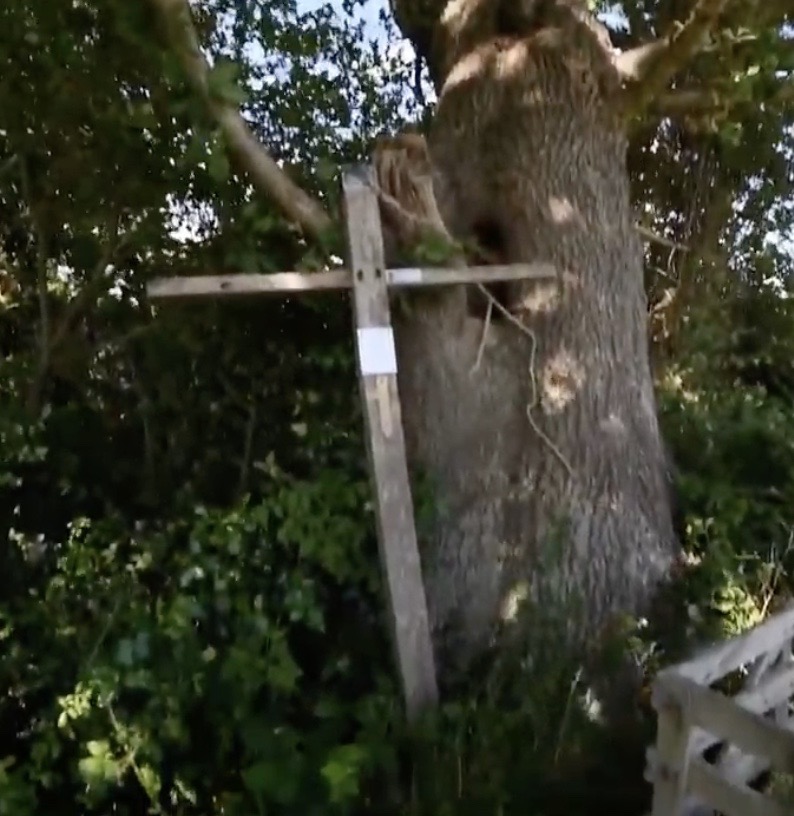 Memorial at oak tree crash site 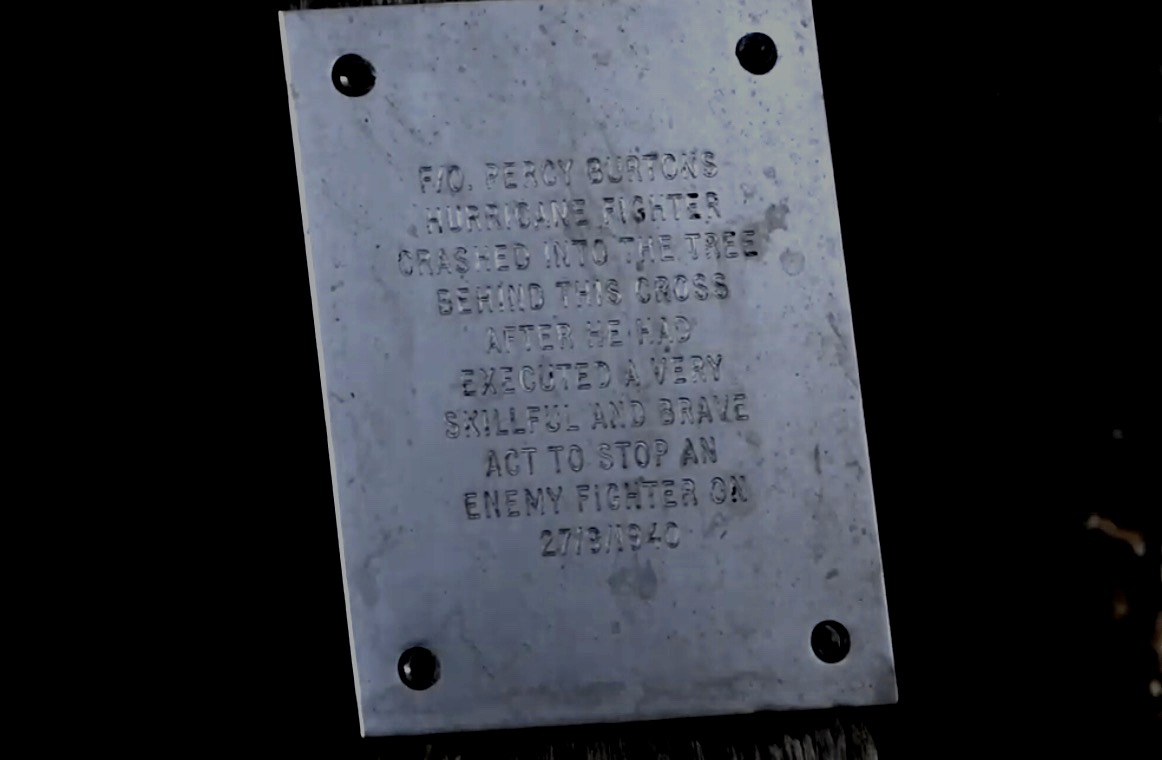 | RAFVR | South African | 249Sqn | MiD | Hurricane | KIA | 1940-09-27 | Born 1917 in South Africa. He joined 249 Sqn in July 1940, killed OTD 27/9/40. Out of ammunition flying Hurricane V6983 he pursued an Me110 . Eye-witnesses suggest he rammed the 110, chopping off its tail as both a/c crashed Killed 1940-09-27 at 09:50hrs. Hurricane I (V6683) collided with Bf 110 over Redhill area. Tangmere Churchyard England Lord Ashcroft Video |
||
| 29 | Bowyer | Walter Stafford | Flt Lt | 39607 |  | RAF | South African | 257Sqn | Hurricane | KIA | 1942-01-24 | Eastbourne Ocklynge Cemetery England |
Results 1 to 29 of 29.


